
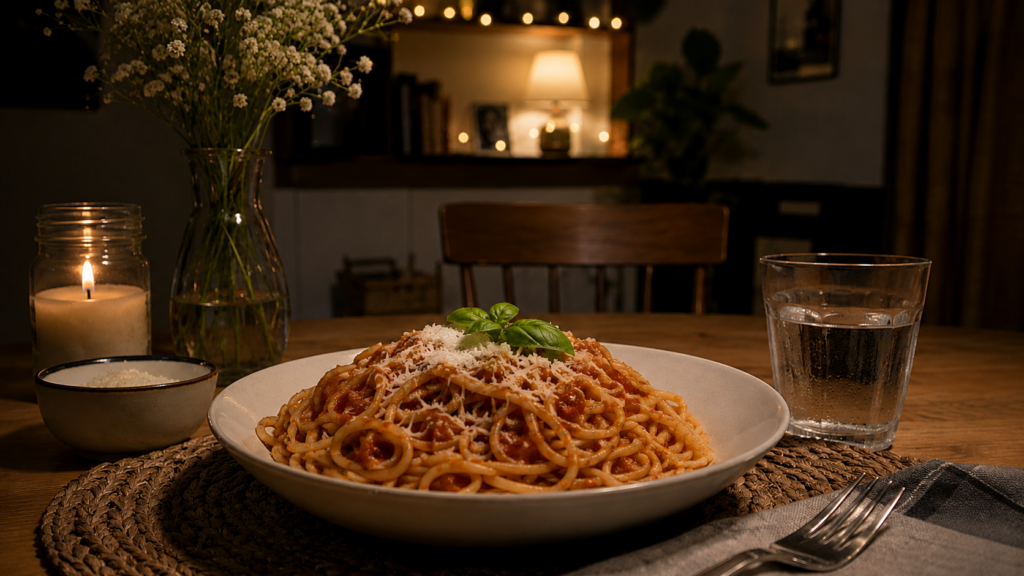
RECONSTRUCTION: Artist reconstruction based on witness descriptions and photographs recorded during the initial investigation. The image depicts the recovered material during the early Northgate incident. This image is an Archive reconstruction and is not photographic evidence.
CLASSIFICATION: Biological Anomaly / Unknown Organic Growth
STATUS: Active — Contained
THREAT LEVEL: High
FIRST RECORDED: March 17, 2008
LOCATION: Northgate, Oregon
KNOWN EXPOSURES: 6
CONFIRMED FATALITIES: 1
CURRENT LOCATION: Ravenwood Biological Storage Unit 04
CURRENT RECOMMENDATION: Do not consume, cut, heat, refrigerate, or introduce liquid to recovered material.
CASE SUMMARY
On March 17, 2008, Northgate resident Nash ordered spaghetti from a small neighborhood restaurant approximately three blocks from her apartment.
The restaurant itself is not considered relevant.
Investigators later inspected the kitchen, ingredients, refrigeration units, supplier records, plumbing, waste containers, and remaining food prepared that evening.
Nothing unusual was found.
Nash ate roughly half of the meal before placing the remaining spaghetti in her refrigerator.
The following afternoon, she noticed the container appeared full again.
Nash assumed she had misremembered how much she had eaten.
Sensible.
She reheated the spaghetti and ate another portion.
The following morning, the container was full again.
This time Nash marked the inside wall of the plastic container with a permanent marker before removing several forkfuls.
She photographed the remaining food.
Six hours later, the spaghetti had risen approximately two centimeters above the mark.
Nash stopped eating it.
The spaghetti did not stop growing.
THE FIRST GROWTH
DATE: March 19, 2008
PRIMARY PHENOMENON: Regeneration
OUTCOME: Material retained by witness
Nash placed the remaining spaghetti in her kitchen trash.
Approximately four hours later, she reported hearing a wet dragging sound from inside the trash can.
When she opened the lid, several strands of spaghetti had extended over the rim.
One had reached the floor.
Nash cut the strand with kitchen scissors.
Both severed ends moved.
Not dramatically.
They contracted approximately half an inch before becoming still.
Nash later described the movement as:
“Like when you touch a worm and it realizes you’re there.”
She placed both pieces in a sealed freezer bag.
By morning, the bag contained enough material to fill approximately one-third of its volume.
There had originally been two strands.
THE SINK INCIDENT
DATE: March 20, 2008
PRIMARY PHENOMENON: Rapid Biological Expansion
OUTCOME: Apartment partially contaminated
Nash attempted to destroy the remaining spaghetti using her garbage disposal.
This was unsuccessful.
It was also the last time Nash attempted to solve the problem herself.
Within approximately twenty minutes, reddish liquid began rising from the opposite basin of the kitchen sink.
Witnesses initially described it as diluted tomato sauce.
Laboratory analysis later determined that it contained tomato, salt, cooking oil, animal proteins, and an unidentified cellular material.
At 11:42 p.m., Nash called her landlord after several spaghetti-like strands emerged through the sink drain.
The landlord arrived twelve minutes later.
By then, Nash had shut off the kitchen water.
The strands continued emerging.
Both witnesses reported that the material appeared to be pulling itself upward rather than being forced from below.
The longest strand measured approximately nine feet.
When touched, it recoiled into the drain.
RAVENWOOD RECOVERY
DATE: March 21, 2008
PRIMARY PHENOMENON: Environmental Attachment
OUTCOME: Material recovered
Ravenwood investigators entered Nash’s apartment at 4:18 a.m.
The kitchen floor contained approximately fourteen pounds of organic material resembling cooked spaghetti.
The majority had gathered beneath the sink.
Several strands had entered cracks between the cabinets and wall.
One had wrapped itself around the copper water line.
Another had entered an electrical outlet.
Power to the apartment was disconnected.
Investigators initially believed the growth was following sources of heat.
That theory lasted eleven minutes.
At 4:37 a.m., Investigator Hale cut his thumb while removing a cabinet panel.
Three strands approximately six feet away immediately changed direction.
All three moved toward him.
Slowly.
Deliberately.
Hale exited the room.
The strands stopped moving once the door was closed.
No further blood testing was performed on site.
THE CONSUMPTION CASE
Investigators contacted everyone known to have eaten from Nash’s original container.
Nash had consumed the largest amount.
She reported no immediate symptoms.
A second individual, Laura Benton, had eaten approximately three forkfuls while visiting Nash on March 18.
On March 24, Benton reported severe abdominal discomfort.
She was admitted to Northgate Memorial Hospital later that evening.
Imaging revealed what physicians initially believed to be an intestinal obstruction.
Surgery began at 2:16 a.m.
The procedure was terminated after thirty-seven minutes.
According to the attending surgeon, several thin structures resembling cooked pasta were found intertwined through approximately four feet of the small intestine.
They were not loose.
They were attached.
Attempts to remove one caused surrounding tissue to contract.
Benton died at 3:41 a.m.
The official cause of death was listed as complications resulting from intestinal perforation.
Ravenwood obtained the surgical samples.
Genetic testing found human cells throughout the recovered strands.
The cells matched Benton.
LABORATORY OBSERVATIONS
Recovered material was divided into six samples.
Testing produced the following results:
Dry samples remained inactive for up to seventy-two hours.
Adding water resulted in measurable growth.
Heating samples accelerated growth.
Refrigeration slowed growth but did not stop it.
Freezing caused no permanent damage.
Salt had no observable effect.
Bleach destroyed exposed surface tissue but failed to kill deeper material.
Incineration remains the only confirmed method of complete destruction.
One additional property was documented.
When animal blood was introduced into a sealed testing chamber, every strand inside the container oriented toward it.
There was no visible sensory organ.
No nervous tissue has been identified.
The material should not have been capable of determining direction.
It did anyway.
ORIGIN
No contamination was discovered at the restaurant that prepared Nash’s meal.
No other customers reported unusual food.
The restaurant’s remaining spaghetti, sauce, meat, cookware, ingredients, and waste samples tested normally.
Investigators eventually located the original takeout container.
A small amount of dried residue remained beneath the folded cardboard base.
The residue was biologically active.
The container manufacturer reported no similar complaints.
Ravenwood traced the cardboard to a processing facility in Washington.
Nothing unusual was found there either.
There is currently no confirmed point of origin.
ARCHIVIST’S NOTES
Nash ate the spaghetti twice.
I mention this because people occasionally become very brave when the alternative is admitting their leftovers have regenerated overnight.
The first time can be forgiven.
The second serving required optimism I do not possess.
Nash survived.
Her follow-up examinations remained normal for eighteen months.
During her final scheduled examination, imaging showed no abnormal growth.
She was released from monitoring in 2010.
Three months later, Nash contacted Ravenwood privately.
She reported waking several nights in a row with the taste of tomato sauce in her mouth.
She denied eating anything containing tomatoes.
A medical examination was offered.
Nash declined.
There were other options.
She disappeared on August 9, 2010.
Her apartment was found locked from the inside.
There were no signs of forced entry.
Her wallet, vehicle, clothing, and phone remained inside.
Investigators found one plate in the kitchen sink.
It had been washed.
Almost.
A single red strand measuring approximately four centimeters was recovered beneath the drain stopper.
DNA analysis matched Nash.
CURRENT RECOMMENDATION
Any food displaying unexplained regeneration should be isolated immediately.
Do not taste it to determine whether it is still edible.
Do not place it in household plumbing.
Do not refrigerate it for later examination.
Do not expose the material to blood.
Recovered samples should be transported in dry, sealed containers and destroyed by controlled incineration.
Ravenwood Biological Storage Unit 04 currently contains one preserved inactive sample for comparison purposes.
It has not demonstrated sustained expansion since 2019.
The container is weighed every morning.
This procedure is not optional.
CASE STATUS
ACTIVE — CONTAINED
Known material associated with the Northgate incident has either been destroyed or secured by Ravenwood.
No confirmed secondary outbreak has been documented.
Laura Benton is the only confirmed fatality associated with the material.
Nash remains missing.
The preserved sample remains contained inside Ravenwood Biological Storage Unit 04.
At the latest inspection, it weighed:
183.4 grams.
Yesterday, it weighed:
183.1 grams.
RAVENWOOD ORIGINAL
This case is a work of fiction created for Ravenwood Archive. Names, characters, locations, events, and accompanying evidence are fictional or presented as part of the story.
FILE REMAINS OPEN