
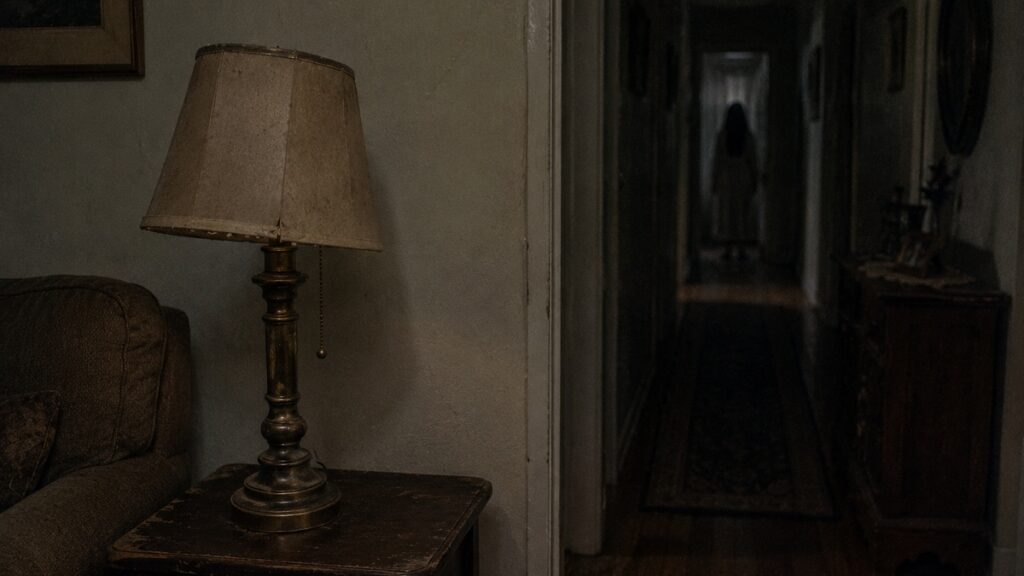
RECONSTRUCTION: Interior of John’s residence in Clayburn, Georgia, October 18, 2023. The lamp is shown illuminated near the living-room hallway shortly after the first visual manifestation. This image is an Archive reconstruction based on witness statements, recordings, and Ravenwood documentation and is not photographic evidence.
CLASSIFICATION: Haunted Object / Recurring Paranormal Manifestation
STATUS: Active — Contained
THREAT LEVEL: High
FIRST RECORDED: October 12, 2023
LOCATION: Clayburn, Georgia
PRIMARY WITNESS: John
KNOWN EXPOSURES: 5
CONFIRMED FATALITIES: 0
OBJECT OF INTEREST: Brass table lamp / unknown manufacturer
CURRENT OBJECT LOCATION: Original residence of John’s great-grandmother
CURRENT RECOMMENDATION: Do not relocate the lamp from its original residence. Maintain illumination after sunset. If the lamp goes dark and footsteps are heard, leave the structure immediately.
CASE SUMMARY
John did not inherit the lamp.
He was going to throw it away.
In October 2023, John helped clear several rooms of his great-grandmother’s house while she temporarily stayed with relatives following a fall.
She was ninety-four years old.
Her house had accumulated decades of furniture, boxes, damaged appliances, old magazines, clothing, and objects nobody in the family appeared to want.
John loaded his truck.
A broken chair.
Two boxes of magazines.
A damaged fan.
Several bags of clothing.
An old brass table lamp.
The lamp was not attractive.
Its shade leaned slightly to one side.
The base was scratched.
The pull chain occasionally caught.
And whenever the lamp was moved, the entire object shook slightly.
John assumed something inside had come loose.
He planned to take the entire load to the county disposal site later that week.
The lamp never made it there.
At home, John unloaded most of the items into his garage.
He noticed the lamp again.
It was still shaking.
John decided to see whether it worked before throwing it away.
If it did, he might donate it instead.
He carried it into the house.
That was when the first problem became noticeable.
The lamp did not fit anywhere correctly.
Measurements said it did.
John’s eyes disagreed.
The shade appeared too wide for one table.
Too tall beneath a shelf.
Too close to a wall despite several inches of clearance.
John moved it repeatedly.
Nothing helped.
Then he plugged it in.
The shaking stopped.
The room looked normal.
Three nights later, the bulb burned out.
At 2:14 a.m., John woke to someone walking barefoot through his hallway.
THE LAMP
No manufacturer markings remain on the object.
The lamp consists of a hollow metal base, brass-colored shaft, fabric shade, pull-chain switch, and replacement electrical cord.
It measures twenty-seven inches tall.
The shade is approximately seventeen inches across.
John remembers the lamp from childhood visits to his great-grandmother’s house.
He does not remember anyone discussing it.
He also does not remember it being illuminated particularly often.
Family photographs later proved otherwise.
The lamp appears repeatedly between 1963 and 2019.
In nearly every photograph taken indoors after sunset, it is on.
The lamp had occupied the same narrow table near the central hallway for more than sixty years.
When unpowered and removed from that location, the base develops a subtle irregular tremor.
Not rocking.
Not vibration.
A continuous unstable movement.
Ravenwood opened the base.
Nothing was loose.
The movement occurs on hardwood.
Concrete.
Metal.
Glass.
Laboratory surfaces confirmed level to less than one millimeter.
When electrical current reaches the lamp, the shaking stops immediately.
When returned to its original location inside Great-Grandma’s house, it stops shaking even without power.
We do not know why.
INCIDENT 01 — IT DOESN’T FIT
DATE: October 12, 2023
PRIMARY PHENOMENON: Perceptual Spatial Distortion
OUTCOME: No Injury
John carried the lamp inside at approximately 4:20 p.m.
He placed it on an end table in the living room.
The shade appeared to touch the wall.
John moved the table forward.
Approximately four inches.
The shade still appeared to touch it.
He measured the distance.
There were 6.3 inches between the shade and drywall.
John photographed the lamp.
In the photograph, the gap appeared normal.
Standing in front of it, John could not see the gap.
He moved the lamp to a desk.
It appeared too tall.
He placed it in the bedroom.
The nightstand suddenly looked too narrow beneath it.
He placed it on the floor.
The ceiling appeared lower.
John later described the sensation as:
“Like the house couldn’t figure out where to put it.”
Nothing measured incorrectly.
Photographs showed no distortion.
Only direct observation produced the effect.
At approximately 6:10 p.m., John plugged the lamp into an outlet beside the sofa.
The bulb illuminated.
The shaking stopped.
The wall appeared to move backward.
Not physically.
John saw no movement.
He simply became aware that the missing space had returned.
The lamp looked ordinary.
John left it there.
He still intended to throw it away.
He simply did not get around to it.
INCIDENT 02 — 2:14 A.M.
DATE: October 16, 2023
PRIMARY PHENOMENON: Auditory Manifestation
OUTCOME: Survivor
At 2:14 a.m., John woke to footsteps.
Bare feet.
Slow.
Moving through the hallway outside his bedroom.
John lived alone.
He remained in bed.
One step.
Pause.
Another.
Pause.
The footsteps continued toward the living room.
Then stopped.
John retrieved his phone and activated the flashlight.
He entered the hallway.
Nobody was there.
The doors remained locked.
The windows remained closed.
No evidence of entry was found.
Then John noticed the living room.
The lamp was dark.
The bulb had burned out.
He walked toward it.
The footsteps resumed behind him.
John turned.
Empty hallway.
Another step.
Closer.
Then another.
John switched on the ceiling light.
The footsteps stopped.
He remained awake until sunrise.
The following morning, he replaced the lamp bulb.
The moment the lamp illuminated, the shaking stopped.
John did not yet understand the connection.
His great-grandmother did.
THE PHONE CALL
Later that afternoon, John spoke with his aunt about the remaining items in Great-Grandma’s house.
She asked whether he had taken anything besides trash.
John mentioned the lamp.
There was silence.
His aunt asked:
“Which lamp?”
John described it.
Old brass base.
Crooked shade.
Shakes a little.
His aunt handed the phone to Great-Grandma.
Her first question was:
“Where is it?”
John told her.
His house.
She asked whether he had already thrown it away.
No.
Then:
“Is it on?”
John laughed.
Great-Grandma did not.
“John. Is the lamp on?”
It was.
She told him not to switch it off.
John asked why.
She told him to bring it back before dark.
He mentioned that the bulb had burned out the previous night.
There was a long silence.
Then Great-Grandma asked:
“Did you hear her walking?”
John stopped laughing.
GREAT-GRANDMA’S ACCOUNT
Ravenwood interviewed John’s great-grandmother on October 23.
She was ninety-four years old.
Her account remained consistent across three interviews.
She remembered the lamp from her childhood home.
Her mother eventually gave it to her.
With it came two instructions.
Keep it lit after dark.
And:
Never let it stay dark in another house.
Great-Grandma admitted that she had ignored the instructions once.
In 1954, while living in a residence prior to the Clayburn house, she switched the lamp off before bed.
She woke to footsteps.
Her husband was asleep beside her.
The footsteps moved through the house for approximately twenty minutes.
Kitchen.
Living room.
Hallway.
Then they stopped outside the bedroom.
Nobody entered.
The following morning, the lamp was standing in the hallway.
She had left it in the living room.
After that, she kept it illuminated.
There was another incident.
In 1978, a thunderstorm caused an overnight power failure at the Clayburn residence.
Great-Grandma woke sometime after 1:00 a.m.
The lamp was dark.
She heard footsteps.
Bare feet.
Slow.
She remained in bed.
Eventually, the footsteps stopped outside the bedroom.
From where she was lying, she could see part of the hallway.
A woman was standing there.
Elderly.
Long hair.
Pale nightgown.
Bare feet.
Facing away from the bedroom.
The woman remained motionless for several minutes.
Then Great-Grandma heard a voice.
Not from the hallway.
Beside the bed.
Very close.
It whispered:
“Is this your room?”
Her husband remained asleep.
The woman in the hallway had not moved.
Great-Grandma did not answer.
The electricity returned approximately two minutes later.
The lamp illuminated.
The woman disappeared.
So did the voice.
Great-Grandma told Ravenwood:
“That was when I stopped wondering what happened if I left it off.”
She did not conduct further experiments.
We approve of this decision.
When asked who the woman was, Great-Grandma replied:
“I don’t know.”
John asked why the family had never been warned.
Great-Grandma answered:
“Because if you tell children there’s a woman in the hallway, what do you think they’re going to do?”
Nobody answered.
She did.
“Turn the lamp off.”
Fair.
INCIDENT 03 — JOHN’S TEST
DATE: October 18, 2023
TIME: 11:42 p.m.
PRIMARY PHENOMENON: Visual Manifestation
OUTCOME: Survivor
John had not yet returned the lamp.
He wanted proof that the footsteps were connected to it.
There were better approaches.
John selected the one available to people with smartphones and poor judgment.
He positioned his phone on a shelf facing the living room and hallway.
The lamp was illuminated.
At 11:42 p.m., John pulled the chain.
Darkness.
For fourteen seconds, nothing happened.
Then the lamp began shaking.
The movement can be heard clearly on the recording.
At twenty-one seconds, a floorboard creaked in the hallway.
At twenty-eight:
One footstep.
Then another.
John remained beside the lamp.
The footsteps approached.
At forty-three seconds, John called:
“Hello?”
The footsteps stopped.
John immediately regretted this.
At fifty-one seconds, something appeared at the far end of the hallway.
An elderly woman.
Barefoot.
Long hair.
Pale nightgown.
Facing away from him.
For several seconds, John thought it might somehow be his great-grandmother.
Then the woman walked toward the wall.
Three slow steps.
Her forehead touched the drywall.
She stopped.
Her arms remained hanging at her sides.
John later described her posture as:
“Like she had been put there.”
He called out again.
No response.
John looked down at the lamp.
Only for a moment.
When he looked back, the woman was no longer against the wall.
She was several feet closer.
John had not heard her move.
She remained facing away from him.
Then the footsteps began again.
One step.
The woman did not move.
Another.
Still nothing.
The sound was coming from somewhere between John and the woman.
John backed toward the lamp.
The woman’s head tilted.
Too far.
Her right ear nearly touched her shoulder.
Then she began turning her head.
Her shoulders remained facing away.
John later insisted that her face seemed to be turning toward him before the rest of her body understood it needed to follow.
He did not wait to see it completely.
He pulled the chain.
The lamp illuminated.
The woman disappeared.
The final footstep occurred approximately half a second after the bulb came on.
Directly beside John.
Nothing was there.
The lamp stopped shaking.
The recording clearly captures John reacting to something.
The woman appears only as an indistinct vertical shape.
John packed the lamp for return the following morning.
Ravenwood became involved before he moved it.
THE PHOTOGRAPHS
John’s family provided Ravenwood with photographs from the Clayburn residence.
The lamp appears repeatedly.
Different furniture surrounds it.
Wallpaper changes.
Carpet changes.
The room is renovated twice.
The lamp remains in approximately the same position.
A narrow table between the living room and central hallway.
In photographs taken after sunset, it is almost always illuminated.
Several photographs contain another recurring feature.
A dark human shape.
In 1974, something stands at the far end of the hallway.
Possibly a person.
Possibly shadow.
In a 1982 photograph, a similar shape is visible beside a doorway.
In 1991, something appears behind a curtain.
Always beyond the direct illumination of the lamp.
Never inside it.
A photograph taken in 2004 is clearer.
Three family members are standing in the living room.
Behind them, only partially visible in the hallway, is the lower half of a person.
Bare feet.
Pale nightgown.
No member of the family could identify her.
Great-Grandma looked at the photograph for approximately four seconds.
Then handed it back.
“That’s her.”
I asked what her face looked like.
Great-Grandma said she remembered.
Then she asked if we could discuss something else.
We did.
RAVENWOOD INVOLVEMENT
The lamp was transferred to a controlled Ravenwood location on October 25.
Initial inspection found nothing mechanically unusual.
The wiring was ordinary.
The shade contained no unusual material.
The base was commercially manufactured.
No hidden compartment.
No abnormal radiation.
No significant electromagnetic activity.
No biological material.
Unpowered:
The lamp shook.
Powered:
It stopped.
The test was repeated seventeen times.
The result remained consistent.
Six personnel then observed the lamp in an ordinary testing room.
Five independently reported that the object appeared incorrectly proportioned to the space.
Too close to the wall.
Too tall.
Too large for the table.
Measurements contradicted every report.
Photographs showed normal spacing.
Video showed normal spacing.
One investigator moved the lamp four times.
The room continued to look wrong.
We understood John’s complaint.
We did not understand the cause.
Then we switched it off.
CONTROLLED DARK TEST
DATE: October 27, 2023
PRIMARY PHENOMENON: Paranormal Manifestation / Spatial Distortion
OUTCOME: Further testing prohibited
At 12:03 a.m., the lamp was placed inside an empty observation room.
Four cameras monitored the interior.
The lamp was switched off remotely.
For thirteen seconds, nothing occurred.
At fourteen seconds, it began shaking.
At nineteen seconds:
A footstep.
Then another.
The sound originated inside the room.
No person was present.
At thirty-one seconds, the footsteps stopped beside the lamp.
At forty-two seconds, Camera 4 recorded a human-sized shape against the rear wall.
An elderly woman.
Her back was toward the cameras.
Her forehead appeared to be touching the wall.
At fifty seconds, microphones recorded breathing.
The sound did not originate from the woman’s location.
It came from directly beneath Camera 3.
At fifty-six seconds, a voice whispered:
“This isn’t my house.”
The test supervisor ordered the lamp reactivated.
The remote switch failed.
A secondary circuit failed.
The woman remained against the wall.
Then the footsteps resumed.
One.
Two.
Three.
The woman did not move.
Four.
Five.
The footsteps approached the observation window.
At the sixth step, the woman was suddenly standing halfway across the room.
No camera recorded movement between the two positions.
At the seventh step, she was approximately six feet from the glass.
Still facing away.
At the eighth step, she was directly in front of the observation window.
All four personnel saw her.
Elderly.
Long hair.
Pale nightgown.
Bare feet.
Her head hung toward her right shoulder at an angle inconsistent with normal posture.
For approximately four seconds, she remained facing away from the observers.
Then her left arm lifted.
Slowly.
She placed one hand against the observation glass.
The palm faced the glass.
The elbow faced us.
The position should not have been possible without severe injury.
One technician left.
Sensible.
The woman began turning her head.
Before her face became visible, the room microphone recorded another voice.
John’s.
“Turn it off.”
John was not present.
Power was restored manually from the external breaker.
The bulb illuminated.
The woman disappeared.
Her handprint remained on the glass for approximately twelve minutes.
Five narrow finger marks.
Longer than expected for a hand of her apparent size.
No usable fingerprints were recovered.
Testing ended.
No further intentional power interruptions have been approved.
THE SPATIAL EFFECT
Measurements taken during the controlled test produced another problem.
Before the lamp was switched off, the observation room measured:
14 feet, 2 inches by 16 feet, 8 inches.
During the dark interval, laser equipment repeatedly returned inconsistent measurements.
Seventeen feet.
Nineteen.
Twenty-three.
Then eighteen.
The rear wall did not visibly move.
Once the lamp illuminated, the room immediately returned to its original dimensions.
This may explain why the lamp appears not to fit correctly inside unfamiliar structures.
One theory proposes that the lamp retains some relationship with the dimensions of the Clayburn residence.
Another suggests the distortion is not caused by the lamp.
It may be caused by whatever approaches when the lamp is dark.
The illuminated area may not be keeping the woman away.
It may be preventing the surrounding room from becoming somewhere she can enter.
Great-Grandma offered a simpler explanation.
“It doesn’t know the rooms there.”
We asked what it meant.
The lamp?
The woman?
Something else?
She said:
“I don’t know.”
Neither do we.
RETURN TO CLAYBURN
On October 30, the lamp was returned to Great-Grandma’s house.
It was placed on the narrow table where family photographs showed it for decades.
Before anyone plugged it in:
The shaking stopped.
This had never occurred during testing.
The apparent spatial distortion stopped as well.
The lamp looked ordinary.
Not merely appropriately sized.
Correct.
John stared at it for several seconds.
Then said:
“Okay. That’s creepy.”
Accurate.
A new bulb was installed.
Ravenwood connected the lamp to an automatic battery backup.
Replacement bulbs were stored nearby.
Great-Grandma was informed that the object had been returned.
She asked:
“Did you put it on the right table?”
We had.
“Good.”
Then:
“Don’t move the table either.”
We have not.
THE HALLWAY
At 3:26 a.m. on November 2, a fixed camera inside the unoccupied Clayburn residence recorded twenty-three seconds of anomalous footage.
The lamp remained illuminated.
The central hallway appeared to lengthen.
The far wall gradually receded.
Sixteen feet.
Twenty.
Approximately thirty.
No doors opened.
No walls visibly moved.
At the far end of the extended hallway was a doorway.
No doorway exists at that location.
Something stood inside it.
Human-shaped.
Motionless.
Too distant for identification.
At 3:27 a.m., the lamp flickered once.
The hallway immediately returned to normal.
The doorway disappeared.
The figure disappeared with it.
The lamp never fully went dark.
Battery redundancy was doubled the following morning.
ARCHIVIST’S NOTES
John was going to throw the lamp away.
I find this important.
To him, it was junk.
An ugly old lamp from Great-Grandma’s house.
Crooked shade.
Shaky base.
Probably worth nothing.
His great-grandmother understood it differently.
The lamp was not decoration.
It was maintenance.
For more than sixty years, she changed the bulbs.
Replaced the cord.
Kept it in the same place.
Kept it on.
And apparently decided the easiest way to prevent family members from interfering was not to tell them why.
I asked her why she never threw it away herself.
She looked at me as though I had suggested setting fire to the house.
Then she said:
“Where do you think she’d go?”
Fair.
We continue to classify the lamp as a haunted object because a classification is required.
I am not convinced it is accurate.
The lamp has never attacked anyone.
It has never spoken.
It does not appear to move voluntarily.
When placed where Great-Grandma kept it, almost nothing happens.
That may be the point.
The woman concerns me more.
She has been seen by John.
Great-Grandma.
Four Ravenwood personnel.
And, apparently, several cameras over several decades.
She is usually facing away.
I suspect that is fortunate.
John nearly saw her face.
Our personnel nearly saw it.
Great-Grandma did.
I asked her about it once.
She said she remembered.
I believe her.
She would not describe it.
I believe that decision too.
There is another detail from the controlled test I do not particularly enjoy.
When the woman moved from the wall to the center of the room, the footsteps did not stop.
They continued.
This suggests either the sound does not represent her movement—
or she was not the only thing walking.
We have not tested this.
We will not.
Before concluding my final interview, I asked Great-Grandma what she thought would have happened if John had reached the landfill.
She asked where the lamp would have been placed.
I said probably among furniture and household waste.
She thought about that.
Then said:
“That’s a lot of rooms for something with no walls.”
I asked what she meant.
She did not answer.
For now, the lamp remains in Clayburn.
On the correct table.
In the correct house.
With the light on.
I consider this one of our more successful containment procedures.
It requires a sixty-watt bulb.
CURRENT RECOMMENDATION
The lamp is not to be removed from the Clayburn residence.
Its position on the original hallway table is not to be altered.
Maintain continuous illumination after sunset.
Battery backup systems are to be tested monthly.
Replacement bulbs must remain on site.
If the lamp begins shaking while illuminated:
Evacuate immediately.
If the bulb fails:
Leave the structure before attempting replacement.
Restore illumination remotely if possible.
If footsteps are heard while the lamp is dark:
Do not investigate.
Do not call out.
Do not follow the sound.
If the footsteps stop:
Do not assume the area is empty.
If the elderly woman is observed:
Do not approach her.
Do not attempt communication.
Do not touch her.
Do not wait for her to turn around.
If she is facing a wall:
Leave her that way.
If interior dimensions begin changing:
Exit the structure immediately.
Under no circumstances is the lamp to be discarded, donated, sold, stored, or transported to another residence.
John has agreed.
Enthusiastically.
CASE STATUS
ACTIVE — CONTAINED
The lamp remains inside the Clayburn residence in its historically documented position.
John has experienced no further activity at his home.
His great-grandmother remains alive.
No confirmed manifestation of the unidentified woman has occurred since the lamp was returned.
The lamp remains continuously powered under redundant electrical supply.
It has not shaken since being placed back on the original table.
No additional dark testing is authorized.
There are still questions.
They can remain questions.
RAVENWOOD ORIGINAL
This case is a work of fiction created for Ravenwood Archive. Names, characters, locations, events, and accompanying evidence are fictional or presented as part of the story.
FILE REMAINS OPEN