
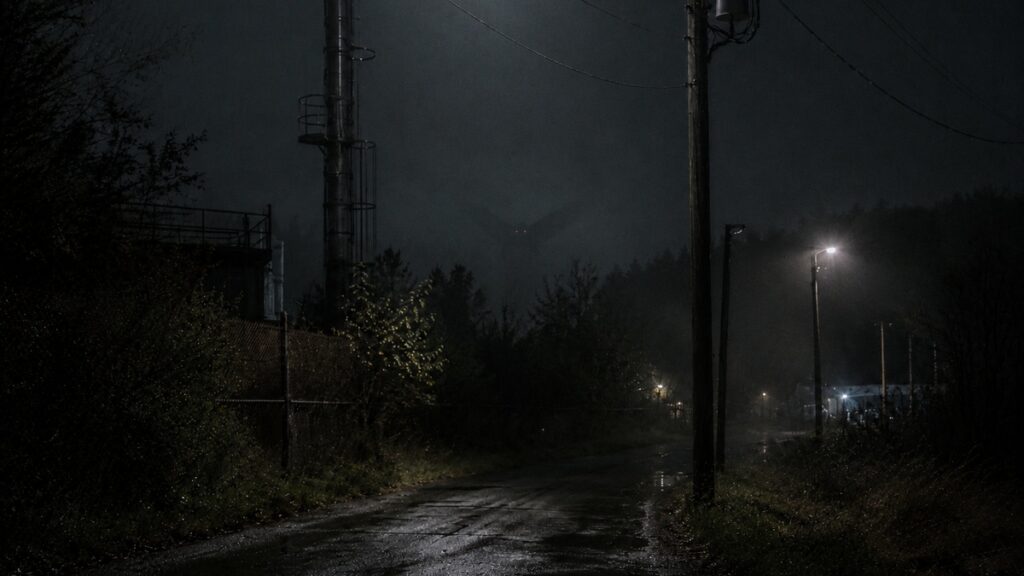
RECONSTRUCTION: Ravenwood reconstruction of the former West Virginia Ordnance Works area near Point Pleasant. The image should be treated as an interpretation of the reported phenomenon, not photographic evidence.
CLASSIFICATION: Unidentified Winged Figure / Regional Folklore
STATUS: Historical — Unresolved
FIRST REPORTED: 1966
PRIMARY LOCATION: Point Pleasant, Mason County, West Virginia
ASSOCIATED LOCATION: Former West Virginia Ordnance Works / McClintic area
ASSOCIATED EVENT: Silver Bridge collapse, December 15, 1967
CONFIRMED FATALITIES ATTRIBUTABLE TO PHENOMENON: 0
CURRENT ACTIVITY: Unconfirmed
CURRENT RECOMMENDATION: Treat the original reports as unresolved eyewitness claims. Do not attribute the Silver Bridge disaster to the reported phenomenon without evidence.
DOCUMENTATION NOTE
Mothman is one of the most heavily retold paranormal stories in the United States.
That creates a problem.
Books, newspaper articles, documentaries, television programs, websites, tourism material, and decades of retelling have added enormous amounts of information to the case.
Some of it may be accurate.
Some may not be.
This Ravenwood file intentionally uses a restricted research standard.
No copyrighted newspaper language has been reproduced.
No quotations from commercial books have been used.
No copyrighted photographs or artwork are required for this file.
Later stories involving prophecies, mysterious visitors, telephone calls, UFOs, curses, and similar claims have been excluded unless they can be independently supported.
What remains is smaller.
That is intentional.
CASE SUMMARY
By the late 1960s, the figure now known as Mothman had become associated with Point Pleasant, West Virginia.
The basic legend concerns reports of an unusually large winged or bird-like figure in the region.
Over time, descriptions became increasingly standardized.
Large body.
Wings.
Unusual eyes.
Human-like characteristics.
Those details are now inseparable from popular depictions of Mothman.
The historical record is less convenient.
There is no recovered animal.
No authenticated biological specimen.
No confirmed skeleton.
No physical evidence establishing that a previously unknown species lived around Point Pleasant.
What does exist is a persistent regional story connected to a very real place.
That place deserves attention.
THE TNT AREA
North of Point Pleasant stood the West Virginia Ordnance Works.
This was not an invented location created by later Mothman stories.
The site was real.
The U.S. Environmental Protection Agency documents it as an approximately 8,320-acre former Department of Defense property used from 1942 to 1945 for TNT production.
After decommissioning, part of the property became wildlife-management land.
The site contained former industrial areas, process facilities, contaminated land, ponds, woodland, and remnants of the wartime complex.
By the time the Mothman legend developed, the facility no longer served its original wartime purpose.
But much of the landscape remained.
Remote roads.
Wetlands.
Woodland.
Concrete structures.
Abandoned industrial remnants.
Limited lighting.
At night, it would have been an effective place to misunderstand almost anything.
It would also have been an effective place to encounter something unusual without getting a particularly good look at it.
Both possibilities remain relevant.
THE REPORTS
The earliest period of the Mothman story occurred in 1966.
Residents in and around Point Pleasant reported encounters with something they could not readily identify.
Later retellings provide specific witness names, exact dialogue, vehicle speeds, detailed measurements, and precise descriptions.
Ravenwood is deliberately not reproducing those details here.
Much of that information survives primarily through newspaper reporting and copyrighted secondary accounts outside the research standard established for this Archive.
The useful core is simpler.
People reported something unusual.
The reports were sufficiently memorable that the figure became part of West Virginia folklore.
Decades later, Mothman was established enough as a state legend to be mentioned on the floor of the United States House of Representatives alongside other elements of West Virginia folklore.
That establishes cultural persistence.
It does not establish a biological creature.
Those are very different things.
WHAT WAS SEEN?
This is where restraint becomes necessary.
The modern Mothman has a remarkably specific appearance.
Popular artwork frequently depicts a dark humanoid creature with enormous wings and bright red eyes.
That image should not be mistaken for a scientific reconstruction.
There is no verified specimen from which one could be made.
Even apparently simple questions remain unanswered.
Was the figure actually standing upright?
Were the reported wings connected to a humanoid body?
Did witnesses accurately estimate its size?
Were unusual eyes physically glowing, reflecting light, or simply interpreted that way?
Did every reported witness encounter the same thing?
We cannot establish any of those points with confidence.
That leaves several broad possibilities.
A previously unidentified animal.
A known animal seen under poor conditions.
Multiple unrelated animals interpreted through an increasingly famous local story.
Deliberate fabrication.
Mistaken perception.
Or something for which no ordinary explanation has yet been demonstrated.
Ravenwood does not require the last possibility in order to keep the file open.
MISIDENTIFICATION
A large bird remains one of the simplest explanations for at least some Mothman reports.
This should not be dismissed merely because it is less interesting.
Night observation is bad evidence for size.
Distance becomes difficult to judge.
Headlights distort shape.
Sudden movement produces poor visual memory.
Fear rarely improves any of those conditions.
The environment around the former ordnance works also included wetlands and wildlife habitat.
That makes encounters with large birds entirely unsurprising.
It does not prove that a bird explains the original reports.
There is a difference between a plausible explanation and a demonstrated one.
No known animal has been conclusively identified as the source of the entire Mothman phenomenon.
Then again, there is no reason to assume every report had one source.
Twenty people can see twenty different things and give all of them the same name afterward.
Once a community knows what Mothman looks like, identification becomes considerably easier.
Perhaps too easy.
THE PROBLEM WITH A NAME
Unexplained sightings change once they receive names.
Before the name, a witness reports:
Something large.
Something flying.
Something beside the road.
Something they could not identify.
After the name, the same experience becomes:
Mothman.
The distinction matters.
A name creates expectations.
Later witnesses already know what they are supposed to see.
Researchers know what details they expect to hear.
Artists produce increasingly consistent imagery.
Retellings favor matching details and discard inconvenient ones.
Eventually, the reconstructed creature can become more precise than the evidence that created it.
Mothman has had sixty years to acquire anatomy.
We should be careful not to mistake that anatomy for a specimen.
THE SILVER BRIDGE
DATE: December 15, 1967
LOCATION: Point Pleasant, West Virginia / Ohio River
CONFIRMED FATALITIES: 46
CONFIRMED INJURIES: 9
RELATIONSHIP TO MOTHMAN: Unsubstantiated
At approximately 5:00 p.m. on December 15, 1967, the U.S. 35 highway bridge connecting Point Pleasant, West Virginia, with Kanauga, Ohio, collapsed.
Thirty-seven vehicles were on the bridge.
Thirty-one fell with it.
Forty-six people died.
Nine were injured.
The disaster became permanently linked to the Mothman story.
That link should not be confused with evidence that Mothman caused the collapse.
The National Transportation Safety Board investigated the failure.
Its conclusion was structural.
The initial failure occurred in an eyebar within the bridge’s suspension chain.
A critical flaw had developed over the bridge’s approximately forty-year life through stress corrosion and corrosion fatigue.
The flaw was located where ordinary inspection techniques could not adequately detect it.
When the component failed, the failure propagated through the bridge structure.
That is the known cause of the Silver Bridge collapse.
Not Mothman.
THE OMEN THEORY
The more common paranormal interpretation is therefore different.
Mothman did not destroy the bridge.
It supposedly appeared before the bridge collapsed.
From there came the idea that the creature was a warning.
A herald.
An omen.
This interpretation remains enormously popular.
It also developed around hindsight.
No evidence available within this restricted record demonstrates that the reported phenomenon communicated a specific warning concerning the Silver Bridge.
No engineering defect was identified because of a sighting.
No evacuation occurred.
No verified message named the bridge.
The disaster happened.
The earlier sightings were then viewed differently.
That is psychologically understandable.
It is not proof of prophecy.
A warning that can only be understood after forty-six people have died is difficult to distinguish from coincidence.
WHY THE BRIDGE MATTERS
It would also be inappropriate to use the Silver Bridge simply because it makes Mothman scarier.
Forty-six real people died.
Their deaths were the result of a documented structural failure.
They are not supporting characters in a cryptid story.
For Ravenwood, the bridge belongs in this file because it became part of the historical development of the Mothman legend.
That is significant.
But the distinction remains:
The association is real.
The supernatural connection is not established.
Both statements can be true.
THE LEGEND AFTER 1967
Mothman did not disappear from American culture when the principal Point Pleasant period ended.
The opposite occurred.
The creature became more famous.
Its appearance became more standardized.
Its story accumulated new interpretations.
Warning of disaster.
Extraterrestrial.
Interdimensional entity.
Paranormal guardian.
Malevolent creature.
Misidentified animal.
Folkloric symbol.
Tourist attraction.
Probably several other things by the time this sentence is being read.
There is no evidentiary reason to select one of those interpretations simply because it is memorable.
The original mystery is considerably less elaborate.
People reported something unusual near Point Pleasant.
Nobody conclusively identified it.
Then a terrible event happened nearby.
Everything after that became very difficult to separate.
WHAT WE DO NOT HAVE
There is value in inventorying absence.
No body.
No skeleton.
No confirmed feather sample.
No tissue.
No DNA.
No verified nest.
No physical structure associated with the creature.
No government report confirming an unknown animal.
No established mechanism connecting the phenomenon to the Silver Bridge collapse.
No evidence that the reported figure possessed foreknowledge of the disaster.
No proof that every reported sighting involved the same object or animal.
That leaves us primarily with testimony and folklore.
That does not make the case worthless.
It determines what kind of case it is.
WHAT WE DO HAVE
A real location.
A documented former wartime industrial complex north of Point Pleasant.
A persistent West Virginia legend recognized decades after its appearance.
And a real bridge disaster whose cause was investigated and established independently of the paranormal story surrounding it.
Between those facts sits Mothman.
That space is smaller than popular mythology suggests.
It is still large enough for uncertainty.
ARCHIVIST’S NOTES
Famous cases become difficult.
Not because evidence disappears.
Because evidence gets buried under better stories.
Mothman has had decades of better stories.
Some give it motives.
Some give it powers.
Some make it a warning.
Some make it responsible for disasters.
Some connect it to phenomena that already possess their own questionable evidentiary histories.
I am less interested in any of those things than I am in the first problem.
People around Point Pleasant believed they had seen something unusual.
What?
I don’t know.
Wildlife is possible.
Misidentification is possible.
Expectation is possible.
Once the story became famous, all three probably became more likely.
That still does not tell us what produced the earliest reports.
The TNT area interests me for a simpler reason.
It existed.
An enormous abandoned wartime industrial property becoming the center of a monster story sounds almost too appropriate.
Unfortunately, reality is occasionally badly written.
The Silver Bridge is where I become less tolerant of embellishment.
There is a documented reason the bridge fell.
A structural component failed.
Forty-six people died.
If someone wishes to believe Mothman appeared beforehand as a warning, I cannot prevent them.
I can ask a question.
What was the warning?
A creature being seen somewhere in the same region is not an evacuation order.
It is not an engineering report.
It is not a message saying the bridge will fail on December 15.
The meaning came afterward.
Perhaps that matters.
Perhaps it doesn’t.
But if we are keeping a record, chronology deserves better than mythology pretending to be causation.
So remove the bridge.
Remove the prophecy.
Remove decades of artwork.
Remove every later embellishment we cannot support.
What is left?
Something was reported around Point Pleasant.
Nobody conclusively identified it.
That is not enough to prove Mothman existed.
It is enough to leave one question unanswered.
What did they see?
For Archive purposes, that is sufficient.
CURRENT RECOMMENDATION
No active Mothman-related threat is recognized.
Historical reports should be documented without assuming identification.
For any new unexplained aerial or winged-figure report, record:
Date.
Time.
Exact location.
Weather.
Lighting.
Estimated distance.
Duration.
Direction of travel.
Nearby wildlife.
Nearby aircraft.
Original photographs or video.
Do not enhance the original file before preserving a copy.
Do not approach abandoned industrial structures in pursuit of a sighting.
Do not disturb wildlife.
And describe what you saw before giving it a name.
CASE STATUS
HISTORICAL — UNRESOLVED
The historical Mothman phenomenon remains unidentified.
No verified physical specimen has established the existence of an unknown winged species around Point Pleasant.
Ordinary misidentification remains plausible for some or all reported encounters.
The Silver Bridge collapse has a documented structural cause and is not classified as a confirmed paranormal event. [2]
The Mothman reports remain part of the record because the central question has never been conclusively answered.
What did people see?
FILE REMAINS OPEN
RESEARCH SOURCES
1. U.S. Environmental Protection Agency — West Virginia Ordnance Works Superfund Site Profile
Used for the documented location, size, wartime TNT-production history, later land use, and environmental context of the former ordnance works near Point Pleasant.
2. National Transportation Safety Board — Collapse of U.S. 35 Highway Bridge, Point Pleasant, West Virginia, December 15, 1967
Used for the date, casualty figures, vehicle count, structural failure sequence, and official cause of the Silver Bridge collapse.
3. Congressional Record — U.S. House of Representatives, June 19, 2013
Used only to support Mothman’s documented status as a long-standing element of West Virginia folklore. No witness testimony or creature description was taken from this source.