
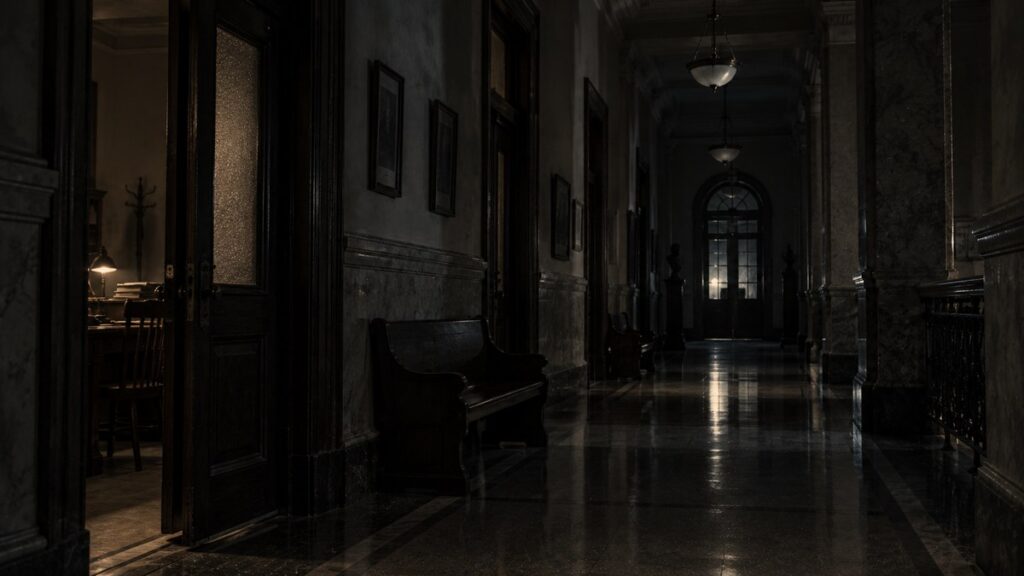
RECONSTRUCTION: Ravenwood reconstruction of the Historic Calcasieu Parish Courthouse after hours, based on the building’s documented setting and reported haunting traditions. Witness accounts describe unexplained laughter, moving shadows, phantom scents, and disturbances within the courthouse. This image is an Archive reconstruction and is not photographic evidence.
CLASSIFICATION: Location Haunting / Apparitional Tradition / Historical Site
STATUS: Historical — Unverified
PRIMARY LOCATION: Calcasieu Parish Courthouse, Lake Charles, Louisiana
CURRENT COURTHOUSE COMPLETED: 1912
ASSOCIATED FIGURE: Annie Beatrice “Toni Jo” Henry
ASSOCIATED EXECUTION: 1942
COMMONLY REPORTED PHENOMENA: Unexplained laughter, shadows, phantom scents, malfunctioning office equipment, doors locking unexpectedly
PHYSICAL EVIDENCE: None verified
CONFIRMED PARANORMAL FATALITIES: 0
CURRENT USE: Active parish government offices / historic courthouse
CURRENT ACTIVITY: Continuing folklore and modern paranormal reports
CURRENT RECOMMENDATION: Treat reported activity separately from the documented history of Toni Jo Henry and the courthouse. Do not assume every unexplained event in the building originates from the same cause.
DOCUMENTATION NOTE
The Calcasieu Parish Courthouse is not an abandoned ruin.
That matters.
It is a functioning historic government building.
People work there.
Doors open and close.
Elevators move.
Office equipment fails.
Old structures make noise.
Visitors know the building has a reputation.
All of those things complicate a haunting investigation.
The courthouse is also genuinely old enough to have accumulated history worth remembering without embellishment.
The current structure was completed in 1912, replacing a courthouse destroyed during the devastating Lake Charles fire of 1910. It remains one of the city’s prominent historic buildings.
Decades after its construction, it became associated with one of Louisiana’s most notorious criminal cases.
That is where the ghost story usually begins.
THE COURTHOUSE
Calcasieu Parish’s courthouse history predates the present building by decades.
The parish was created in 1840.
Its first courthouse was a rough log structure.
When the parish seat moved to Lake Charles in 1852, that early courthouse was physically transported to the new seat of government.
Later buildings replaced it.
A brick courthouse constructed in 1891 stood until April 23, 1910, when fire destroyed the courthouse along with much of downtown Lake Charles.
Many parish records were lost or damaged.
The replacement was completed in 1912.
Brick.
Terracotta.
Large columns.
A copper dome.
Designed by the New Orleans firm Favrot and Livaudais and modeled after the architectural tradition of Palladio’s Villa Capra.
It was built to look permanent.
It has done reasonably well at that.
TONI JO HENRY
The person most commonly associated with the courthouse haunting was born Annie Beatrice McQuiston.
History remembers her as Toni Jo Henry.
Henry was convicted of the murder of Joseph P. Calloway, who was killed in 1940.
Her case became highly publicized.
Multiple proceedings followed.
By 1942, the sentence remained death.
Louisiana had recently replaced hanging with electrocution as its method of carrying out death sentences.
Henry became the only woman executed in Louisiana’s electric chair.
Local government accounts place her execution in the courthouse complex in 1942.
That fact eventually became inseparable from the building’s supernatural reputation.
THE BASEMENT
The courthouse haunting is frequently centered on the basement.
Local accounts state that Henry’s execution was carried out there.
Whether one believes that execution created a haunting is another matter.
Historically significant deaths often become anchors for paranormal stories because they provide a ready explanation for later experiences.
A noise occurs.
Someone remembers the execution.
The noise now belongs to Toni Jo.
A door closes.
Toni Jo.
A shadow crosses the corridor.
Toni Jo.
Once the association is established, the identity of an unseen presence can become more certain than the presence itself.
Ravenwood does not work backward that way.
The execution is documented.
The apparition is not.
THE STORIES BEGIN
There is no single clean starting date for reports of the courthouse being haunted.
That alone separates this case from something like an isolated apparition encounter.
The reputation appears to have accumulated.
Employees and visitors told stories.
Paranormal enthusiasts investigated.
The courthouse eventually appeared in media devoted to ghost reports.
Calcasieu Parish itself has publicly acknowledged the rumors.
The parish’s own historical material describes ongoing claims that the courthouse is haunted.
That does not mean the parish government has certified a ghost.
It means the folklore is sufficiently established to have become part of the building’s public history.
That is worth documenting.
Carefully.
THE LAUGHTER
One recurring modern claim involves laughter.
Not conversation.
Not a clearly identified voice.
Laughter.
The Imperial Calcasieu Museum includes unexplained laughter among the phenomena associated with the courthouse in its current presentation of Southwest Louisiana’s haunted history.
Sound behaves poorly in large old buildings.
Hallways carry it.
Stairwells distort direction.
Rooms that appear empty may connect acoustically to occupied spaces elsewhere.
Outside sound enters through structures in ways difficult to locate.
An unexplained laugh therefore establishes one thing reliably.
Someone heard laughter.
Determining who produced it requires more.
THE SHADOWS
Dark figures and moving shadows are another part of the courthouse tradition.
This category of paranormal evidence deserves caution almost automatically.
Historic buildings contain:
Long hallways.
Tall windows.
Glass.
Reflective surfaces.
Artificial lighting.
Exterior traffic.
People moving between rooms.
Doors opening and closing.
A human-shaped shadow appearing briefly at the edge of vision is therefore not unusual.
A shadow repeatedly behaving independently of visible people would be more interesting.
No verified recording presently establishes that.
The stories remain stories.
Some of them may be sincere.
Sincerity and identification are separate matters.
THE SCENT
The phantom scents are more interesting.
Witnesses associated with the courthouse legend have reported unexplained odors or fragrances that appear without an obvious source.
Smell is one of the stranger categories in haunting reports.
It creates a strong impression of physical presence.
Perfume.
Smoke.
Flowers.
Food.
Decay.
A scent arrives before the witness has time to interpret something visually.
That makes it persuasive.
It does not make it paranormal.
Old buildings contain wood, masonry, cleaning chemicals, plumbing, ventilation systems, offices, paper archives, moisture, and people.
Any of these can produce transient odors.
Ravenwood has identified no collected chemical sample tied to the courthouse phenomena.
For now:
Reported.
Unexplained.
Not supernatural.
THE DOORS
Another frequently repeated courthouse story involves doors.
Doors locking.
Doors behaving unexpectedly.
People finding entrances secured when they believed they had been left open.
These stories became associated strongly enough with the haunting that official parish material discussing the courthouse’s paranormal reputation mentions them.
This is the kind of activity investigators like.
A door is physical.
It can theoretically be tested.
Lock.
Hinge.
Pressure.
Airflow.
Alignment.
Human access.
Unfortunately, historical ghost stories rarely preserve that information.
We are usually given the conclusion.
The door locked itself.
The mechanism is already gone.
The witnesses have gone home.
And somebody has said Toni Jo.
Case closed.
Too quickly.
THE OFFICE EQUIPMENT
Stories also describe office equipment operating incorrectly or unexpectedly.
Printers.
Machines.
Electronic devices.
Modern technology behaving strangely inside an old building sounds impressive until anyone who has worked in an office is consulted.
Printers require no supernatural assistance.
Ravenwood has been quite clear about this.
Still, repeated malfunction occurring in association with other documented phenomena could become meaningful.
No controlled record demonstrating such a pattern has been made publicly available.
The claim remains part of the courthouse tradition.
It is not currently evidence of an entity.
THE IDENTITY PROBLEM
Suppose, for the sake of investigation, that something genuinely unexplained occurs inside the courthouse.
Why must it be Toni Jo Henry?
This question is rarely asked.
The building has existed since 1912.
Thousands of people have entered it.
Criminal cases have been heard there.
Employees have worked there for generations.
The structure stands on a site used for parish government since before the current building existed.
Yet one historical figure dominates the haunting.
The reason is obvious.
Her story is memorable.
Execution.
Electric chair.
Courthouse.
A young woman.
A famous criminal case.
The narrative arrives preassembled.
That makes Toni Jo an effective ghost.
It does not make her the correct one.
THE ONLY WOMAN
The phrase appears repeatedly.
The only woman executed in Louisiana’s electric chair.
It makes the story memorable.
It also risks turning a real crime and execution into a piece of haunted-house decoration.
Ravenwood will avoid that.
Henry was convicted of murder.
Joseph P. Calloway was the victim.
The later courthouse legend should not erase that fact.
Nor should the historical execution automatically be treated as supernatural evidence.
The Archive is interested in what witnesses report.
Not in making a death stranger because a building needs a ghost.
THE ELECTRIC CHAIR
Louisiana’s transition from hanging to electrocution occurred during the period surrounding Henry’s trials.
That historical change has contributed to the macabre reputation of the case.
Modern storytelling sometimes treats the electric chair as though it remains hidden somewhere beneath the courthouse waiting to produce supernatural consequences.
The important historical point is simpler.
Henry was executed.
Electrocution was the state’s chosen method.
The execution became part of the courthouse’s identity.
The haunting came afterward.
No electrical anomaly has been documented that would physically connect the execution to later reports.
Emotionally, the connection is much easier.
That is how legends work.
A WORKING BUILDING
The historic courthouse remains occupied.
The Clerk of Court’s office identifies the building as its current location along with other parish offices.
Modern civil and criminal hearings take place primarily in the adjoining Judicial Center.
That gives this haunting an unusual quality.
People are not entering an abandoned building at midnight hoping to become frightened.
At least not usually.
Employees encounter the location during normal life.
Paperwork.
Elections.
Records.
Public business.
If courthouse workers genuinely report unexplained experiences in ordinary working conditions, those accounts deserve somewhat different consideration from experiences produced during deliberately frightening nighttime tours.
Expectation still matters.
But the setting is not theatrical by default.
PARANORMAL INVESTIGATORS
The courthouse’s reputation has attracted paranormal investigators for years.
Local government has acknowledged visits by ghost enthusiasts.
Television productions have also examined the site.
This increases visibility.
It does not automatically increase evidence.
Paranormal television has a structural problem.
Nothing happening for six hours makes poor television.
A mysterious sound makes excellent television.
Ravenwood therefore treats recorded investigation material individually.
An electronic voice phenomenon does not become a dead person because it resembles speech.
A cold spot does not become an apparition because it occurs near a historic execution site.
Equipment documents signals.
Interpretation comes afterward.
Sometimes far afterward.
THE CURRENT EXHIBIT
The courthouse legend remains active.
In 2026, the Imperial Calcasieu Museum included the Calcasieu Courthouse in its Haunted Histories of SWLA exhibition.
The museum describes the courthouse as permanently linked in local memory to Toni Jo Henry and specifically notes continuing stories involving unexplained laughter, shadows, and phantom scents.
This does not prove the haunting.
It demonstrates something else.
The legend is not dead history.
Southwest Louisiana is still documenting it.
Still repeating it.
Still deciding what the building means.
That makes the folklore active even if the ghost is not.
WHY THE STORY PERSISTS
The Calcasieu Courthouse has nearly everything required for a durable haunting.
Historic architecture.
A catastrophic fire in the history of the site.
Courtrooms.
Criminal trials.
A documented execution.
A famous condemned prisoner.
Basement spaces.
Employees who have spent years inside the building.
Paranormal investigators.
Television coverage.
Local museum recognition.
And a building still standing in the center of public life.
That combination produces continuity.
A deserted building eventually loses witnesses.
A courthouse creates new ones every morning.
POSSIBLE EXPLANATION: THE BUILDING
The first suspect should be the courthouse itself.
Old buildings move.
Temperature changes materials.
Plumbing produces noise.
Ventilation systems carry sound and odor.
Doors settle.
Locks wear.
Light passes through old windows differently throughout the day.
Footsteps travel between floors.
An office worker hearing movement in an apparently empty hallway may genuinely have no obvious explanation.
That does not mean no ordinary explanation exists.
Historic architecture is an efficient producer of ghost reports.
It does not even need to try.
POSSIBLE EXPLANATION: EXPECTATION
Knowing a building is haunted changes observation.
The change can be subtle.
A sound that would normally be dismissed becomes interesting.
A shadow gets a second look.
An unexpected fragrance becomes evidence.
A locked door becomes intentional.
Once a famous ghost has a name, ambiguous events begin organizing themselves around that person.
This is not dishonesty.
People interpret unfamiliar information using familiar narratives.
At the Calcasieu Courthouse, the familiar narrative is Toni Jo Henry.
She has been waiting in the story longer than many current employees have been alive.
POSSIBLE EXPLANATION: SOMETHING UNRESOLVED
The conventional explanations are strong.
They are not complete.
Ravenwood has not interviewed every courthouse employee.
Not every incident is preserved in sufficient detail to reconstruct.
Some experiences may remain genuinely unexplained.
That word is allowed.
Unexplained.
It means the available information is insufficient.
It does not mean dead.
It does not mean ghost.
And it certainly does not mean Toni Jo Henry unless evidence establishes identity.
So far, it does not.
WHAT WE DO NOT HAVE
No verified apparition photograph.
No preserved physical evidence associated with an entity.
No controlled recording conclusively demonstrating an intelligent disembodied voice.
No repeatable experiment showing doors operated without physical cause.
No chemical analysis of alleged phantom scents.
No evidence that reported shadows possess independent physical form.
No documentation establishing that Toni Jo Henry identified herself during an encounter.
No evidence connecting Henry’s execution causally to later activity.
No verified paranormal mechanism.
For a famous haunted courthouse, the physical file is surprisingly thin.
WHAT WE DO HAVE
A historic courthouse completed in 1912.
A documented criminal case connected to Toni Jo Henry.
A documented execution in 1942.
A longstanding local tradition that Henry’s ghost remains associated with the courthouse.
Reports involving unexplained laughter.
Moving shadows.
Phantom scents.
Doors and office equipment behaving unexpectedly.
Official acknowledgment by local government that the haunting reputation exists.
Repeated interest from paranormal investigators.
And a current museum exhibit preserving the supernatural tradition as part of Southwest Louisiana’s regional history.
The haunting remains unverified.
The legend is well established.
THE MORE INTERESTING QUESTION
Most versions of this case ask:
Does Toni Jo Henry haunt the courthouse?
Ravenwood prefers another question.
At what point did unexplained activity inside the courthouse become Toni Jo Henry?
That transition is the real center of the case.
Someone hears a noise.
Someone else remembers the execution.
The next story contains both.
Years pass.
Now the noise belongs to her.
This does not prove the ghost was invented.
It shows how identity enters haunting traditions.
Once a ghost has a name, anonymity becomes difficult.
Even for the dead.
ARCHIVIST’S NOTES
I expected an electric chair.
The stories always make you expect the electric chair.
Dark basement.
Old courthouse.
Condemned woman.
You can practically hear the television narrator lowering his voice.
The building is more interesting without the performance.
People still work there.
That changes things.
Ghost stories usually improve when everyone leaves.
The courthouse never had that luxury.
Someone has to arrive Monday morning.
Someone has to unlock the doors.
Someone has to use the printer.
Which means the reported activity lives beside ordinary routine.
I like that.
Not as proof.
As a problem.
If a person already expects Toni Jo Henry, a locked door means very little.
If someone who has worked there for twenty years stops in a hallway because they hear laughter from a room they know is empty, I want the details.
Time.
Room.
Other witnesses.
Doors.
Windows.
Nearby offices.
Ventilation.
What exactly did they hear?
Instead we usually receive:
Toni Jo laughed.
That skips the investigation.
The phantom scent is similar.
What scent?
How long?
Where?
Who smelled it?
Did everyone agree?
Questions are less dramatic than ghosts.
They are considerably more useful.
I am also reluctant to give Henry ownership of every unexplained event simply because her death is memorable.
The courthouse has had more than a century to become strange.
If something is there, it may not be her.
If nothing is there, the building has done an excellent job keeping the story employed.
Either way, I would leave the lights on in the basement.
Not because of the ghost.
Old courthouses have stairs.
CURRENT RECOMMENDATION
The Calcasieu Courthouse should be treated as a historically significant public building with an established haunting tradition.
Future reports should record:
Exact room or corridor.
Time and date.
Number of witnesses.
Lighting conditions.
Nearby occupants.
Open doors and windows.
HVAC activity.
Description and duration of any odor.
Direction and character of unexplained sounds.
Door and lock condition.
Original audio or video files.
Whether the witness knew the Toni Jo Henry legend beforehand.
Do not identify an unexplained presence by name without supporting evidence.
Do not interfere with active courthouse operations.
Do not enter restricted basement or office areas seeking paranormal activity.
And do not blame the dead for a malfunctioning printer until someone has checked the toner.
There are standards.
CASE STATUS
ARCHIVED — INSUFFICIENT EVIDENCE
The Historic Calcasieu Parish Courthouse remains associated with a longstanding Louisiana ghost tradition centered on Toni Jo Henry, who was executed in 1942 following her murder conviction.
Modern reports attributed to the courthouse include unexplained laughter, shadows, phantom scents, malfunctioning equipment, and doors behaving unexpectedly.
These reports are part of established regional folklore and continue to receive attention from museums, paranormal investigators, and local historical organizations.
No verified physical evidence presently establishes that the courthouse contains a paranormal entity.
No evidence establishes Toni Jo Henry as the source of the reported phenomena.
Ordinary architectural, mechanical, environmental, and perceptual explanations remain plausible for many accounts.
Some individual reports remain insufficiently documented to reconstruct.
The courthouse is real.
The history is real.
The identity of anyone still walking its halls after hours remains considerably less certain.
FILE REMAINS OPEN
RESEARCH SOURCES
[1] Calcasieu Parish Police Jury — History of Calcasieu Parish
Used for the documented history of the courthouse site, the 1910 fire, construction of the current courthouse in 1912, its architecture, later additions, restoration, and continuing government use.
Source Type: Official Calcasieu Parish government historical resource.
[2] Calcasieu Parish Police Jury / Calcasieu Clerk of Court — Courthouse History and Haunting Tradition
Used for the documented local association between Toni Jo Henry and the courthouse, Henry’s 1942 execution, and longstanding reports involving doors, office equipment, and the courthouse’s reputation among paranormal investigators.
Source Type: Official parish and Clerk of Court resources.
[3] Imperial Calcasieu Museum — Haunted Histories of SWLA (2026)
Used for the continuing regional folklore surrounding the courthouse and current reports or traditions involving unexplained laughter, shadows, and phantom scents.
Source Type: Regional museum / contemporary historical and folklore exhibit.