
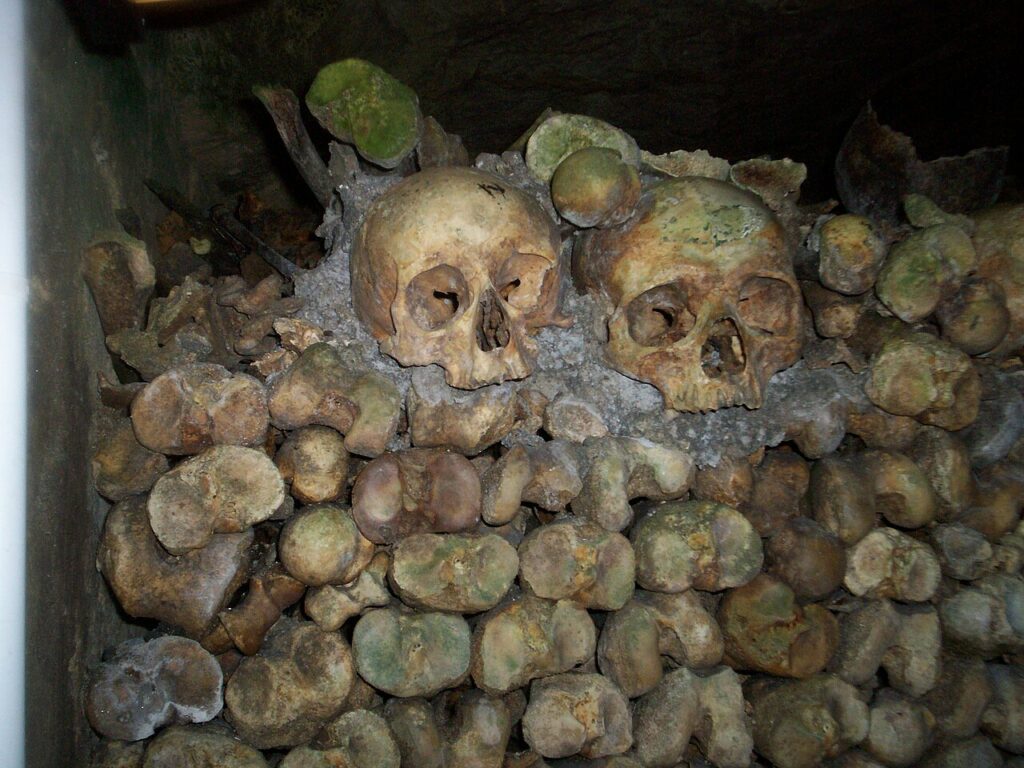
LOCATION RECORD: Paris Catacombs, France. Photograph by Junge aus B-Town, 2006. Public domain via Wikimedia Commons.
ARCHIVE CATEGORY: Location
REGION: Europe
LOCATION RECORD: The Paris Catacombs are a documented historical site beneath Paris, created from former quarries and later used as a municipal ossuary. Any accompanying image should be treated as a location record or restrained reconstruction of the accessible ossuary spaces, not as evidence of paranormal activity.
CLASSIFICATION: Historic Underground Site / Ossuary / Folklore Location
STATUS: Historical — Unresolved
PRIMARY LOCATION: Paris, France
SITE ORIGIN: Former underground quarries later converted into a municipal ossuary
FORMAL OSSUARY CONSECRATION: April 7, 1786
PUBLIC OPENING: 1809
ESTIMATED REMAINS: Several million Parisians
DEPTH OF PUBLIC CIRCUIT: Approximately 20 meters underground
PUBLIC CIRCUIT LENGTH: Approximately 1.5 kilometers
ASSOCIATED CLAIMS: Hauntings, disorientation, apparitions, oppressive sensory experiences, underground folklore
CURRENT RECOMMENDATION: Treat the Catacombs first as a real historical burial site and only second as a subject of legend. Confine all visits to authorized public areas.
DOCUMENTATION NOTE
The Paris Catacombs are frequently treated as though they were built for horror.
They were not.
They were built out of necessity.
The site began as part of the quarry network under Paris and later became a response to public health problems created by the city’s cemeteries. In other words, the Catacombs are unsettling because they are real before they are legendary.
That distinction matters.
Many locations in the Archive are difficult to verify because the story came first.
Here, the location is not in question.
The bones are not in question.
The tunnels are not in question.
Only the claims attached to them remain uncertain.
As a result, the Paris Catacombs belong to a category of case that Ravenwood handles carefully: a genuine historical place that accumulates folklore simply by existing long enough in the human imagination.
CASE SUMMARY
The Paris Catacombs are an underground ossuary established in former quarries beneath Paris after major public health concerns tied to the city’s cemeteries forced authorities to relocate human remains below ground.
According to the official site history, Paris authorities selected the former Tombe-Issoire quarries, then outside the capital, as the new repository for cemetery remains. The site formed only a small part of a far larger underground network extending beneath the city. Preparation of the site and organization of transfers were entrusted to officials connected to the General Quarry Inspection, a body created after serious ground collapses in eighteenth-century Paris.
The first major transfers took place from 1785 to 1787 and focused on the Saints-Innocents cemetery, which had already become a serious problem. Bone transfers continued after the French Revolution and resumed again during later urban redevelopment. The site was formally consecrated as the Paris Municipal Ossuary in 1786 and gradually became known by the more mythic name that survived: the Catacombs.
Public visits began in 1809.
That, perhaps more than anything, ensured the site’s second life.
Once a city lets people descend beneath it to stand among arranged walls of skulls and femurs, folklore does not need much encouragement.
BEFORE THE BONES
The Catacombs did not begin as a burial place.
They began as quarries.
The official site describes the underground spaces as former quarries used for extracting stone and notes that the underground network extended under the city over roughly 800 hectares. Quarrying beneath Paris was useful, but it also created a structural problem. By the eighteenth century, collapses of ground and instability in parts of the city made the underground voids a matter of public concern.
This detail tends to disappear beneath the theatrical language surrounding the site.
It should not.
The Catacombs are partly a burial record.
They are also an engineering record.
Paris did not merely place its dead underground. It also inherited the consequences of having hollowed out its foundations.
This dual identity explains some of the enduring unease associated with the site.
The Catacombs are a city’s memory and a city’s underside occupying the same space.
THE CEMETERY PROBLEM
The official site traces the Catacombs directly to major public health problems caused by Paris’s cemeteries.
The most important of these was the Saints-Innocents cemetery.
It had been in use for centuries.
That was the problem.
By the late eighteenth century, Paris was dealing with overcrowded burial grounds inside the city, and the consequences were no longer abstract. The cemetery had already been closed in 1780 after nearly ten centuries of use. Authorities then undertook the removal of tomb contents, common graves, and charnel remains. These bones were transported at night to reduce hostile reaction from the public and the Church.
This fact alone provides enough atmosphere without embellishment.
Cartloads of human remains moving through Paris after dark are not an invention added later for effect.
They are part of the documented history of the site.
Legends did not create the macabre tone.
Administration did.
THE NIGHT TRANSFERS
From 1785 onward, bones from major cemeteries were moved into the prepared quarry spaces.
At first, the remains were dumped into quarry wells.
Later they were distributed and arranged through the galleries by quarry workers.
Transfers continued into the nineteenth century, and further deposits followed phases of urban renovation.
This is one of the most important features of the case.
The Catacombs were not formed from a single disaster, plague event, or mass death concentrated in one moment. They were built gradually, through administrative relocation, over years.
That changes the emotional texture of the site.
Visitors do not descend into a place created by one catastrophe.
They descend into the organized remains of many ordinary lives, collected together only because the city ran out of space above ground.
That is quieter.
And usually more disturbing.
“EMPIRE OF DEATH”
The official site notes the inscription above the entrance to the ossuary:
“Stop, this is the empire of Death.”
The phrase has become inseparable from the site’s identity.
It also illustrates something important about the Paris Catacombs: the place was not merely functional for very long.
It was curated.
By the early nineteenth century, the ossuary was being arranged in a way that encouraged contemplation as much as storage. When the Catacombs opened to the public in 1809, visitors were not entering a hidden utilitarian chamber. They were entering a space already shaped into a symbolic encounter with mortality.
That matters because many later supernatural impressions may arise from design rather than anomaly.
A place labeled the Empire of Death has already introduced itself before anything unexplained occurs.
The Catacombs do not need a ghost to unsettle people.
They have architecture, scale, darkness, humidity, and suggestion.
That is often sufficient.
WHAT PEOPLE EXPERIENCE THERE
The public Catacombs are approximately twenty meters underground.
The official visitor guidance notes a 1.5-kilometer circuit, 131 steps down, 112 steps back up, a cool average temperature of 14°C, high humidity, and conditions not recommended for individuals with certain motor, cardiac, or respiratory limitations.
In plain terms:
It is underground.
It is enclosed.
It is physically demanding for some visitors.
It is lined with human remains.
This has predictable effects.
Feelings of pressure.
Disorientation.
Heightened awareness of sound.
The sense that someone is behind you when no one is.
Unease produced by repetition of bone patterns.
A distorted sense of time.
These experiences are often described later in paranormal language.
Sometimes unfairly.
An oppressive environment can produce genuine fear without producing the supernatural.
Ravenwood does not dismiss witness experience.
It does distinguish between experience and interpretation.
If a visitor reports feeling watched in a dim ossuary under Paris, the feeling is real.
What caused it remains another matter.
WHY THE CATACOMBS ATTRACT LEGEND
Few places invite storytelling as efficiently as the Catacombs.
The ingredients are almost offensive in their completeness.
Dark passages.
Human remains.
A maze beneath a famous city.
Restricted spaces.
Centuries of history.
And the knowledge that the visible public route represents only a tiny controlled portion of a much larger underground system.
Legends attach naturally to environments where the scale exceeds the visitor’s perception.
The Catacombs therefore attract several recurring kinds of story:
- claims of apparitions among the bone walls
- accounts of voices or footsteps in apparently empty passages
- tales of people losing all sense of direction
- suggestions that the deeper tunnels conceal things other than quarries and remains
- stories that treat the underground network as a second, hidden Paris
Most of these claims are difficult or impossible to verify.
That does not make them useless.
Folklore tells us what a place does to the mind long before it tells us what the place objectively contains.
In the case of the Catacombs, it tells us that people do not easily accept a boundary between the visible city and the dead beneath it.
THE MISTAKE PEOPLE MAKE
The most common error in writing about the Paris Catacombs is assuming that because the site is eerie, the paranormal claims are therefore strengthened.
That is not how evidence works.
A place can feel haunted and still provide no verified haunting.
The Catacombs already contain enough authentic historical weight to generate unease on their own.
Human remains.
Restricted subterranean passages.
Centuries of death relocated into ordered walls.
Those factors alone explain why so many visitors leave convinced they encountered something more than architecture.
Some may have.
Ravenwood is not in a position to prove otherwise.
But the burden does not disappear simply because the setting is persuasive.
The Catacombs are one of the clearest examples of environment doing most of the work.
A REAL SITE, NOT A HORROR SET
Popular culture has not helped.
The Catacombs are often presented as though they were designed to host disappearances, cult activity, secret chambers, or demonic encounters.
The reality is both more mundane and more interesting.
This is a historic ossuary and former quarry system maintained as a fragile heritage site. The official materials emphasize preservation, safety, and respect for the remains. Visitors are specifically instructed not to touch the bones. The site is treated as a place of cultural and historical significance, not a theatrical haunted attraction.
That tone should be preserved in the Archive.
The Catacombs do not need embellishment.
They also do not benefit from being reduced to an internet dare.
Any location holding the remains of several million people deserves a better class of curiosity.
The internet, naturally, has other plans.
WHAT WE CAN SAY WITH CONFIDENCE
We can say the Paris Catacombs are real.
We can say they were created in response to public health problems connected to overcrowded cemeteries.
We can say authorities used former quarries beneath Paris to receive transferred bones beginning in the late eighteenth century.
We can say the municipal ossuary was consecrated in 1786.
We can say public visits began in 1809.
We can say the site today preserves a controlled visitor route roughly 1.5 kilometers long, around twenty meters underground, in cool and humid conditions.
We can say the environment is psychologically potent.
We can say it has acquired an enduring reputation for haunting, dread, and strange experience.
That is already more than enough for an Archive file.
WHAT WE CANNOT SAY WITH CONFIDENCE
We cannot confirm that the Catacombs are haunted.
We cannot verify that specific apparitions reported there represent anything more than misperception, suggestion, or normal reactions to an intense environment.
We cannot treat later urban legends as eighteenth-century fact simply because they match the mood of the place.
We cannot assume that getting lost, panicking, or feeling watched beneath Paris automatically constitutes paranormal evidence.
And we cannot responsibly flatten the site into a tourist horror prop without losing what makes it compelling in the first place.
The Catacombs are powerful because they are documented.
The legends matter because they grew around something real.
ARCHIVIST’S NOTES
There are easier ways to make people uncomfortable than taking them underground into a damp corridor lined with the dead.
Paris selected one of the more permanent options.
I am generally suspicious of locations that arrive pre-described as cursed, haunted, or impossible. The Catacombs do not require any of that language to remain effective. Their documented history already provides the necessary discomfort.
A city had too many dead.
A city had unstable ground.
A city solved both problems with the same underground space.
That is not supernatural.
It is, however, extremely French in the specific sense that even the solution eventually acquired an inscription.
What interests me most is not whether the Catacombs are haunted.
It is how little a place must do once it has earned its reputation.
A visitor descends.
The temperature drops.
The air changes.
The bones appear.
The mind becomes helpful.
Soon every sound belongs to someone unseen.
This is not fraud.
It is human pattern-making under pressure.
Still, I do not dismiss every account.
A site that has accumulated so many impressions over so much time deserves at least a little caution.
Not because I am convinced there is something in the Catacombs beyond history.
Because history, properly arranged, is often enough to make people see more than they brought with them.
If there is a haunting there, it would hardly be competing for space.
CURRENT RECOMMENDATION
Treat the Paris Catacombs first as a historic ossuary and burial site.
Visit only through the authorized public circuit.
Respect site restrictions.
Do not touch the bones.
Do not assume discomfort is evidence.
Document any unusual experience with the same discipline you would apply elsewhere:
time, duration, location, environmental conditions, number of witnesses, prior expectations, and physical symptoms.
If an experience occurs deep underground in a dark, humid space after a long descent through a place explicitly framed as the Empire of Death, note that context before deciding a ghost was involved.
Ravenwood does not rule out anomalous reports from the Catacombs.
It does insist on doing better than atmosphere alone.
CASE STATUS
HISTORICAL — UNRESOLVED
The Paris Catacombs are a verified historic underground ossuary created from former quarries and filled through the documented transfer of remains from Parisian cemeteries beginning in the late eighteenth century.
The site’s association with death, enclosure, darkness, and scale has produced a long-lasting reputation for hauntings and unusual experiences, but Ravenwood has identified no verified paranormal evidence sufficient to distinguish those claims from folklore, suggestion, or normal responses to an oppressive environment.
The location remains historically significant, psychologically potent, and culturally haunted whether or not it is supernaturally so.
FILE REMAINS OPEN
RESEARCH SOURCES
[1] Catacombes de Paris — Official Site History
Used for the historical origin of the Catacombs, the role of former quarries, the cemetery crisis, the transfer of remains, the 1786 consecration of the municipal ossuary, the 1809 opening to the public, and the site chronology.
[2] Catacombes de Paris — Official Visitor Information
Used for the present-day physical details of the public circuit, including approximate depth, circuit length, stair count, temperature, humidity, preservation guidance, and visitor restrictions.
Both sources are official City of Paris museum resources. All prose in this Archive file has been independently written for Ravenwood Archive.