
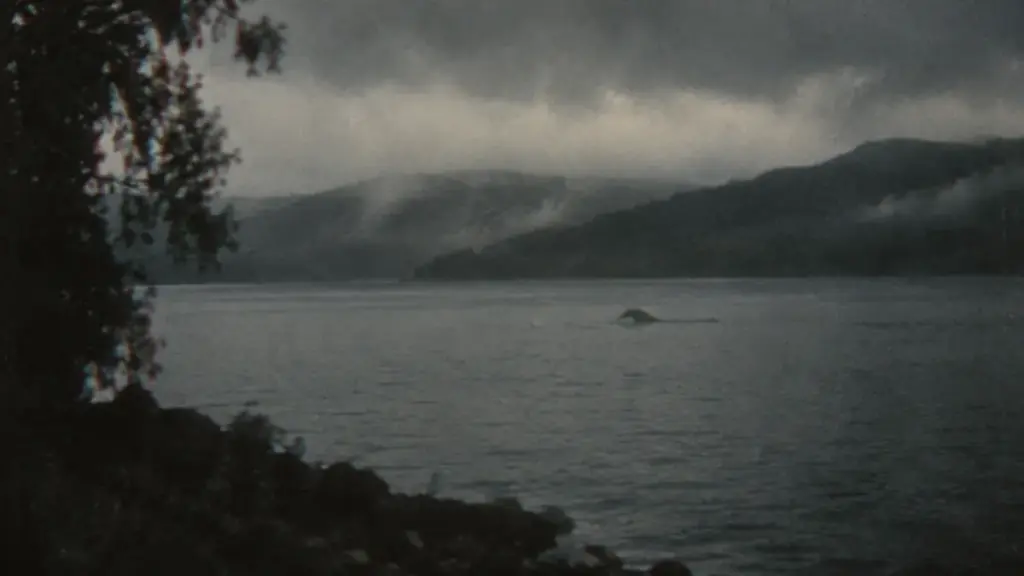
RECONSTRUCTION: Ravenwood reconstruction based on recurring descriptions associated with the Loch Ness Monster: a large dark aquatic form, one or more visible humps, and occasional reports of an elongated neck. No verified photograph establishes the creature’s appearance.
CLASSIFICATION: Aquatic Cryptid / Regional Folklore / Unidentified Water Phenomenon
STATUS: Historical — Unresolved
PRIMARY LOCATION: Loch Ness, Scottish Highlands
MODERN LEGEND ESTABLISHED: 1933
ALTERNATE NAME: Nessie
LOCH LENGTH: Approximately 23 miles
MAXIMUM DEPTH: Approximately 230 meters
COMMON REPORTED FEATURES: Large dark body / humps / long neck / substantial wake
PHYSICAL EVIDENCE: None verified
CONFIRMED FATALITIES ATTRIBUTABLE TO PHENOMENON: 0
CURRENT ACTIVITY: Continuing reports
2026 RECORDED REPORTS: 13 as of preparation of this file
CURRENT RECOMMENDATION: Evaluate individual sightings independently. Do not treat the accumulated legend as corroboration for any single report.
DOCUMENTATION NOTE
There may be no cryptid more recognizable than the Loch Ness Monster.
That creates a problem.
Most witnesses who look across Loch Ness already know what is supposed to live there.
Long neck.
Dark humps.
Something enormous moving beneath the surface.
“Nessie” existed in the public imagination before many modern witnesses ever arrived at the loch.
Ravenwood therefore approaches this case backward.
Not:
How many people have seen the monster?
But:
What did each person actually see before the word monster was applied?
The distinction matters.
Loch Ness has generated photographs, films, sonar contacts, expeditions, hoaxes, scientific investigations, eyewitness accounts, and more than enough cultural material to keep the case alive indefinitely.
What it has not produced is a verified animal.
That remains the central fact.
THE LOCH
Loch Ness stretches through the Scottish Highlands southwest of Inverness.
It is more than twenty-three miles long and reaches approximately 230 meters at its deepest point, making it Scotland’s second-deepest loch and its largest by volume. [1]
Its size immediately explains part of the attraction.
A large body of dark water hides things easily.
Distance reduces scale.
Waves distort shape.
Boats produce wakes that survive after the vessel has passed.
Animals appear briefly and disappear below the surface.
And because the water is stained dark by peat, visibility below the surface becomes poor quickly.
This is excellent habitat for ambiguity.
It does not require an unknown animal to produce one.
BEFORE NESSIE
Claims that the Loch Ness Monster has been reported continuously for more than 1,500 years require caution.
The most famous early story concerns Saint Columba in the sixth century.
The account appears in The Life of St. Columba, written by Adomnán roughly a century after the supposed event.
In the story, Columba encounters people burying a man said to have been attacked by a “water beast” while swimming.
The important detail is location.
The episode takes place in the River Ness, not Loch Ness itself. [1]
The story also belongs to a medieval religious text where miraculous encounters served purposes very different from modern eyewitness reporting.
Later Nessie literature adopted the episode as evidence that the monster was known in antiquity.
That interpretation is possible only in the broadest sense.
It is not evidence that the modern Loch Ness creature tradition existed in the sixth century.
Ravenwood classifies the Columba account as:
HISTORICAL FOLKLORE PRECURSOR — NOT A CONFIRMED NESSIE SIGHTING
Older does not automatically mean stronger.
Sometimes it simply means harder to check.
1933
The modern case begins much later.
In April 1933, Aldie Mackay, manager of the Drumnadrochit Hotel, reported seeing a large disturbance and animal-like form in Loch Ness.
Her account was published shortly afterward and described something unusually large moving through the water. [1]
The sighting attracted attention.
Then more reports followed.
This period matters more than every ancient legend attached afterward.
Because 1933 is when the modern creature took shape.
Newspapers began reporting unusual observations.
Witnesses supplied different descriptions.
Public interest grew.
And within months, people were no longer merely reporting something in Loch Ness.
They were looking for the Loch Ness Monster.
Once that happens, evidence changes.
Every log acquires context.
Every wake has a suspect.
Every unusual photograph enters an existing story.
The monster was now waiting before the witness arrived.
THE SPICER REPORT
One of the strangest early accounts did not take place in the water.
On July 22, 1933, George Spicer and his wife reported seeing a large animal cross the road in front of their car before moving toward Loch Ness. [1]
Spicer described a large-bodied creature with an elongated neck.
He reported no clearly visible limbs.
The encounter became influential because it pushed the emerging creature toward the long-necked prehistoric-animal form that would eventually dominate popular depictions.
It is also highly problematic.
The event was brief.
The creature was never recovered.
No tracks provided useful evidence.
And later researchers have questioned whether contemporary popular culture may have influenced the description. [1]
Ravenwood does not classify the Spicer account as fraudulent.
We also do not treat it as anatomical documentation.
The distinction should be obvious.
It rarely is.
THE LONG NECK
Ask someone to draw Nessie today and the result is predictable.
Small head.
Long neck.
Rounded body.
Flippers.
Plesiosaur.
That image is so culturally dominant that it is easy to forget the eyewitness record has never been anatomically consistent enough to justify it.
Reports include:
Single humps.
Multiple humps.
Long necks.
No neck.
Large wakes.
Dark shapes.
Serpentine movement.
Objects visible only beneath the surface.
The classic plesiosaur shape is therefore better understood as the standardized image of the legend rather than a verified biological reconstruction.
This matters enormously.
An illustration repeated often enough begins to look like evidence.
It is not.
THE SURGEON’S PHOTOGRAPH
In April 1934, one image appeared to solve the problem.
A photograph associated with London physician Robert Kenneth Wilson showed what appeared to be a small head and long neck emerging from Loch Ness.
It became the most famous photograph of the creature.
For decades, it helped define Nessie’s appearance.
It was also a hoax. [1]
Accounts of the fabrication eventually described a small model mounted on a toy submarine and photographed in the loch.
The uncropped image also made the apparent scale much less impressive than many reproductions suggested.
The photograph remains important.
Not as evidence for Nessie.
As evidence for what a successful fake can do to an entire legend.
One small object created one very large animal.
Afterward, millions of people knew what Nessie looked like.
That was arguably more influential than any genuine witness.
THE PHOTOGRAPH PROBLEM
The Surgeon’s Photograph is not the only disputed image.
Loch Ness has produced decades of photographs and film.
Some are obvious.
Some are vague.
Some remain debated.
The recurring problem is scale.
A dark shape in open water provides few reliable reference points.
A small bird photographed at distance can become large.
A floating branch can become a back.
A wake can resemble several humps.
A seal surfacing briefly can produce an unfamiliar silhouette.
Poor image quality does not merely hide detail.
It invites anatomy.
People fill in what the camera did not record.
This is not dishonesty.
It is perception doing what perception does.
Unfortunately, cryptids benefit enormously from it.
SONAR
Photographs were not the only approach.
Investigators increasingly turned to sonar.
If something large lived beneath Loch Ness, perhaps it could be detected even when the water prevented visual observation.
Several searches produced unusual sonar contacts over the decades.
The most famous large-scale attempt was Operation Deepscan in 1987.
Twenty-four boats equipped with echo-sounding equipment crossed the loch in formation, sending acoustic signals through the water. [1]
Some unexplained sonar contacts were recorded.
No monster was identified.
Suggestions for the contacts included known animals, including seals.
This creates a recurring problem in the Loch Ness file:
Something unusual is detected.
It cannot immediately be identified.
The unidentified result then becomes associated with Nessie.
But:
Unidentified sonar contact
and
unknown giant animal
are not equivalent statements.
The first may be true.
The second requires considerably more evidence.
THE PLESIOSAUR
For decades, one explanation dominated popular imagination.
A surviving plesiosaur.
The idea is appealing.
A prehistoric marine reptile survives extinction and persists unseen inside a deep Scottish loch.
It is also extraordinarily difficult biologically.
A viable animal population requires more than one individual over century-scale periods.
Breeding animals require food.
They leave bodies.
They leave genetic material.
They interact with their environment.
A large population of air-breathing reptiles should also appear at the surface regularly.
None of this has been demonstrated.
Modern environmental DNA research placed even greater pressure on this explanation.
THE DNA SEARCH
In 2018, an international research team led by Professor Neil Gemmell of the University of Otago collected approximately 250 water samples from Loch Ness.
Environmental DNA—or eDNA—allows researchers to identify organisms through genetic material they leave in their environment.
The samples were taken from multiple locations and depths throughout the loch.
Results were announced in 2019. [2]
The researchers found no evidence supporting a large reptile related to the plesiosaur hypothesis.
They also found no DNA supporting several other proposed large-animal candidates, including shark, catfish, or sturgeon. [2]
One animal appeared everywhere.
Eels.
A lot of eels.
THE EEL
European eels are known inhabitants of Loch Ness.
The eDNA survey detected eel DNA throughout the sampling area. [2]
Professor Gemmell emphasized an important limitation:
DNA establishes presence.
Not size.
The study therefore could not determine whether some Loch Ness eels might grow unusually large.
This produced perhaps the least glamorous Nessie hypothesis ever to survive a major scientific investigation:
A very large eel.
There is no verified giant eel matching the largest Nessie descriptions.
None was discovered by the eDNA project.
But based on the DNA results, the researchers could not completely exclude unusually large eels as an explanation for at least some observations. [2]
Ravenwood likes this theory.
Not because it is proven.
Because it behaves properly.
It explains some evidence.
It admits what it cannot explain.
And it does not require the Jurassic period to have misplaced anything.
KNOWN ANIMALS
Other sightings may involve animals already known to occur in or around the loch.
Birds.
Otters.
Deer swimming.
Fish.
Seals occasionally entering freshwater systems.
Each can look considerably stranger when only part of the animal is visible.
Swimming deer are particularly useful reminders of how poorly familiar animals translate when most of the body is underwater.
A head.
A neck.
A dark body behind it.
Distance.
Mist.
A witness expecting Nessie.
There are easier ways to build a monster.
Few are as efficient.
THE WAKE
Some of the strongest Nessie reports involve no visible creature at all.
Only water.
A large wake crossing calm surface.
A disturbance moving against expectations.
A series of humps that appear and vanish.
These deserve attention precisely because they resist simple illustration.
Loch Ness is narrow enough that vessel wakes can interact with shorelines and return in unexpected patterns.
Multiple waves may align.
Distant boats may no longer be visible when their wakes arrive.
Wind conditions change local surfaces.
None of this proves every wake report mundane.
It demonstrates why wake evidence requires careful reconstruction.
Water remembers boats longer than witnesses sometimes do.
WHAT A REAL ANIMAL WOULD REQUIRE
Assume for a moment that witnesses have occasionally observed an unknown large animal.
Several questions follow immediately.
How many exist?
What do they eat?
How long do they live?
Where do they reproduce?
Why have no carcasses been recovered?
Why has no unambiguous tissue been collected?
Why did environmental DNA sampling fail to detect an unexpected large vertebrate lineage?
Why are clear images absent despite increasingly common high-resolution cameras?
These questions do not prove nonexistence.
They define the biological cost of the claim.
A monster does not become easier to hide simply because the loch is deep.
Living things leave evidence.
THE 2026 REPORTS
And yet people are still seeing things.
The Loch Ness Monster Sightings Register continues to record modern reports.
At the time this file was prepared, 13 reports had been recorded for 2026 from people at Loch Ness. [3]
One report dated August 6 came from a visitor at Urquhart Castle, who described seeing a dark, nearly black mound-like shape protruding above the water approximately half a mile away.
The witness recorded brief phone footage and photographed the object. [3]
Ravenwood does not classify the report as evidence of an unknown animal.
We do classify it as evidence of something else.
The phenomenon is still active.
Not necessarily the creature.
The sightings.
Ninety-three years after the 1933 wave, people are still looking across Loch Ness and occasionally seeing something they cannot immediately identify.
That distinction keeps the file open.
THE REGISTER
The sightings register currently contains more than a thousand recorded reports extending across the historical record. [3]
This number sounds impressive.
It requires context.
Reports are not specimens.
One thousand uncertain observations do not automatically combine into one confirmed animal.
Different witnesses may have seen different things.
Some reports may involve:
Known animals.
Wakes.
Floating debris.
Optical effects.
Hoaxes.
Memory distortion.
Expectations.
And perhaps genuinely unidentified events.
The Archive therefore does not treat the total number as cumulative biological proof.
What the number demonstrates beyond dispute is cultural durability.
People keep watching.
People keep reporting.
Nessie remains present whether the animal is or not.
WHY LOCH NESS?
There are large lakes throughout the world.
Many have strange sightings.
Very few produce anything approaching Nessie’s cultural lifespan.
Loch Ness had several advantages.
A dramatic landscape.
Deep dark water.
Early twentieth-century newspaper attention.
Memorable eyewitness accounts.
A photograph that appeared extraordinary before being exposed as fraudulent.
Scientific expeditions.
Repeated media coverage.
And eventually an image recognized almost everywhere.
Once the creature became famous, the fame itself generated observation.
People visit Loch Ness specifically to look.
Looking produces sightings.
Sightings produce coverage.
Coverage produces more looking.
This does not make the phenomenon false.
It makes it self-sustaining.
WHAT WE DO NOT HAVE
No body.
No verified bones.
No tissue conclusively belonging to an unknown large animal.
No confirmed eggs.
No confirmed nesting or breeding location.
No repeatable biological sample.
No unambiguous photograph.
No unambiguous film.
No verified plesiosaur DNA.
No confirmed giant eel of the dimensions required by the largest reports.
No sonar result establishing an unknown species.
No single physical description consistently shared across the entire historical record.
After nearly a century of modern investigation, this absence matters.
It should not be explained away.
WHAT WE DO HAVE
A genuine large and unusually deep body of water.
A modern wave of documented public interest beginning in 1933. [1]
Numerous eyewitness reports.
Historic photographs, including confirmed or strongly established hoaxes.
Unexplained and disputed images.
Sonar contacts that have not established an unknown animal.
A major environmental DNA survey that found abundant eel DNA but no evidence supporting the classic prehistoric-reptile explanation. [2]
And continuing reports into 2026. [3]
That is enough to justify investigation.
It is not enough to declare a species.
THE QUESTION THAT REMAINS
The easiest position is:
There is no monster.
That may be correct.
The second easiest position is:
Witnesses have been seeing the same unknown creature for generations.
That is much harder to support.
The most defensible answer sits between them.
People have unquestionably seen unusual things at Loch Ness.
Some have been explained.
Some were fabricated.
Some were probably ordinary animals or environmental effects.
Some remain difficult to reconstruct decades later.
Whether any of those observations require an unknown animal remains unproven.
That is less satisfying than a plesiosaur.
It is also where the evidence leads.
ARCHIVIST’S NOTES
I wanted Nessie to survive this file.
Not literally.
As a possibility.
That is an embarrassing sentence for an investigator.
There is something appealing about the idea that after sonar, cameras, tourists, boats, DNA sampling, and approximately ninety years of people staring aggressively at the water, the loch has simply declined to answer.
Unfortunately, wanting a mystery to survive is one of the more efficient ways to preserve bad evidence.
The Surgeon’s Photograph should have taught everyone this.
A tiny model in water became the anatomical standard for an animal nobody had demonstrated existed.
That is impressive.
Not scientifically.
But impressive.
The eels are better.
I mean that sincerely.
We know they are there.
We have genetic evidence.
We know some observations could plausibly involve elongated animals breaking the surface.
We do not know whether Loch Ness contains an exceptionally large one.
That is a proper mystery.
Small enough to test.
Large enough to remain interesting.
I also do not dismiss the modern witnesses.
Most people do not travel to Scotland intending to become internationally associated with having misidentified a wave.
They see something.
They interpret it.
Those are separate acts.
The Archive is interested in the first.
The legend usually begins with the second.
There is still one thing I like about Loch Ness more than most cryptid cases.
Nobody has to make it frightening.
Nessie does not need to chase anyone.
It does not need red eyes.
It does not need victims.
Something rises.
Someone sees it.
Then the water closes.
That is enough.
Perhaps that is why it lasted.
CURRENT RECOMMENDATION
Future Loch Ness sightings should be documented before interpretation.
Record:
Exact location.
Direction of observation.
Time.
Weather.
Wind.
Water conditions.
Viewing distance.
Duration.
Number of witnesses.
Nearby boat traffic.
Visible wildlife.
Object direction and speed.
Whether the shape repeatedly surfaced.
Whether a wake was visible.
Original photographs or video files.
Camera model and zoom level.
Do not crop original photographs before preserving copies.
Do not estimate size without a reliable reference point.
Do not describe anatomy that was not clearly visible.
And do not call something Nessie simply because it occurred in Loch Ness.
If a long neck rises beside the boat:
Ignore the last instruction.
Take the photograph first.
CASE STATUS
ACTIVE — UNRESOLVED
The Loch Ness Monster remains one of the world’s best-known cryptid traditions, centered on a modern wave of reports beginning in 1933 and continuing into the present.
No verified biological evidence currently establishes the existence of a large unknown animal in Loch Ness.
The famous long-necked plesiosaur interpretation is unsupported by modern environmental DNA results, and several historically influential pieces of evidence have been exposed as hoaxes or remain disputed.
Known animals, wakes, optical effects, and misidentification provide plausible explanations for many reports.
They do not allow every historical observation to be reconstructed with certainty.
Reports continue.
As of this file’s preparation, thirteen Loch Ness sightings had been recorded during 2026.
The monster remains unverified.
The mystery remains active.
FILE REMAINS OPEN
RESEARCH SOURCES
[1] Wikipedia — “Loch Ness Monster”
Used as a freely licensed reference source for the historical development of the modern Nessie legend, the Saint Columba precursor, the 1933 Aldie Mackay and George Spicer reports, the Surgeon’s Photograph, and major investigations including Operation Deepscan.
Source Type: Creative Commons Attribution-ShareAlike reference source.
All factual material has been independently summarized and contextualized. No source prose has been reproduced.
[2] University of Otago — “First eDNA Study of Loch Ness Points to Something Fishy”
Used for the 2018 environmental DNA sampling program and 2019 results. Approximately 250 water samples were examined. Researchers reported no evidence supporting plesiosaur, shark, catfish, or sturgeon explanations, while eel DNA was detected extensively throughout the loch.
Source Type: University / scientific research institution.
[3] The Official Loch Ness Monster Sightings Register — 2026 Sightings
Used for the current count of reported sightings and the August 6, 2026 report from the Urquhart Castle area.
Source Type: Primary sightings registry / contemporary report archive.
Current report totals may increase after publication.