
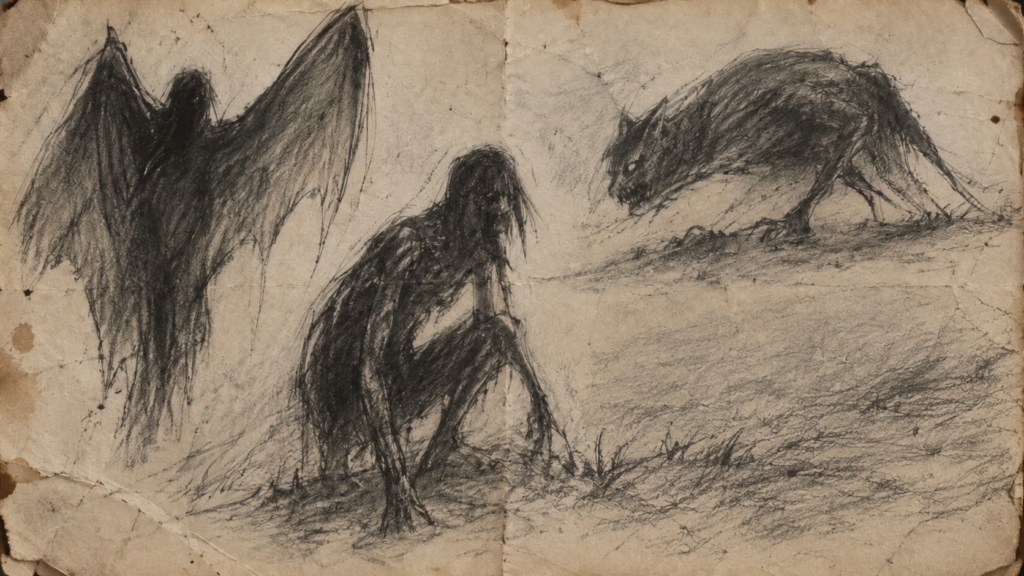
RECONSTRUCTION: Ravenwood reconstruction based on recurring descriptions associated with Popobawa traditions in Zanzibar. Accounts do not provide one stable physical form, and any accompanying depiction should be treated as an interpretation of folklore rather than photographic evidence.
CLASSIFICATION: Nocturnal Spirit / Shapeshifting Entity / Collective Panic Phenomenon
STATUS: Folkloric — Unverified
PRIMARY REGION: Zanzibar Archipelago, Tanzania
PRIMARY LOCATIONS: Pemba and Unguja
MAJOR DOCUMENTED PANIC: February–April 1995
EARLIER REPORTED EPISODE: Mid-1960s, retrospectively described
NAME: Popobawa / Popo Bawa
NAME MEANING: Commonly translated from Swahili as “bat-wing” or “winged bat”
COMMONLY REPORTED PHENOMENA: Nighttime attacks, chest pressure, difficulty breathing, unseen or changing form, strong odor
PHYSICAL EVIDENCE: None verified
CONFIRMED PARANORMAL FATALITIES: 0
DOCUMENTED HUMAN HARM: Mob assaults and at least one well-documented killing during the 1995 panic
CURRENT ACTIVITY: Periodic reports; no continuous verified phenomenon
CURRENT RECOMMENDATION: Treat Popobawa primarily as a documented Zanzibari folklore and collective-panic phenomenon. Do not treat accusations against living people as evidence of supernatural involvement.
DOCUMENTATION NOTE
Popobawa presents a problem different from most Archive cases.
The creature is not difficult to document because nothing happened.
Quite a lot happened.
People stayed awake at night.
Families gathered together outside their homes.
Communities searched for the thing they believed was attacking them.
Men were accused of being Popobawa.
Some were beaten.
At least one was killed.
The uncertain part is the creature.
Researcher Martin Walsh, who lived and worked in Zanzibar during the period surrounding the 1995 events, later examined the panic using locally collected accounts and contemporary material. His work describes a rapidly expanding episode of fear beginning on Pemba and spreading to Unguja and parts of the mainland coast. [1]
The historical panic is therefore not folklore in the sense of a story that merely circulated.
People acted on it.
That makes the distinction between belief and evidence considerably more important.
THE NAME
Popobawa is generally translated from Swahili as something close to “bat-wing” or “winged bat.” [1]
The name should not be mistaken for a reliable anatomical description.
Accounts collected around the phenomenon do not describe one consistent creature with one consistent body.
Popobawa could be spoken of as a spirit.
A shapeshifter.
A human figure.
An animal-like presence.
Something visible.
Something mostly unseen.
The bat association appears to relate more to the impression or shadow associated with the entity than to a standardized giant bat creature.
This is worth emphasizing.
Modern artwork likes monsters with identifiable silhouettes.
Folklore is less cooperative.
There is no reliable Popobawa model sheet.
There should not be one.
BEFORE 1995
People interviewed after the 1995 events remembered an earlier Popobawa episode associated with Pemba following the Zanzibar Revolution of 1964.
The frequently repeated date is 1965.
Walsh cautions, however, that he was unable to locate contemporary documentation establishing the details of this earlier episode, and later accounts disagreed about its timing and specifics. [1]
Ravenwood therefore records 1965 carefully.
Not:
FIRST CONFIRMED APPEARANCE — 1965
But:
EARLIER EPISODE REMEMBERED IN LATER ORAL ACCOUNTS
Those sentences mean different things.
The earlier tradition matters because people in 1995 did not necessarily believe they were inventing a new spirit.
They had a name ready.
And once the name returned, so did expectations about what came with it.
FEBRUARY 1995
The best-documented modern panic began in southern Pemba in early February 1995, during the beginning of Ramadan. [1]
Residents began reporting nocturnal attacks.
The most consistent early descriptions were not cinematic.
People woke suddenly.
They felt something pressing or crushing the chest and ribs.
Some experienced difficulty breathing.
Some described being unable to respond normally.
Others reported losing consciousness.
The attacker itself could remain visually indistinct.
A presence.
Weight.
Pressure.
Fear.
Then another household reported something similar.
Then another.
The identity assigned to it was Popobawa.
THE NIGHT ATTACK
The physical sensations described in a number of accounts are noteworthy.
Waking suddenly.
Inability to move or respond.
Pressure across the chest.
Difficulty breathing.
A powerful sense that another presence is in the room.
These features overlap substantially with experiences now commonly associated with sleep paralysis.
That provides a plausible explanation for at least some individual attacks.
It does not settle the entire historical event.
Sleep paralysis can explain a person waking terrified beneath an apparently unseen presence.
It does not by itself explain how communities interpret that experience.
Or why a particular supernatural identity becomes attached to it.
Or why reports spread.
Or why people begin organizing their behavior around the threat.
The body may provide the sensation.
Culture helps provide the visitor.
THE HOUSEHOLDS
As fear increased, sleeping alone became less attractive.
Residents reportedly gathered outside houses or stayed awake together in groups, sometimes around fires, attempting to protect themselves from nighttime attack. [1]
This changed the phenomenon.
A private experience became communal.
People compared stories.
Descriptions circulated.
Warnings circulated.
Explanations circulated.
Everyone knew what Popobawa was doing.
Everyone knew where it had supposedly been.
Everyone knew where it might go next.
In an environment like this, another frightened sleeper does not wake wondering what happened.
They wake with an answer waiting.
That does not require anyone to lie.
Fear spreads perfectly well among sincere people.
THE FORM
Descriptions of Popobawa were unstable.
That instability appears to be part of the tradition rather than a flaw later introduced into it.
The entity could change shape.
It could appear human.
Animal.
Shadowlike.
Invisible.
Some accounts associated its arrival with an intense unpleasant smell. [1][2]
This flexibility makes the spirit difficult to investigate as a biological claim.
Almost any contradiction can be absorbed by transformation.
If one witness sees an animal and another sees a man, the legend does not break.
Popobawa changed.
If no one sees anything:
Popobawa was unseen.
If an accused person looks completely ordinary:
Popobawa returned to human form.
A belief system capable of explaining every possible observation is extremely difficult to disprove.
It is also extremely difficult to prove.
THE SPREAD
The 1995 panic did not remain confined to one village.
Reports moved across Pemba.
By late March, the phenomenon had spread to Zanzibar Town on Unguja, the largest island of the Zanzibar Archipelago. [1]
Accounts there became more severe.
People reported physical and sexual assaults attributed to Popobawa.
The Archive will not reproduce the more graphic versions of those reports.
They are unnecessary.
What matters is that the nature of the feared attack changed as the panic moved between communities.
That is important evidence.
If investigators were dealing with one physical animal, we might expect behavior to remain comparatively stable.
Folklore behaves differently.
It adapts.
APRIL 3, 1995
The most important date in this file does not involve a verified supernatural attack.
It involves a man.
On the night of April 3, 1995, a visitor from mainland Tanzania was attacked by a mob in Zanzibar Town after being accused of being Popobawa.
He was killed.
The following morning, large crowds reportedly gathered near the mortuary because word had spread that Popobawa was dead. [1][2]
Henriette Jansen, then working with Zanzibar’s Ministry of Health, recorded the atmosphere in a contemporary account later published by Tanzanian Affairs. [2]
The body in the mortuary was human.
That did not immediately end the belief.
Explanations circulated that the spirit had transformed back into an ordinary man.
This is where the Popobawa file stops being an entertaining monster story.
A person was dead.
The supernatural evidence did not become stronger.
The consequences of believing in it did.
THE WRONG TARGET
Walsh documented multiple incidents during the 1995 panic in which men were attacked because communities believed they were Popobawa or manifestations of it.
Some reports of additional deaths were less securely corroborated than the April 3 killing. [1]
The Archive records that distinction.
We do not inflate the death count.
One confirmed victim of panic is enough.
This is also why Ravenwood does not reproduce folklore accusations as though they were eyewitness identification.
A stranger behaving unusually at night is not evidence of shapeshifting.
A mentally ill person is not evidence.
Someone carrying unfamiliar objects is not evidence.
An outsider appearing at the wrong moment is not evidence.
Once a community believes an invisible or shape-changing enemy can become human, almost anyone can become suspicious.
That is the most dangerous transformation in the file.
WHY TELLING PEOPLE MATTERED
Some Popobawa traditions held that victims needed to tell others about the attack.
Silence could invite another visit.
Whether this feature existed consistently across every episode is less important than what it accomplishes socially.
A supernatural encounter becomes something that must be communicated.
The victim does not simply experience the event.
They repeat it.
That creates an unusually efficient mechanism for transmission.
Normally an embarrassing or frightening nighttime experience might remain private.
Under this belief:
Privacy becomes dangerous.
The story protects you.
So you tell it.
Then someone else knows what to fear when they wake tomorrow night.
THE POLITICAL EXPLANATION
The 1995 panic occurred during an important political period.
Tanzania was approaching its first multiparty national elections, and Zanzibar was experiencing significant political tension.
This eventually produced one of the best-known interpretations of Popobawa.
Some people believed the phenomenon was connected to political forces or deliberately created to frighten, distract, or control communities. [1]
This interpretation has often been repeated as though politics straightforwardly caused the Popobawa panic.
Walsh’s research is more cautious.
Local explanations changed during the crisis.
The political interpretation became increasingly important rather than necessarily being the original explanation from the beginning. [1]
Ravenwood therefore does not classify Popobawa as:
POLITICAL HOAX
The historical relationship is more complicated.
Fear can absorb politics.
Politics can absorb fear.
By the end, separating them becomes difficult.
WHY PEMBA?
The panic began on Pemba and moved.
It did not affect every community equally.
Walsh noted differences between locations and suggested that local social organization, belief traditions, community responses, and patterns of communication influenced how the panic spread or failed to spread. [1]
This matters because Popobawa did not behave like an epidemic with a simple biological transmission route.
Some communities resisted the panic better than others.
Some adopted collective protective behavior.
Some produced accusations.
Some produced different explanations.
Whatever Popobawa was culturally, people were not passive.
Communities shaped the phenomenon while responding to it.
THE SMELL
A recurring element in some accounts was smell.
Strong.
Offensive.
An indication that the entity was near.
Smell is unusually effective in supernatural traditions because it feels physical.
You cannot easily dismiss something you believe you smelled.
But odors have poor evidentiary value without independent measurement.
Smoke.
Waste.
Animals.
Human bodies.
Cooking.
Standing water.
Chemical substances.
All can become meaningful once a witness expects an odor to signal danger.
There is no preserved chemical sample associated with Popobawa.
No environmental reading.
No material trace.
Only memory.
That should remain where we place it.
NOT A BAT MONSTER
Modern retellings frequently turn Popobawa into a winged cryptid.
Large bat wings.
Claws.
A fixed demonic face.
That is visually effective.
It is also misleading.
The documented tradition is much less anatomically stable.
Popobawa is better understood as a spirit capable of changing form than as an undiscovered flying animal.
Ravenwood therefore does not classify this case under Cryptids.
There is no proposed breeding population.
No ecological range.
No carcass.
No footprint standard.
No stable body.
The subject belongs under Folklore.
That is not a lesser classification.
In this case, folklore produced more measurable consequences than most cryptids ever have.
LATER RETURNS
The 1995 panic eventually subsided.
It did not permanently erase Popobawa.
Walsh’s historical chronology records smaller subsequent episodes around 2000, 2001, and 2007. [1]
The later events were less extensive than 1995.
Their recurrence is important.
Once established, Popobawa became available as an explanation whenever similar experiences returned.
This is one reason folklore can persist without continuous sightings.
It does not need to remain physically present.
It remains culturally available.
A frightening nighttime experience happens.
The old name is still there.
THE SLEEP PARALYSIS EXPLANATION
Sleep paralysis deserves serious consideration.
During an episode, a person may regain awareness while normal REM-related muscle paralysis has not yet ended.
The result can include:
Temporary inability to move.
Chest pressure.
Difficulty breathing.
A sensed presence.
Fear.
Visual or auditory hallucinations.
These experiences have generated supernatural interpretations across many cultures.
The overlap with some Popobawa reports is substantial.
It is not complete.
Some reported events occurred outside the classic sleep-paralysis pattern.
Some involved community activity unrelated to individual sleep experiences.
Some claims developed through rumor rather than firsthand experience.
Ravenwood therefore classifies sleep paralysis as a strong partial explanation.
Not a universal one.
THE SOCIAL EXPLANATION
Another explanation requires no creature at all.
A frightening initial experience occurs.
People discuss it.
The community recognizes an old supernatural category.
Attention increases.
Ambiguous events are interpreted through that category.
Reports increase.
Fear changes sleeping behavior.
More people stay awake.
Rumors accelerate.
Authorities respond.
Media attention expands.
Accusations begin.
The phenomenon becomes self-reinforcing.
This model explains much of the 1995 crisis without requiring deliberate fabrication.
The people involved can be sincerely afraid.
Their experiences can be psychologically real.
Their conclusion can still be wrong.
That distinction is uncomfortable.
It is also necessary.
WHAT WE DO NOT HAVE
No verified photograph of Popobawa.
No biological specimen.
No tissue.
No hair.
No fingerprints attributed reliably to an unknown entity.
No stable physical description.
No authenticated recording demonstrating an anomalous creature.
No independently verified transformation from animal to human.
No evidence establishing supernatural responsibility for the reported attacks.
No evidence that the people assaulted or killed as suspected manifestations were anything other than human beings.
That final point is the one Ravenwood considers most important.
WHAT WE DO HAVE
A documented episode of intense public fear in Zanzibar in 1995. [1][2]
Numerous reported nocturnal encounters.
Recurring descriptions involving pressure, suffocation, sensed presence, and changing form.
Collective attempts to avoid attack.
A folklore tradition capable of adapting to different communities.
Political interpretations developing during a period of significant tension.
Mob violence against people believed to be the entity.
At least one well-documented death resulting from that violence.
And subsequent smaller episodes demonstrating that the Popobawa tradition survived after the primary panic ended. [1]
Something happened in Zanzibar.
The evidence strongly establishes that.
The evidence does not establish a winged supernatural attacker.
THE IMPORTANT DISTINCTION
There are two Popobawa cases.
The first asks:
Did a shapeshifting spirit attack people in Zanzibar?
The evidence is insufficient.
The second asks:
Did belief in a shapeshifting spirit alter human behavior across communities strongly enough to produce fear, sleepless nights, accusations, violence, and death?
Yes.
That case is documented.
Ravenwood is interested in both.
Only one requires the supernatural.
The other may be more frightening without it.
ARCHIVIST’S NOTES
I expected the difficult part of this file to be deciding whether Popobawa could be explained by sleep paralysis.
It was not.
That part is relatively straightforward.
The symptoms overlap.
Not perfectly.
Enough to matter.
The difficult part is the man who died.
An unknown creature can remain unknown indefinitely.
A person accused of being one does not receive that luxury.
Someone decided the explanation before the evidence arrived.
Then a crowd acted on it.
There is a tendency in paranormal writing to treat widespread belief as support.
Ten witnesses are better than one.
A hundred stories must mean something.
Sometimes they do.
Sometimes one frightened person tells another frightened person what to expect.
Then both become witnesses to the same idea.
That does not make either person stupid.
Fear is highly teachable.
Popobawa may be one of the clearest examples in the Archive of why we document mundane explanations even when witnesses hate them.
Especially then.
Sleep paralysis does not explain every story.
Politics does not explain every story.
Rumor does not explain every story.
Hoax does not explain every story.
Perhaps something remains.
I am comfortable leaving that possibility open.
I am less comfortable with what happens when uncertainty is replaced by certainty too quickly.
In 1995, people went looking for Popobawa.
They found human beings.
That should be remembered before the wings.
CURRENT RECOMMENDATION
Popobawa reports should be documented as individual experiences before they are grouped into a larger phenomenon.
Record:
Time of occurrence.
Sleep state immediately before the event.
Ability to move or speak.
Breathing difficulty.
Chest pressure.
Visual observations.
Auditory observations.
Odors.
Duration.
Other witnesses physically present.
Whether the witness knew of recent Popobawa reports beforehand.
Any physical injury should receive ordinary medical examination before supernatural interpretation.
Do not identify living individuals as manifestations of Popobawa.
Do not organize armed searches.
Do not treat unusual behavior as evidence of transformation.
Do not assume shared belief equals shared physical cause.
If a frightened community begins searching for a creature capable of looking human:
Stop searching for the creature.
Start protecting the humans.
CASE STATUS
ARCHIVED — INSUFFICIENT EVIDENCE
Popobawa remains a significant modern Zanzibari folklore tradition associated with recurring reports of nocturnal attacks and episodes of collective panic.
The most extensive documented episode occurred in 1995, beginning on Pemba and spreading to Unguja and parts of the mainland coast.
Some reported experiences are consistent with known sleep-paralysis phenomena, while social transmission, political interpretation, rumor, and cultural expectations provide plausible explanations for the broader spread of the panic.
No verified physical evidence establishes the existence of a supernatural or biological entity.
The human consequences were nevertheless real.
Fear of Popobawa contributed to assaults against people accused of being the spirit, including at least one well-documented killing.
The entity remains unverified.
The panic does not.
FILE REMAINS OPEN
RESEARCH SOURCES
[1] Martin Walsh — “The Politicisation of Popobawa: Changing Explanations of a Collective Panic in Zanzibar” — Journal of Humanities, University of Dodoma, 2009
Used for the chronology and development of the 1995 panic, earlier remembered Popobawa traditions, reported symptoms, geographic spread from Pemba to Unguja, community responses, violence against suspected manifestations, later episodes, and the changing political interpretations surrounding the phenomenon.
Source Type: Academic / ethnographic research.
Facts have been independently summarized. No source prose has been reproduced.
[2] Henriette Jansen — “Popobawa Is Dead!” — Tanzanian Affairs, January 1996
Used as a near-contemporary written account of events in Zanzibar Town during April 1995, particularly the crowd response following the killing of a man accused of being Popobawa and descriptions circulating during the panic.
Source Type: Contemporary eyewitness / historical account.
No wording or text from the original source was copied or reproduced.