
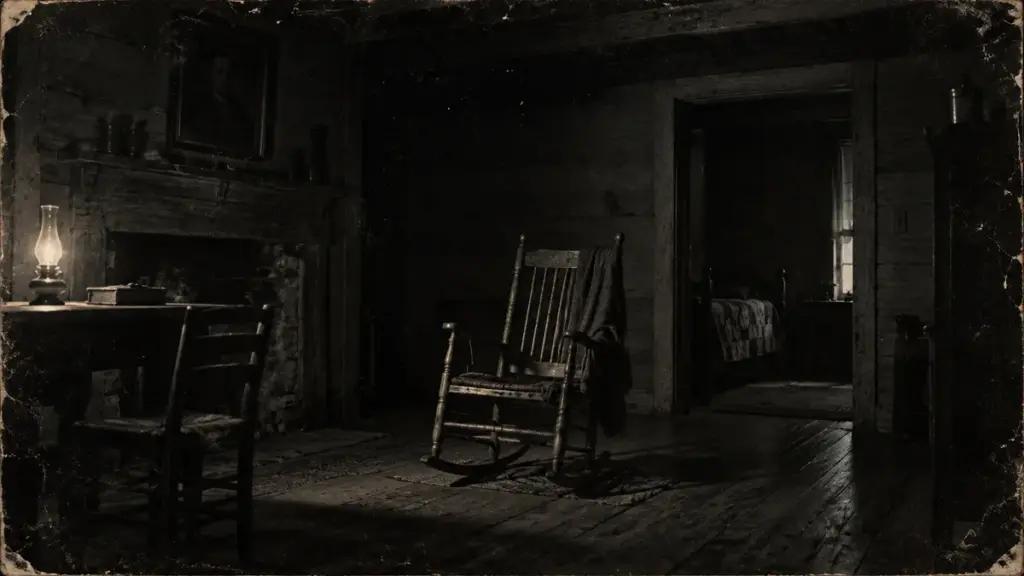
RECONSTRUCTION: Ravenwood reconstruction based on recurring descriptions preserved in later accounts of the Bell family disturbances. No authenticated contemporary image documents the alleged entity, and the Bell Witch was frequently described as invisible or capable of changing form.
CLASSIFICATION: Haunting / Poltergeist Tradition / Regional Folklore
STATUS: Historical — Unverified
PRIMARY LOCATION: Adams, Robertson County, Tennessee
PRIMARY FAMILY: John and Lucy Bell household
TRADITIONAL ACTIVITY PERIOD: Approximately 1816–1821
PRIMARY TARGETS: John Bell and his daughter Betsy Bell
ENTITY NAME: Commonly called “Kate” / the Bell Witch
COMMONLY REPORTED PHENOMENA: Knocking, scratching, disembodied speech, voice mimicry, physical harassment, disturbed bedding, apparitions
PHYSICAL EVIDENCE: None preserved for modern examination
CONFIRMED PARANORMAL FATALITIES: 0
ASSOCIATED DEATH: John Bell, December 20, 1820; supernatural responsibility unverified
CURRENT ACTIVITY: Folkloric / periodic modern claims
CURRENT RECOMMENDATION: Separate the nineteenth-century legend from evidence produced decades later. Treat supernatural explanations as unverified.
DOCUMENTATION NOTE
The Bell Witch has a documentation problem.
Not because nobody wrote the story down.
Because the version most people know was written down too late.
The haunting is traditionally placed between approximately 1816 and 1821.
The first major book-length account, Martin Van Buren Ingram’s An Authenticated History of the Famous Bell Witch, did not appear until 1894.
More than seventy years had passed.
Ingram claimed access to an earlier family account written by John Bell’s son Williams Bell in 1846, itself roughly twenty-six years after John Bell’s death. He also collected letters, recollections, and stories from descendants and people who said they had heard the events from earlier witnesses. [1]
That makes Ingram invaluable.
It also makes him late.
The Bell Witch therefore occupies an uncomfortable place between history and folklore.
Names are real.
Places are real.
John Bell was real.
The tradition surrounding his family is real.
The invisible thing in the house remains another matter.
THE BELL FARM
John and Lucy Bell moved with their children from North Carolina to Middle Tennessee in 1804, settling near the Red River in what is now Robertson County.
For more than a decade, nothing remarkable is recorded in the familiar version of the family’s history.
Then, sometime around 1816, the disturbances supposedly began. [2]
The first reports were comparatively simple.
Unusual animals seen around the property.
Scratching near the house.
Knocking.
Sounds beneath floors or inside walls.
No obvious source.
These are ordinary ingredients in haunting traditions.
They are also ordinary ingredients in houses.
Animals enter walls.
Wood shifts.
Roofs settle.
Branches scrape.
People hear things incorrectly at night.
The Bell story did not remain at that level.
The noises began answering back.
SOMETHING IN THE HOUSE
According to the later tradition, scratching and knocking developed into more complex disturbances.
The family reportedly heard sounds resembling:
Rats gnawing.
Chains dragging.
Dogs fighting.
Objects striking walls.
Someone walking where nobody was visible.
Eventually the disturbances became associated with physical interference.
Blankets were supposedly pulled from beds.
Children were pinched or slapped.
Hair was pulled.
Betsy Bell became one of the principal targets.
The Tennessee Encyclopedia preserves the traditional account that members of the household experienced physical harassment while Lucy Bell was treated comparatively kindly by the presence. [2]
The story was no longer about noises.
Something appeared to be choosing people.
BETSY BELL
Betsy Bell became central to the legend.
She was still young when the disturbances were said to have begun.
Accounts describe her being struck, scratched, pinched, and tormented at night.
Her relationship with Joshua Gardner also became part of the tradition.
The entity supposedly objected aggressively to their marriage and repeatedly interfered with the courtship until Betsy eventually ended the engagement.
Why an unseen presence would care about a teenager’s marriage remains unclear.
Later interpretations turned this into evidence that the haunting revolved around Betsy.
Others suggested something less supernatural.
If the disturbances centered disproportionately around one young household member, perhaps the phenomenon involved pranking, psychological stress, family conflict, or behavior that later observers misunderstood.
Ingram himself acknowledged that suspicions eventually arose that Betsy or her brothers might have been responsible for at least some of the activity.
He rejected that explanation. [1]
Rejection is not disproof.
Neither is suspicion evidence of fraud.
The Archive records both.
THE VOICE
At some point in the traditional chronology, the Bell Witch began to speak.
This changed everything.
An unexplained sound can be an animal.
A spoken sentence requires something else.
Accounts attributed an extraordinary range of abilities to the voice.
It supposedly answered questions.
Repeated conversations occurring elsewhere.
Quoted religious material.
Argued with visitors.
Imitated people.
Sang.
Told stories.
Insulted members of the household.
The Tennessee Encyclopedia records the tradition that the spirit recited prayers, imitated local voices, debated Scripture, and even joined in religious singing. [2]
If accurate, this would make the Bell phenomenon substantially more complex than an ordinary haunting.
It would also make concealment harder.
A speaking entity surrounded by visitors should have produced abundant contemporary written evidence.
Very little secure contemporary documentation survives.
That absence matters.
“KATE”
The entity eventually acquired a name.
Kate.
The popular version often identifies the Bell Witch directly with a neighbor named Kate Batts, sometimes alleging that Batts had quarreled with John Bell over a business transaction and cursed him.
The historical situation is less clean.
Ingram’s own 1894 book contains accounts suggesting that Kate Batts became a convenient target for local suspicion because she was considered eccentric and because the alleged spirit itself claimed some connection with her.
But Ingram also preserved recollections from people who explicitly rejected the idea that Batts was responsible.
One interviewee described her as kindhearted and said the accusation against her was essentially superstition attaching itself to an unpopular explanation. [1]
That distinction has largely disappeared from the modern legend.
Kate Batts was a woman.
The Bell Witch was a story.
Ravenwood does not merge them.
THE PROBLEM WITH A NAME
Once the entity became Kate, its behavior became easier to describe.
That is useful for storytelling.
Less useful for investigation.
A knock can come from anywhere.
Kate knocked.
A voice could belong to anyone.
Kate spoke.
A blanket moved.
Kate pulled it.
John Bell became ill.
Kate was blamed.
Naming an unknown cause gives unrelated events somewhere to accumulate.
Soon the name itself becomes evidence.
This happens frequently in long-running paranormal cases.
At first:
Something happened.
Later:
It happened.
Eventually:
She did it.
By then, the investigation has already made several assumptions.
VISITORS
News of the disturbances supposedly spread beyond the Bell household.
Neighbors came.
Friends came.
Curious visitors came.
Some accounts describe rooms full of people attempting to communicate with the entity or challenge it.
This expanding witness pool is one of the strongest elements of the legend.
It is also one of the hardest to evaluate.
Most of the detailed testimony available today was preserved or collected decades after the events.
Memory changes.
Family stories improve.
Community stories become standardized.
One generation tells another what happened.
Eventually the person repeating the story knows where everyone stood.
That does not necessarily mean the story is false.
It means precision arriving late should be treated carefully.
ANDREW JACKSON
Then there is Andrew Jackson.
The most famous visitor of all.
According to the traditional story, future president Andrew Jackson traveled with several men to investigate the Bell Witch.
As they approached the Bell property, their wagon supposedly stopped moving despite the horses pulling.
A voice attributed to the witch announced itself.
The wagon then moved again.
Jackson and his party allegedly experienced further disturbances and eventually left.
The Tennessee Historical Commission’s Bell Witch marker includes the Jackson story as part of the local legend. [3]
That does not make the episode contemporaneously documented.
The detailed version familiar today appears prominently in Ingram’s 1894 book, where it was supplied through an account written in 1894 by attorney Thomas L. Yancey, who said the story had been related by his grandfather. [1]
That is a story about a story about an event roughly three-quarters of a century earlier.
Could Jackson have visited?
Possibly.
The tradition is longstanding.
Can Ravenwood verify the famous wagon incident from records produced at the time?
No.
So we classify it accordingly.
LEGENDARY VISIT — NOT CONTEMPORARILY VERIFIED
Andrew Jackson survived worse documentation.
JOHN BELL’S ILLNESS
The darkest part of the story centers on John Bell himself.
During the alleged haunting, Bell reportedly developed worsening physical symptoms.
Accounts describe difficulty speaking, weakness, facial spasms or seizures, and periods of incapacitation.
The Bell Witch was said to express particular hostility toward him.
By late 1820, his health had deteriorated severely.
On December 20, 1820, John Bell died. [2]
The legend did not allow the death to remain medical.
It turned it into murder.
THE VIAL
The traditional account states that a small vial containing an unidentified dark liquid was discovered in the Bell household around the time of John Bell’s death.
The entity supposedly announced that it had given Bell the substance.
According to later versions, some of the liquid was administered to a cat.
The animal died.
The remainder was supposedly thrown into a fire.
The Bell Witch then celebrated John Bell’s death.
The story appears in Ingram’s account and later retellings. [1]
No vial survives.
No chemical analysis exists.
No medical examination established poisoning.
No preserved tissue exists for toxicological testing.
No contemporary criminal investigation demonstrated homicide.
John Bell died.
The claim that a supernatural entity poisoned him remains folklore.
Those statements should not be combined.
THE FUNERAL
The legend continues even after Bell’s death.
During his funeral procession or burial, the Witch was supposedly heard singing or laughing.
It is one of the more memorable details.
It is also exactly the sort of detail that accumulates easily around famous deaths.
A hostile entity tormenting someone for years requires a final gesture.
Folklore understands structure.
The historical record is less considerate.
Ravenwood found no independent evidence that an invisible voice attended John Bell’s funeral.
We therefore leave the scene where it belongs.
Inside the tradition.
THE DEPARTURE
After John Bell’s death, the Bell Witch supposedly remained for a short time.
The Tennessee Encyclopedia places its departure in the following spring, after roughly four years of activity, with the spirit promising to return seven years later. [2]
Later stories claim that it did.
The return was less dramatic.
Another tradition claims the entity predicted a still later return.
As with many haunting cycles, future dates allowed the legend to survive beyond the original witnesses.
A haunting with an appointment is difficult to retire.
THE CAVE
Modern Bell Witch folklore is strongly associated with Bell Witch Cave, located near Adams.
The cave is real.
Its connection to the original nineteenth-century events is less straightforward.
The Bell Witch story centered primarily on the Bell property and household.
Over time, the nearby cave became incorporated into the wider legend and is now one of the locations most strongly associated with it.
This is an important distinction for Ravenwood.
A location can become part of a legend after the legend has formed.
That does not make the location fraudulent.
It makes the chronology important.
The Archive does not treat modern cave stories as direct corroboration of events in the Bell home.
THE HISTORICAL MARKER
The Bell Witch is unusual among American ghost stories in having a Tennessee Historical Commission marker acknowledging the tradition near Adams.
The wording matters.
It says:
According to legend.
The marker identifies John Bell’s nearby farm and summarizes the famous stories, including family disturbances and the alleged Andrew Jackson visit. [3]
A state historical marker therefore confirms something important.
Not that a witch existed.
That the legend itself became part of Tennessee history.
There is a difference.
Ravenwood appreciates that the marker makes it for us.
WHAT INGRAM ACTUALLY GIVES US
Martin Van Buren Ingram’s 1894 book remains foundational.
Without it, much of the detailed Bell Witch narrative familiar today would be difficult to reconstruct.
That makes it valuable.
But Ingram was not writing as a skeptical modern historian.
He believed strongly in the authenticity of the phenomenon.
His introduction openly argues for supernatural possibilities and presents the Bell Witch as genuine.
He relied heavily on family material, local reminiscence, correspondence, and accounts preserved through oral tradition. [1]
This does not make the book useless.
Quite the opposite.
It tells us how the legend existed in nineteenth-century community memory.
But a source can be historically important without proving the claims it records.
That is exactly how Ravenwood uses it.
THE LOST CONTEMPORARY RECORD
This is the central weakness.
If the Bell Witch events occurred between approximately 1816 and 1821, the evidence investigators would want most is documentation from 1816 to 1821.
Letters.
Diaries.
Church records.
Medical notes.
Newspaper coverage.
Court documents.
Statements written by direct witnesses while events were occurring.
Instead, the most detailed surviving narrative comes later.
Williams Bell’s purported family manuscript was said to have been written in 1846.
Ingram published his compilation in 1894.
By then, the story had spent decades moving through families and communities.
Every year between event and documentation is room for something to change.
Sometimes only a sentence.
Sometimes the whole witch.
POSSIBLE EXPLANATION: HOUSEHOLD PHENOMENA
The earliest disturbances are the easiest to explain conventionally.
Scratching.
Knocking.
Movement inside walls.
Animal noises.
Floor sounds.
These are ordinary features of rural buildings.
Rodents.
Birds.
Wood expansion.
Wind.
Loose materials.
Human activity.
The problem is escalation.
Ordinary structural explanations do not easily produce intelligent speech or conversations.
Unless those later elements did not occur exactly as remembered.
Which brings us back to documentation.
POSSIBLE EXPLANATION: HUMAN AGENCY
Deliberate pranking has long been proposed.
A hidden person can produce:
Knocking.
Voices.
Moved bedding.
Thrown objects.
Some apparently intelligent responses.
The concentration of activity around Betsy has led some skeptics to suspect her or other family members.
Ingram records that such an accusation existed even before his book was published. [1]
No culprit was demonstrated.
No reliable confession survives.
And the later legend credits the entity with phenomena that would have been difficult for one person to produce continuously.
Human agency remains plausible for some incidents.
It does not provide a proven unified explanation.
POSSIBLE EXPLANATION: ILLNESS AND INTERPRETATION
John Bell’s decline can be approached without a ghost.
People became sick in 1820.
Neurological illness existed.
Stroke existed.
Infection existed.
Poisoning by human means existed.
Medicine was limited.
Symptoms unexplained at the time could easily acquire supernatural meaning inside a household already convinced something hostile was present.
Once the Witch was believed to hate John Bell, every deterioration in his condition could become another attack.
His death then supplied the legend with its strongest apparent confirmation.
But sequence is not cause.
An alleged spirit threatened a sick man.
The sick man died.
That does not prove the spirit killed him.
POSSIBLE EXPLANATION: A GROWING STORY
The least dramatic explanation may account for the most material.
Something strange happened in the Bell household.
Perhaps several strange things.
The family talked.
Neighbors became involved.
Explanations developed.
Stories were repeated.
Children grew old.
Witnesses died.
Descendants inherited the account.
Local identity formed around it.
Writers collected the stories.
Contradictions were softened.
Memorable details survived.
Better details replaced weaker ones.
By 1894, Ingram had enough material for a book.
By the twentieth century, Tennessee had one of America’s most famous hauntings.
This does not require the original family to invent everything.
Folklore rarely does.
Stories grow perfectly well around a real seed.
We simply no longer know how large that seed was.
WHAT WE DO NOT HAVE
No verified contemporary recording of the Bell Witch.
No photograph.
No physical specimen.
No preserved object conclusively manipulated by the entity.
No surviving poison vial.
No toxicological evidence proving John Bell was murdered.
No contemporary document establishing that Andrew Jackson experienced supernatural events at the Bell property.
No reliable demonstration that Kate Batts was responsible.
No agreed physical appearance.
No single preserved firsthand account written during the height of the alleged haunting that establishes the full later narrative.
For a case this famous, the list is substantial.
WHAT WE DO HAVE
A longstanding Tennessee legend associated with a real family and a real community.
A traditional activity period beginning around 1816. [2]
Detailed nineteenth-century accounts collected by Martin Van Buren Ingram in 1894. [1]
Stories involving knocking, voices, physical disturbances, illness, and apparent intelligent interaction.
A tradition centered particularly on John Bell and Betsy Bell.
A documented death of John Bell in 1820 incorporated into the supernatural narrative. [2]
A famous but poorly contemporaneously documented story involving Andrew Jackson.
And a Tennessee Historical Commission marker that recognizes the Bell Witch as a significant local legend. [3]
The haunting remains unverified.
The folklore does not.
WHY THE BELL WITCH SURVIVED
The Bell Witch has almost everything a ghost story needs.
A family.
A house.
A young woman.
A hostile unseen presence.
A voice.
A famous visitor.
A death.
A named suspect.
And a location people can still travel to.
More importantly, the Witch had personality.
It did not merely move furniture.
It talked.
It argued.
It mocked.
It chose favorites.
It hated John Bell.
It interfered with Betsy’s relationship.
That makes the entity memorable in a way generic apparitions rarely are.
People remember characters.
By the nineteenth century, the Bell Witch was one.
Whether anything supernatural ever occupied the Bell household is almost secondary to why the story survived.
Kate could speak.
So people kept speaking about Kate.
ARCHIVIST’S NOTES
The Andrew Jackson story is irritating.
Naturally, it is also one of the best parts.
A future president travels into rural Tennessee to challenge a witch.
His wagon stops.
The witch announces herself.
Jackson retreats.
Excellent story.
Terrible evidence.
The account we can actually trace in detail arrives decades later through a man repeating what his grandfather supposedly told him.
That does not mean it never happened.
It means we should stop pretending the distance between those statements is small.
The vial bothers me for a different reason.
If it existed, someone destroyed the best evidence in the case.
Of course they did.
This happens often enough that I have started assuming anomalous objects possess an instinctive ability to locate fireplaces.
But John Bell’s death should be handled quietly.
He was a sick man who died.
Later tradition gave the Witch responsibility.
We cannot.
The most interesting part of this file is not the poison.
It is the voice.
If even a fraction of the speaking phenomena occurred as described, something genuinely unusual was happening in that household.
A hidden prankster is possible.
Several pranksters are possible.
Memory is possible.
Suggestion is possible.
Stories changing over seventy years is extremely possible.
What remains difficult is determining where one explanation ends and another begins.
Perhaps the original Bell haunting was small.
A few noises.
A frightened family.
A daughter who experienced something nobody understood.
Then the story grew teeth.
Or perhaps Ingram preserved a damaged version of something that genuinely happened and arrived too late to prove it.
Both possibilities end in the same place.
No test.
No recording.
No room left to inspect.
Only testimony.
The Witch was said to be good at talking.
Two hundred years later, that is still mostly what we have.
CURRENT RECOMMENDATION
The Bell Witch should be treated as a historically significant American haunting tradition rather than a verified supernatural event.
When evaluating individual claims, distinguish:
Events attributed to the original Bell family.
Accounts written decades later.
Modern Bell Witch Cave folklore.
Tourism-era stories.
Adaptations created for books, film, and television.
Do not attribute unexplained illness to supernatural attack without medical evidence.
Do not repeat accusations against Kate Batts as established historical fact.
Do not present the Andrew Jackson visit as contemporaneously documented evidence.
Preserve original source dates whenever quoting or summarizing testimony.
The later the account, the more clearly that should be stated.
If an unseen voice begins answering questions intelligently:
Record it.
The Bells deserved better equipment.
CASE STATUS
ARCHIVED — INSUFFICIENT EVIDENCE
The Bell Witch remains one of Tennessee’s most enduring supernatural traditions, centered on disturbances said to have affected the family of John Bell near present-day Adams during the early nineteenth century.
The historical existence of the Bell family, John Bell’s death, and the later regional importance of the legend are not in dispute.
The supernatural claims are.
The most detailed surviving narrative was assembled decades after the alleged events, making it difficult to separate original testimony from family recollection, community folklore, and later embellishment.
No preserved physical evidence establishes an intelligent paranormal entity.
No evidence demonstrates that such an entity caused John Bell’s death.
No reliable contemporary record confirms the most famous Andrew Jackson episode.
Something may have happened in the Bell household.
Whatever it was had already become a legend before investigators arrived with anything resembling useful documentation.
The entity remains unverified.
The story remains very much alive.
FILE REMAINS OPEN
RESEARCH SOURCES
[1] Martin Van Buren Ingram — An Authenticated History of the Famous Bell Witch (1894)
Used as the foundational nineteenth-century source for the detailed Bell Witch tradition, including the alleged family manuscript, reported household phenomena, accusations surrounding Kate Batts, the Andrew Jackson tradition, contemporary skepticism preserved by Ingram, and the claimed circumstances surrounding John Bell’s death.
Source Type: Historical primary/near-primary compilation — published 1894 and now public domain.
Because Ingram wrote decades after the alleged events and openly believed the phenomenon was genuine, Ravenwood treats the work as documentation of the historical tradition rather than independent proof of supernatural claims.
[2] Tennessee Encyclopedia — “Bell Witch,” William T. Turner / Tennessee Historical Society
Used for the Bell family’s move to Tennessee, the commonly accepted chronology, reported household disturbances, John and Betsy Bell’s roles in the tradition, John Bell’s December 20, 1820 death, and the continuing historical significance of the legend.
Source Type: State/regional historical reference.
Facts have been independently paraphrased. No copyrighted source prose has been reproduced.
[3] Tennessee Historical Commission — Bell Witch Historical Marker, Adams, Tennessee
Used to confirm the State of Tennessee’s recognition of the Bell Witch as a significant local legend and the historical marker’s characterization of the account explicitly as legend.
Source Type: Official state historical marker.