
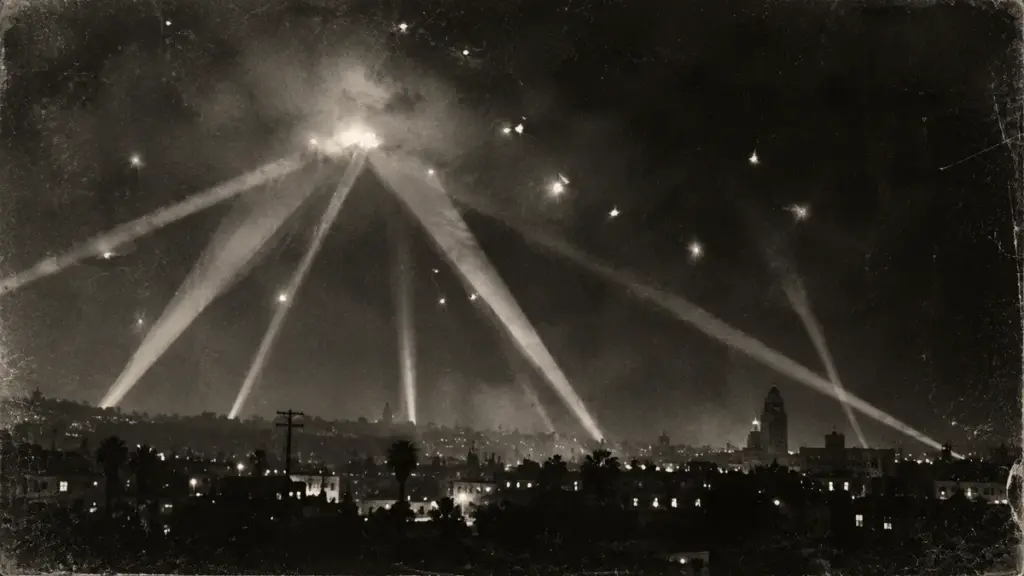
RECONSTRUCTION: Ravenwood reconstruction of the February 25, 1942 anti-aircraft barrage over Los Angeles. Searchlights, gunfire, and the blackout are historically documented; no verified image establishes an extraterrestrial or unknown craft above the city.
CLASSIFICATION: Wartime Air-Defense Incident / Unidentified Aerial Report / Later UFO Folklore
STATUS: Historical — Explained, Trigger Disputed
DATE: February 24–25, 1942
PRIMARY LOCATION: Los Angeles County, California
CONTEXT: United States entry into World War II
ANTIAIRCRAFT ROUNDS FIRED: Approximately 1,400
ENEMY AIRCRAFT RECOVERED: 0
CONFIRMED ENEMY BOMBS DROPPED: 0
CIVILIAN DEATHS ASSOCIATED WITH EVENT: 5 indirectly attributed to crashes and heart attacks
PRIMARY EXPLANATION: Wartime false alarm / probable balloon or misidentified aerial target
LATER INTERPRETATION: UFO / unidentified craft
CURRENT RECOMMENDATION: Treat the incident as a genuine wartime air-defense response. Separate the documented barrage from later extraterrestrial interpretations.
DOCUMENTATION NOTE
The Battle of Los Angeles was real.
That sentence requires clarification immediately.
The blackout was real.
The searchlights were real.
The anti-aircraft batteries were real.
The shells were real.
People on the ground were injured by the consequences of the event, property was damaged, and five civilians died indirectly amid the confusion.
What remains uncertain is much smaller.
What started it.
Official American military histories record reports of unidentified aircraft approaching Los Angeles from the Pacific and approximately 1,400 rounds of three-inch anti-aircraft ammunition fired against various perceived targets. The Army and Navy did not even agree afterward about whether meaningful aerial targets had been present. [1][2]
That disagreement gave the incident somewhere to live.
Decades later, UFO folklore moved in.
THE WEST COAST IN 1942
The event cannot be understood without the date.
February 1942.
Pearl Harbor had been attacked less than three months earlier.
The United States was newly at war.
California contained major naval installations, aircraft manufacturing centers, ports, oil facilities, and other strategically important infrastructure.
The fear of attack on the West Coast was not imaginary.
Enemy action had already occurred.
On February 23, 1942—only one day before the Los Angeles incident—the Japanese submarine I-17 surfaced off the California coast near Santa Barbara and shelled oil installations at Ellwood.
The physical damage was limited.
The psychological effect was not.
The enemy was no longer an ocean away.
Someone had fired at California.
The following night, Los Angeles was ready to believe they had returned.
THE RADAR CONTACT
During the early morning hours of February 25, military personnel received reports of possible aircraft approaching Southern California from the ocean.
A coastal radar contact reportedly contributed to the alert.
The city prepared for attack.
Air raid sirens sounded.
Los Angeles went dark.
Searchlights began probing the sky.
Anti-aircraft crews waited.
Then somebody saw something.
Or thought they did.
After that, the sky became considerably harder to interpret.
THE FIRST SHOTS
Shortly after 3:00 a.m., anti-aircraft fire began over the Los Angeles area.
Once firing started, batteries across the region joined.
Searchlights crossed through smoke and cloud.
Shells exploded overhead.
Tracer fire rose from the ground.
Fragments fell back into neighborhoods.
Residents emerged from homes despite blackout orders to watch.
Some believed enemy bombers were directly overhead.
Others reported formations.
Some saw individual aircraft.
Some saw nothing except the barrage.
The United States Army Air Forces later recorded approximately 1,400 rounds of three-inch anti-aircraft ammunition fired during the incident. [1]
No Japanese aircraft fell.
No wreckage appeared.
No enemy pilot was captured.
No bombs struck Los Angeles.
The guns nevertheless continued.
THE TARGETS
This is where the record becomes untidy.
Witnesses and military personnel did not agree on what was above the city.
Descriptions included:
One aircraft.
Several aircraft.
Large formations.
Slow-moving objects.
High-altitude objects.
Targets changing direction.
Targets apparently remaining almost stationary.
Some observers believed they saw aircraft illuminated directly by searchlights.
Others could not identify anything.
The official Air Force chronology later recorded that the Army concluded the battle had been triggered by between one and five unidentified aircraft.
The Navy maintained that there had been no reason for the firing at all. [1]
Both services had participated in the same war.
They left the night with different skies.
THE BARRAGE CREATES ITS OWN EVIDENCE
Once hundreds of explosive shells begin detonating over a city at night, visual observation deteriorates rapidly.
Smoke accumulates.
Searchlight beams illuminate debris.
Explosions produce flashes.
Shell bursts become moving points of light.
Fragments fall.
Clouds brighten unexpectedly.
People begin tracking objects because everyone around them is tracking objects.
The barrage itself can generate the appearance of additional targets.
This is one of the less satisfying explanations in the case.
It is also one of the most practical.
The defenders may have begun firing at something ambiguous.
After that, they were looking through the consequences of their own firing.
THE SEARCHLIGHT PHOTOGRAPH
One image eventually became inseparable from the event.
A nighttime photograph shows multiple searchlight beams converging in the sky while anti-aircraft fire surrounds the illuminated area.
Later UFO interpretations frequently present the convergence point as though a large solid craft is visibly trapped inside the beams.
The photograph does not establish that.
Bright searchlights intersecting smoke, haze, shell bursts, and photographic exposure can produce a visually dense illuminated region.
The image documents the search.
It does not identify what was being searched for.
That distinction became increasingly inconvenient as the photograph grew more famous.
Eventually, the empty space between the lights acquired a spacecraft.
THE WEATHER BALLOON
One of the most persistent conventional explanations is remarkably modest.
A balloon.
The National Park Service summarizes the event as a false alarm likely triggered by a weather balloon, followed by a massive anti-aircraft response. [3]
A balloon fits several reported characteristics better than an attacking bomber.
Slow movement.
Apparent hovering.
Difficulty establishing size or altitude.
A reflective or illuminated object becoming unusually prominent under searchlights.
It also explains why nothing attacked Los Angeles.
It does not reconstruct every individual sighting.
It does not need to.
There is no requirement that every witness saw the same object.
Once the barrage began, they almost certainly did not.
THE MILITARY DISAGREEMENT
Immediately afterward, officials disagreed publicly.
Navy Secretary Frank Knox characterized the episode as a false alarm associated with wartime nerves.
Army officials were less dismissive.
The possibility of actual unidentified aircraft remained in military discussion.
This disagreement is one of the main reasons the case survived.
A clean explanation would have ended the story.
Instead, the public received:
We fired at aircraft.
There were no aircraft.
There may have been aircraft.
They were unidentified.
Nothing was shot down.
No attack occurred.
Excellent.
The case had been provided with everything it needed.
THE FIVE DEATHS
The phrase “Battle of Los Angeles” can make the incident sound harmless in retrospect.
It was not.
The National Park Service records five civilian deaths associated with the event, caused by traffic crashes and heart attacks during the alarm and barrage. [3]
Buildings and automobiles were damaged by falling shell fragments.
The deaths were not evidence of an enemy attack.
They were evidence of what happened when an entire metropolitan area believed an enemy attack was underway.
That distinction matters.
No aircraft needed to drop a bomb for the night to become dangerous.
Los Angeles supplied its own explosives.
A CITY FIRING UPWARD
Approximately 1,400 rounds is difficult to visualize.
Each one had to return somewhere.
Most shells were designed to explode in the air.
Fragments were not.
Pieces of metal came back down across populated areas.
Windows broke.
Roofs and vehicles were damaged.
Residents collected fragments afterward.
For people standing below, the distinction between enemy action and friendly anti-aircraft fire would have been academic.
Something was exploding over the city.
The fear was legitimate.
The target was another question.
WHAT JAPAN SAID
No evidence emerged demonstrating that Japan had conducted an aerial attack on Los Angeles that night.
The Japanese submarine action at Ellwood the previous day was real and is independently documented.
A follow-up bomber raid over Los Angeles was not.
No Japanese aircraft loss corresponds to the barrage.
No mission record establishes a Japanese air operation over the city.
No bombs were dropped.
No wreckage appeared.
Whatever the batteries fired upon, the evidence does not support a conventional Japanese air raid.
This removes one explanation.
It does not automatically add aliens.
THE UFO ARRIVES LATER
The incident occurred in 1942.
The modern flying-saucer era had not yet begun.
The famous Kenneth Arnold sighting would not occur until 1947.
Roswell was still five years away.
Contemporary Los Angeles residents overwhelmingly understood the event through war.
Enemy aircraft.
Sabotage.
Invasion.
The extraterrestrial interpretation became more prominent later, once UFO culture provided a new vocabulary for unidentified objects in the sky.
This is essential.
The Battle of Los Angeles did not begin as an alien story.
It became one.
That does not invalidate unusual eyewitness observations.
It changes how they should be interpreted historically.
THE LARGE OBJECT
Later retellings frequently describe one enormous craft moving slowly over Los Angeles while anti-aircraft shells exploded harmlessly around it.
The image is excellent.
Searchlights.
A giant object.
Hundreds of shells.
Nothing brings it down.
Unfortunately, the surviving wartime record does not establish one enormous structured craft.
Witness accounts conflicted.
Military interpretations conflicted.
No physical evidence of such a vehicle was recovered.
The large-object narrative is partly the product of later attempts to turn a chaotic collection of observations into one coherent event.
Coherence is useful.
It is not always historical.
EXECUTIVE ORDER 9066
There is another part of the context that cannot be separated from the night.
Six days before the Battle of Los Angeles, President Franklin D. Roosevelt signed Executive Order 9066.
The order enabled military exclusion zones that ultimately led to the forced removal and incarceration of Japanese Americans from the West Coast. [4]
Wartime suspicion was already intense.
The Los Angeles alert made it worse.
Japanese Americans were falsely accused in some reports of signaling enemy aircraft.
The National Park Service notes arrests following such allegations despite the lack of evidence that an attacking aircraft existed. [3]
This matters.
Fear of an unidentified thing in the sky did not remain in the sky.
People on the ground paid for it.
WHY EVERYONE SAW SOMETHING
A witness does not need to fabricate an observation for the observation to be wrong.
Consider the conditions.
Middle of the night.
Blackout.
War.
An actual enemy submarine attack the previous evening.
Sirens.
Searchlights.
Explosions.
Tracer fire.
Smoke.
Military personnel shouting aircraft bearings.
Neighbors pointing.
Everyone expecting an invasion.
Under those circumstances, seeing something is easy.
Determining what you saw is considerably harder.
A balloon becomes an aircraft.
A shell burst becomes another aircraft.
Several illuminated smoke patches become a formation.
Then someone fires at the formation.
Now everyone knows where to look.
THE FEEDBACK LOOP
The incident may have become self-sustaining.
A target is reported.
Searchlights move toward it.
People see the searchlights converge.
The convergence convinces more observers that something must be there.
Anti-aircraft crews fire.
Explosions create new visible objects.
Other crews engage those objects.
More searchlights follow the firing.
More residents see the activity.
More targets are reported.
At some point, the original stimulus barely matters.
The response has become the phenomenon.
This possibility explains an otherwise peculiar feature of the Battle of Los Angeles.
The longer the engagement continued, the less certain anyone became about what they were fighting.
THE ABSENCE OF WRECKAGE
More than 1,400 rounds were fired.
If multiple ordinary enemy aircraft passed slowly through concentrated anti-aircraft fire, the complete absence of confirmed damage is worth considering.
No aircraft wreckage was recovered.
No Japanese loss was identified.
No injured crew member appeared.
No fuel or aircraft parts were found.
This does not mathematically prove no aircraft were present.
Anti-aircraft fire in 1942 was not guaranteed to hit its target.
But the larger the claimed formation becomes, the more difficult the complete absence of physical evidence becomes.
One unidentified target is plausible.
Dozens become expensive.
THE EXTRATERRESTRIAL EXPLANATION
The UFO theory solves one problem elegantly.
Why couldn’t the military shoot the object down?
Because it was something technologically extraordinary.
It creates considerably larger problems immediately afterward.
Where did it come from?
Why Los Angeles?
Why remain under searchlights?
Why not respond?
Why leave no material evidence?
Why do contemporary military records describe confusion rather than a clearly observed impossible vehicle?
Why does the strongest argument depend so heavily on interpreting a photograph whose illuminated center does not establish a solid craft?
Extraterrestrial technology can explain almost anything if granted unlimited capability.
That is precisely why it explains very little without evidence.
WHAT WE DO NOT HAVE
No enemy aircraft wreckage.
No verified extraterrestrial debris.
No recovered unknown vehicle.
No biological evidence.
No confirmed photographs showing a structured craft.
No Japanese mission record documenting an air raid on Los Angeles.
No bombs attributable to attacking aircraft.
No confirmed aircraft destroyed by the anti-aircraft barrage.
No consistent witness description establishing one type of object.
No evidence demonstrating extraterrestrial involvement.
Whatever occurred, the evidence does not require visitors from elsewhere.
WHAT WE DO HAVE
A real wartime alert.
A documented blackout.
Military radar and observer reports involving possible unidentified aerial targets.
Approximately 1,400 rounds of anti-aircraft ammunition fired into the Los Angeles sky. [1]
A United States Army interpretation that initially allowed for unidentified aircraft.
A Navy interpretation that considered the barrage unnecessary. [1]
A modern National Park Service summary identifying a probable weather balloon as the triggering object. [3]
Five civilian deaths indirectly associated with the panic and blackout. [3]
Damage caused by falling anti-aircraft fragments.
And one of the most visually dramatic false alarms in American military history.
There is plenty here.
Aliens are not required.
WHY IT SURVIVED
The Battle of Los Angeles survived because something enormous happened.
Not necessarily in the sky.
On the ground.
Searchlights swept one of America’s largest cities.
Anti-aircraft guns fired hundreds of shells.
Millions of people were placed under blackout conditions.
Photographs captured the barrage.
Military branches disagreed about the cause.
Then nothing was found.
That final step is essential.
Nothing.
A battle occurred without an enemy anyone could produce afterward.
That kind of empty space attracts explanations.
Weather balloons.
War nerves.
Enemy reconnaissance.
Secret aircraft.
UFOs.
The event has enough documentation to prove the battle.
Not enough to provide everyone with the target they want.
ARCHIVIST’S NOTES
This one nearly tricks you.
Look at the photograph long enough and you begin seeing the craft.
Searchlights meet.
Shells explode around it.
There.
Obviously.
Except there is an important question.
What exactly are you pointing at?
Light?
Smoke?
Exposure?
An object?
Once I stopped looking at where the beams met and started looking for the edge of the supposed vehicle, the certainty disappeared rather quickly.
That does not make the night less extraordinary.
Fourteen hundred rounds.
Over Los Angeles.
At something nobody successfully identified.
There are much worse foundations for an Archive file.
The timing explains most of it for me.
Pearl Harbor was still fresh.
A Japanese submarine had shelled California one night earlier.
People had every reason to believe the next warning might be real.
Then the alarms sounded.
The guns did what guns do when nervous people point them upward.
After that, I am not convinced anyone had a clean view of anything.
There may have been a balloon.
There may have been one or more unidentified aircraft.
There may have been nothing after the first contact except smoke, shell bursts, and expectation.
What I do not see is evidence requiring an extraterrestrial craft.
The mystery is smaller than the legend.
That does not make it uninteresting.
Someone fired the first shot.
Presumably at something.
I would still like to know what.
CURRENT RECOMMENDATION
The Battle of Los Angeles should be classified primarily as a documented wartime false alarm and air-defense incident.
When evaluating extraordinary claims associated with the event:
Separate eyewitness statements by time and location.
Distinguish radar reports from visual reports.
Distinguish the original 1942 accounts from later UFO interpretations.
Do not treat searchlight convergence as proof of a solid object.
Do not infer immunity to anti-aircraft fire merely because no aircraft was recovered.
Preserve the context of the Ellwood submarine attack and intense West Coast invasion fears.
And remember that uncertainty regarding the initial target does not automatically establish an extraordinary one.
Something triggered the alarm.
The response is documented.
The extraterrestrial explanation is not.
CASE STATUS
CLOSED — EXPLAINED
The Battle of Los Angeles was a genuine wartime air-defense event during the early morning hours of February 25, 1942.
Military batteries fired approximately 1,400 anti-aircraft rounds after reports of unidentified aerial targets approaching or appearing over the Los Angeles area.
No Japanese air raid occurred.
No enemy aircraft were destroyed or recovered.
Later official historical interpretations have attributed the incident to a false alarm, with a stray balloon considered a likely initial trigger amid intense wartime anxiety.
The precise object responsible for every individual observation cannot be reconstructed.
It does not need to be.
The surviving evidence supports misidentification, wartime confusion, and a rapidly escalating defensive response far more strongly than an extraterrestrial vehicle.
The sky remains partly uncertain.
The battle does not.
FILE CLOSED — EXPLANATION ESTABLISHED
RESEARCH SOURCES
[1] U.S. Army Air Forces / Center for Air Force History — Combat Chronology, 1941–1945
Used for the official military chronology of the February 24–25 incident, including reports of unidentified aircraft approaching Los Angeles, approximately 1,400 rounds of anti-aircraft ammunition fired, and the differing Army and Navy conclusions afterward.
Source Type: Official U.S. government military history / public-domain federal material.
[2] U.S. Army Center of Military History — Guarding the United States and Its Outposts
Used for wartime context surrounding the incident, including the Japanese submarine attack near Santa Barbara, the heightened expectation of West Coast attack, the radar warning, blackout, and military response.
Source Type: Official U.S. Army historical publication / federal government source.
[3] National Park Service — “The American Home Front During World War II: Enemies on the Home Front”
Used for the modern historical assessment that a weather balloon likely triggered the anti-aircraft response, the approximately 1,400 shells fired, property damage from falling fragments, and five civilian deaths associated with crashes and heart attacks.
Source Type: Official U.S. Department of the Interior / National Park Service historical resource.
[4] National Archives — Executive Order 9066
Used only for historical context regarding Executive Order 9066, signed February 19, 1942, and the wartime environment of fear and suspicion affecting Japanese Americans on the West Coast.
Source Type: Official U.S. National Archives historical record.