
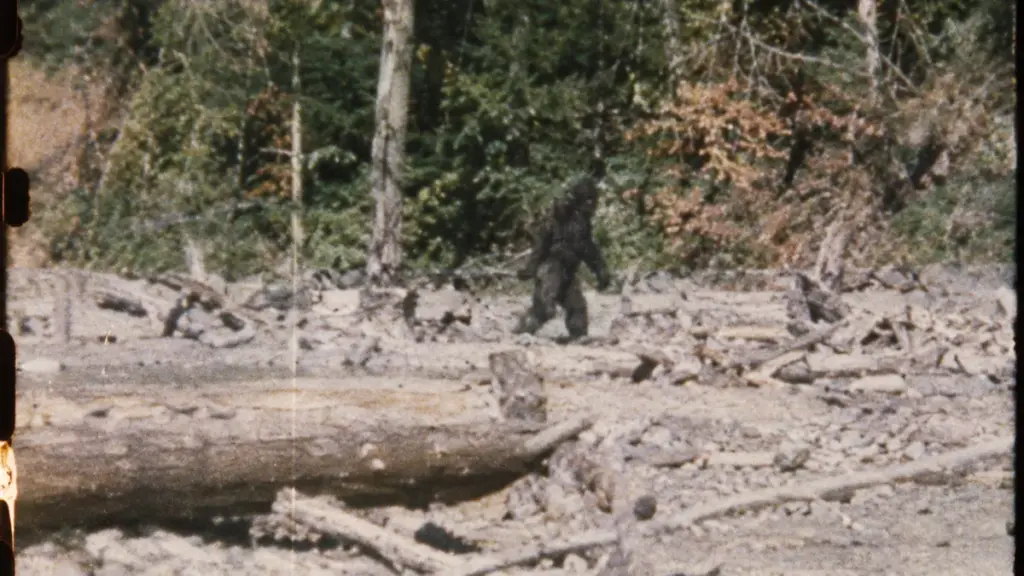
RECONSTRUCTION: Ravenwood reconstruction based on the circumstances surrounding the October 20, 1967 Patterson–Gimlin film at Bluff Creek, Northern California. The image should depict a distant, dark, humanlike figure crossing an open creek bed toward heavy forest, partially obscured by motion, distance, and vegetation. This image is an Archive reconstruction and is not a frame from the original Patterson–Gimlin film.
CLASSIFICATION: Alleged Unknown Primate / Historical Film Evidence / Possible Hoax
STATUS: Historical — Contested
DATE: October 20, 1967
PRIMARY LOCATION: Bluff Creek, Northern California
PRIMARY WITNESSES: Roger Patterson and Bob Gimlin
RECORDED MEDIUM: 16mm motion-picture film
FILMED SUBJECT: Large hair-covered bipedal figure
COMMON NAME: “Patty”
ESTIMATED RECORDING LENGTH: Approximately one minute
PHYSICAL SPECIMEN: None recovered
BIOLOGICAL EVIDENCE: None conclusively associated with the filmed subject
KNOWN FATALITIES: 0
AUTHENTICITY: Disputed
CURRENT ACTIVITY: Renewed public scrutiny in 2026
CURRENT RECOMMENDATION: Treat the film as genuine historical footage of an unidentified subject. Do not treat the identity of that subject as established.
DOCUMENTATION NOTE
Most cryptid cases have an evidence problem.
They have witnesses.
Footprints.
Stories.
A noise in the woods.
Perhaps a photograph that becomes considerably less interesting when enlarged.
The Patterson–Gimlin case has the opposite problem.
We have the film.
We have had the film since 1967.
We can watch it.
Slow it down.
Stabilize it.
Enlarge it.
Measure it.
Argue about its gait.
Argue about its shoulders.
Argue about its knees.
Argue about whether those are muscles moving beneath hair or fabric folding over a human body.
Nearly sixty years of improvement in image analysis has not produced universal agreement.
Which is impressive.
Not necessarily for Bigfoot.
Certainly for the argument.
CASE SUMMARY
On October 20, 1967, Roger Patterson and Bob Gimlin were traveling on horseback in the Bluff Creek region of Northern California.
The location already had a connection to Bigfoot lore.
Large footprints discovered around Bluff Creek during the previous decade had helped popularize the name Bigfoot nationally.
Patterson was not a random traveler encountering the legend by accident.
He was already deeply interested in the subject.
He had traveled to the region specifically looking for evidence.
Then, according to Patterson and Gimlin, they found it.
A large hair-covered figure appeared ahead of them near the creek.
Patterson dismounted.
He retrieved his camera.
And he started filming.
What followed became one of the most recognizable pieces of unexplained footage ever recorded. [1]
THE SUBJECT
The figure walks away from the camera on two legs.
It is covered in dark hair.
Its arms appear long.
Its torso is broad.
At one point, it turns its upper body and looks back toward Patterson.
That turn became the image.
Frame enlargements from the sequence have been reproduced for decades.
The figure has also generally been interpreted as female because what appear to be breasts are visible on the torso.
Researchers eventually gave the subject a nickname.
Patty.
This was considerably friendlier than:
Unidentified Large Biped Recorded Near Bluff Creek.
Marketing was inevitable.
THE FILM
The original footage was captured on 16mm film.
This matters.
The Patterson–Gimlin film predates smartphones.
Digital compositing.
Consumer video editing.
Computer-generated imagery.
And most of the convenient ways modern fraudulent footage can be manufactured.
If the subject is artificial, the basic possibilities are therefore much narrower.
A person.
A costume.
A staged encounter.
Camera technique.
Or some combination of them.
That makes the film unusually useful.
It does not make it authentic.
Old fraud is still fraud.
It simply requires older tools.
THE ENCOUNTER
Patterson’s camera initially shakes heavily.
This is not surprising.
He was moving quickly over uneven terrain while attempting to film an unexpected subject.
As the footage continues, the image becomes more stable.
The figure walks steadily toward the tree line.
It does not sprint.
It does not charge.
It does not appear particularly concerned about the humans behind it.
Then it disappears into the forest.
There is no dramatic ending.
No roar.
No attack.
No final close-up.
The most famous Bigfoot footage in history ends with the alleged Bigfoot doing something exceptionally reasonable.
Leaving.
AFTER THE FILM
Patterson and Gimlin reported finding tracks associated with the figure.
Casts were made.
The film itself soon entered public circulation and attracted enormous attention.
For believers, it was extraordinary.
A large unidentified primate had finally been captured on motion-picture film.
For skeptics, there was an obvious problem.
Patterson had gone into Bigfoot country hoping to make Bigfoot material.
And then he filmed Bigfoot.
This does not prove fraud.
It does provide motive and opportunity.
Both deserve examination.
PATTERSON BEFORE PATTY
Roger Patterson was already interested in Bigfoot before October 1967.
This point is sometimes treated as damaging evidence.
It is certainly relevant.
Patterson did not accidentally photograph something while documenting wildflowers.
He wanted to find Bigfoot.
He pursued stories about Bigfoot.
He created material about Bigfoot.
And he carried a camera into an area associated with Bigfoot reports.
Then:
Bigfoot.
Convenient.
But preparedness and fraud are not the same thing.
A wildlife photographer who spends months searching for a rare animal and eventually photographs one has not become suspicious merely because the camera was ready.
The difficulty here is simpler.
If Patterson staged the film, his prior interest explains why.
If Patterson genuinely encountered something, his prior interest explains why he was there.
The same fact supports both stories.
Unhelpful.
THE WALK
Much of the modern argument revolves around movement.
The subject walks with a distinctive gait.
Its arms swing.
Its shoulders rotate.
Its knees remain noticeably flexed.
Its stride appears heavy and deliberate.
Supporters have argued that the movement does not resemble an ordinary human wearing a costume.
Some analyses have claimed unusual limb proportions or body mechanics.
Skeptics disagree.
Primatologist John Napier, who examined the film, considered the walking pattern compatible with a human deliberately exaggerating his stride.
Napier reportedly found elements of the upper body ape-like while regarding the lower-body movement as distinctly human. [2]
That is a considerable problem if the subject is an undocumented primate.
It is less concerning if the subject is a man attempting to look like one.
THE MUSCLE ARGUMENT
Supporters of the film frequently point to apparent movement beneath the hair.
Thigh.
Calf.
Shoulder.
Back.
They argue that the surface changes visible during movement resemble muscles operating beneath skin rather than fabric hanging from a costume.
If correct, this would matter considerably.
A convincing full-body creature suit in 1967 capable of reproducing natural underlying anatomy would have been a sophisticated piece of work.
But interpreting small movements in grainy moving film is dangerous.
Image enhancement does not create information that was never recorded.
Contrast can become anatomy.
Shadow can become muscle.
Compression and enlargement can transform ambiguous movement into whatever the viewer expects to find.
Believers see flesh.
Skeptics see fabric.
The film provides enough detail to continue the argument.
Not enough to finish it.
THE HEAD
The head is equally difficult.
There appears to be little visible separation between the head and shoulders.
The skull seems low or sloped compared with an ordinary human profile.
Supporters argue that fitting a human head inside those apparent dimensions would be difficult.
Skeptics argue that costume construction, posture, hair, and image quality make precise anatomical measurements unreliable.
Both positions suffer from the same problem.
We do not know the subject’s exact dimensions.
We do not know exactly how much apparent anatomy is body.
Hair.
Costume.
Shadow.
Perspective.
Or motion blur.
A measurement is only as reliable as the boundaries being measured.
Patty has inconvenient boundaries.
THE BREASTS
One of the stranger details is also one of the strongest arguments made by supporters.
The figure appears female.
If Patterson intended to fake a generic monster film, adding visible breasts to the costume would have been an oddly specific complication.
A male gorilla costume would have been easier.
Supporters argue that this detail suggests observation rather than invention.
The counterargument is obvious.
An unusual detail can also make a hoax more convincing.
If someone wished to create a creature that did not resemble a commercially available gorilla suit, deliberately changing the anatomy would help.
Unexpected details are interesting.
They are not certificates of authenticity.
THE COSTUME PROBLEM
If Patty is human, there was almost certainly some form of costume.
The question then becomes:
What costume?
Skeptics have repeatedly argued that nothing visible in the footage exceeds the special-effects capabilities of the period.
Supporters disagree and point particularly to body proportions and apparent muscle movement.
No surviving costume has been conclusively established as the one seen in the film.
This absence is frequently used in favor of authenticity.
It should not be.
A hoaxer is under no obligation to preserve evidence.
Particularly evidence shaped like Bigfoot.
BOB HEIRONIMUS
Decades after the film was recorded, Bob Heironimus, an acquaintance of Patterson, publicly claimed that he had been the figure inside the suit.
If true:
Case closed.
Unfortunately, confessions are evidence.
Not magic.
Heironimus’s claim has been challenged by supporters of the film, particularly over details of the alleged costume and whether his body adequately matches the filmed figure.
A costume maker, Philip Morris, separately claimed that he had sold Patterson a gorilla costume of the general type that could have been modified for the filming. [2]
Those claims provide a coherent hoax scenario.
Patterson acquires or modifies a costume.
Heironimus wears it.
The encounter is staged.
The footage is released as genuine.
Simple.
But coherence is not proof.
No contemporaneous document currently establishes Heironimus as the filmed subject beyond reasonable dispute.
No identified surviving suit settles the question.
No single piece of evidence closes the loop.
The confession considerably weakens the extraordinary interpretation.
It does not physically climb into the film and remove Patty.
THE BLUFF CREEK PROBLEM
Bluff Creek itself deserves attention.
The region was already associated with famous footprint reports.
The word Bigfoot had become nationally known after large tracks were reported in the area in 1958.
Some of those earlier tracks were later tied to admitted hoax activity.
That does not automatically implicate Patterson.
It does mean he went looking for a creature in an area where Bigfoot mythology and Bigfoot hoaxes had already become entangled. [1]
Bluff Creek was excellent Bigfoot country.
For believers.
For filmmakers.
And for anyone interested in making Bigfoot continue to be Bigfoot.
WHAT SCIENCE WOULD REQUIRE
The film is visually compelling.
Biologically, it is almost useless by itself.
A genuinely unknown North American primate should produce more than imagery.
Hair.
Feces.
Tissue.
Bones.
Teeth.
DNA.
Carcasses.
Repeated populations.
Ecological effects.
Reliable modern recordings.
A breeding population of very large mammals cannot normally survive through one exceptional piece of 1967 film.
There must be others.
Not stories.
Animals.
This remains Bigfoot’s larger problem.
Patty may be difficult to explain from one minute of film.
A continental population is considerably more difficult to hide for generations.
WHAT THE FILM ACTUALLY PROVES
Something was filmed.
This is occasionally forgotten.
The Patterson–Gimlin film is not a fabricated modern digital clip.
There was a physical subject in front of Patterson’s camera.
What that subject was remains the question.
The film proves the presence of:
A large bipedal figure.
Covered in something resembling hair.
Moving across Bluff Creek.
On October 20, 1967.
It does not independently prove:
An unknown species.
A surviving hominid.
A North American great ape.
A population of Sasquatch.
Or even that Patterson and Gimlin’s account of the encounter was truthful.
Film records appearance.
Not identity.
THE RECREATION PROBLEM
One argument has survived almost as long as the film.
If it was only a costume:
Why has nobody perfectly reproduced it?
This sounds stronger than it is.
A failed reconstruction does not validate the original.
To reproduce the footage exactly would require matching:
The performer.
The costume.
The camera.
The lens.
The film stock.
The recording speed.
The lighting.
The distance.
The terrain.
The subject’s route.
And dozens of smaller variables.
Failing to reproduce Patty proves only that the recreation failed.
It does not transform Patty into an undocumented primate.
There is another problem.
A perfect recreation would not prove the original was fake either.
It would establish possibility.
Not history.
Experiments are useful.
Time machines would be better.
Ravenwood currently has neither.
FRAME 352
One frame became more famous than the rest.
The figure has turned toward Patterson.
One leg is forward.
The face is visible in profile.
The body is unmistakably humanoid.
Even people who have never watched the complete film have probably seen some version of this image.
It has become visual shorthand for Bigfoot itself.
This creates a problem for investigation.
We no longer look at Frame 352 without context.
We know what it is supposed to show.
Bigfoot.
That expectation arrives before the image does.
The original question is harder.
If this film had been discovered without a story attached, what would we conclude was walking through the frame?
That experiment can no longer be performed.
The silhouette has already won.
2026 — THE CASE REOPENS
Nearly fifty-nine years after the original filming, the Patterson–Gimlin case returned to significant public attention.
A documentary directed by Marq Evans, titled Capturing Bigfoot, premiered at the 2026 South by Southwest Film & TV Festival.
The documentary centers on Patterson, Gimlin, the history surrounding the footage, and previously unseen 16mm material discovered decades later.
Its promotional material claims the newly surfaced footage significantly changes the understanding of the Patterson–Gimlin story. [3]
The film is scheduled for wider release on October 20, 2026.
Exactly fifty-nine years after Patterson filmed Patty.
Ravenwood’s position is uncomplicated.
We have not changed the classification of the 1967 film based on promotional claims surrounding an unreleased documentary.
New evidence should be examined when that evidence becomes publicly inspectable.
Not before.
Trailers are designed to produce questions.
Conveniently, we already had several.
THE NEW FOOTAGE
Reports surrounding Capturing Bigfoot describe a separate reel of 16mm material found decades after the original event.
The documentary presents that material as relevant to whether the Patterson–Gimlin encounter was staged.
That may prove important.
Or it may prove important primarily to the documentary.
Until the material itself can be examined with adequate provenance, dating information, context, and access to competing interpretations, Ravenwood records it as:
NEWLY REPORTED EVIDENCE — PENDING PUBLIC REVIEW
No more.
No less.
A sixty-year-old mystery can survive another month without our help.
WHAT WE DO NOT HAVE
No body.
No skeleton.
No verified tissue sample from Patty.
No verified hair sample establishing an unknown primate.
No DNA.
No identified biological population.
No confirmed second film of the same individual.
No surviving object conclusively established as the alleged costume.
No contemporaneous confession conclusively establishing a hoax.
No scientific consensus identifying Patty as an unknown animal.
And no evidence requiring Bigfoot as the explanation.
WHAT WE DO HAVE
A genuine 1967 film.
Roger Patterson.
Bob Gimlin.
A physical subject recorded at Bluff Creek.
A large hair-covered bipedal appearance.
Reported footprints.
Decades of anatomical and photographic analysis.
A named individual who later claimed to have worn a costume.
A costume-maker claim supporting a possible hoax scenario.
Researchers who continue to argue that aspects of the figure are difficult to reproduce using a human performer.
And almost sixty years of disagreement.
That last item is not evidence for Bigfoot.
It may be evidence that Patterson captured exactly the right amount of detail.
Enough to see something.
Not enough to know what.
THE MOST LIKELY RECONSTRUCTION
Ravenwood currently considers a staged human performance the most economical explanation.
Roger Patterson had prior interest in Bigfoot.
He was actively attempting to produce Bigfoot-related material.
A human performer in a modified costume requires no unknown species.
Later testimony has identified a possible performer.
Later testimony has identified a possible source for a costume.
Several scientific and skeptical examinations have found the figure compatible with human movement.
Nothing in the footage has demonstrated the existence of an unknown primate population.
That makes the hoax hypothesis strong.
It does not make every element of the proposed hoax established fact.
The identity of the performer remains disputed.
The exact costume remains disputed.
The construction remains disputed.
The circumstances remain disputed.
The film exists.
The explanation remains one step behind it.
ARCHIVIST’S NOTES
There is a temptation with old mysteries to become annoyed when they refuse to die.
I understand it.
We have watched the film.
Thousands of people have watched the film.
People with better knowledge of primates than I have watched it.
People with better knowledge of costumes than I have watched it.
People with considerably worse knowledge of both have also watched it.
Frequently at greater volume.
Still:
Patty walks.
Turns.
Looks toward the camera.
Walks away.
That’s it.
There are no impossible movements.
No glowing eyes.
No disappearance.
No enormous leap into the trees.
The subject does almost nothing.
Perhaps that is why the footage works.
A man trying to perform a monster usually performs a monster.
Patty does not.
She walks away.
If this was staged, restraint may have been Patterson’s best special effect.
There is also something almost irritating about the image quality.
Move Patterson twenty feet closer.
Give him another ten seconds.
Let the figure turn completely around.
One clear face.
One visible seam.
One anatomical feature that cannot belong to a human.
Anything.
Instead, we received exactly enough.
Bigfoot research would become easier if Bigfoot occasionally cooperated with photography.
It has declined to do so.
For nearly sixty years, Patty has remained the exception.
Or the reason.
CURRENT RECOMMENDATION
The Patterson–Gimlin film should be preserved as a historically significant piece of cryptid evidence without presenting the filmed subject as an identified Sasquatch.
When discussing the film:
Separate the existence of the footage from claims about what it depicts.
Do not treat image enhancement as newly recovered detail.
Do not present estimated body measurements as exact.
Do not treat later confessions as proven solely because they provide a convenient solution.
Do not dismiss conventional explanations solely because no surviving costume has been produced.
Do not treat an unreproduced effect as proof of biological authenticity.
And do not describe the 2026 documentary’s conclusions as established before its underlying evidence can be independently examined.
The correct question remains the oldest one.
Not:
Is the film real?
It is.
The question is:
What did Roger Patterson film?
CASE STATUS
CLOSED — UNRESOLVED
The Patterson–Gimlin film remains one of the most important and controversial artifacts in the history of Bigfoot research.
Roger Patterson and Bob Gimlin recorded a large hair-covered bipedal figure at Bluff Creek, California on October 20, 1967.
The footage itself is genuine physical film.
The identity of the subject is not established.
A deliberate hoax involving a human performer and costume provides a strong conventional explanation and is supported by later claims from individuals who said they participated in or facilitated such a production.
Those claims remain disputed.
No biological evidence has established that the figure represents an unknown primate species.
No subsequent discovery has demonstrated the existence of a population corresponding to the creature shown in the footage.
New material associated with the 2026 documentary Capturing Bigfoot may provide additional evidence concerning the film’s origin.
Until that material can be independently examined, its significance remains undetermined.
The footage survives.
The species does not.
At least not yet.
FILE REMAINS OPEN
RESEARCH SOURCES
[1] Smithsonian Magazine — “Why Do So Many People Still Want to Believe in Bigfoot?”
Used for the broader history of Bigfoot reports, Bluff Creek’s importance to the modern legend, the disputed history of earlier footprint evidence in the region, and the Patterson–Gimlin film’s status as the most famous and contested piece of Bigfoot evidence.
Source Type: Smithsonian historical / cultural reference.
[2] Skeptical Inquirer — “Bigfoot as Big Myth: Seven Phases of Mythmaking”
Used for skeptical analysis of the Patterson–Gimlin film, primatologist John Napier’s assessment of the subject’s movement, and the later claims of Bob Heironimus and costume maker Philip Morris.
Source Type: Investigative / skeptical analysis.
Ravenwood records the Heironimus and Morris accounts as claims supporting a hoax hypothesis rather than treating either account as independently proven fact.
[3] South by Southwest Film & TV Festival — Capturing Bigfoot (2026)
Used for documentation of the 2026 documentary’s SXSW premiere, its participants, and its description of newly surfaced 16mm material connected to the Patterson–Gimlin story.
Source Type: Official festival / contemporary documentary record.
Ravenwood does not treat promotional descriptions of the newly discovered material as established proof of a hoax pending broader public access and independent examination.