
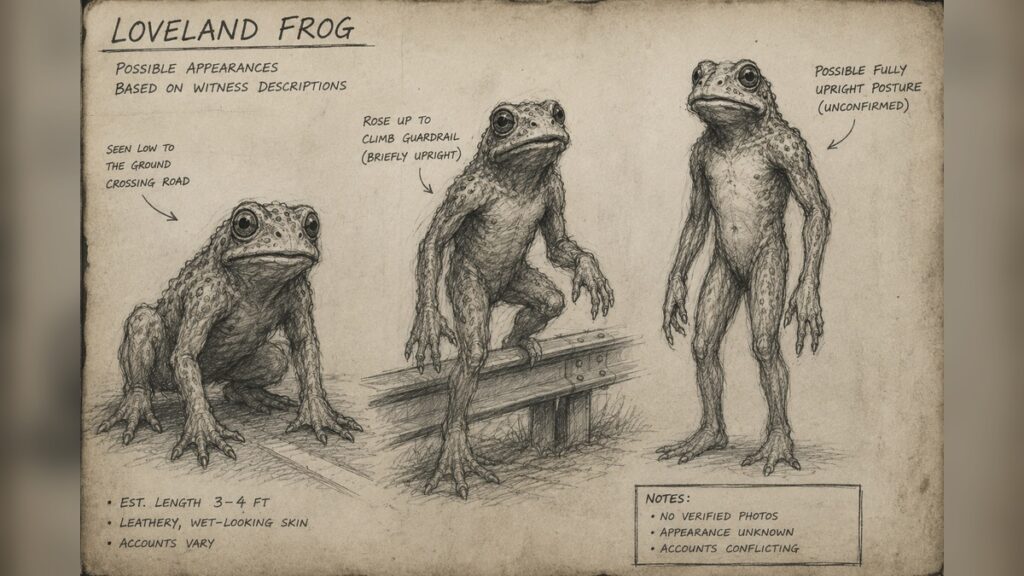
RECONSTRUCTION: Ravenwood reconstruction of the alleged Loveland Frog based on the broad characteristics preserved in historical retellings: small stature, crouched posture, leathery or amphibian-like appearance, and occasional upright movement. No verified photograph establishes the creature’s appearance. This image is an Archive reconstruction and is not photographic evidence.
CLASSIFICATION: Cryptid / Regional Folklore / Misidentified Animal Candidate
STATUS: Historical — Disputed
FIRST REPORTED: 1955
PRIMARY LOCATION: Loveland, Ohio
ASSOCIATED WATERWAY: Little Miami River
BEST-DOCUMENTED ACTIVITY: March 1972
COMMON DESCRIPTION: Three- to four-foot frog- or lizard-like figure capable of briefly standing upright
PHYSICAL EVIDENCE: None verified
CONFIRMED FATALITIES ATTRIBUTABLE TO PHENOMENON: 0
KNOWN SPECIMEN: None
CURRENT ACTIVITY: Unconfirmed
CURRENT RECOMMENDATION: Treat the Loveland Frog as regional folklore with at least one strong known-animal explanation. Do not treat later artistic depictions as evidence of what witnesses actually saw.
DOCUMENTATION NOTE
The Loveland Frog has a problem.
There are really several Loveland Frogs.
One lives in the 1955 story.
Another crossed a road in front of a police officer in 1972.
Another was reportedly shot.
Another became a city mascot.
They are often presented as if they describe one continuous animal.
The record does not justify that confidence.
The oldest story changes considerably depending on who is telling it.
The 1972 accounts are better defined.
One of those accounts also comes with an inconvenient detail.
The animal was reportedly recovered.
And one of the officers involved later said it was an iguana.
That does not make the legend disappear.
It does change the investigation.
CASE SUMMARY
The Loveland Frog, also called the Loveland Frogman or Loveland Lizard, is a legendary humanoid creature associated with Loveland, Ohio and the Little Miami River.
The City of Loveland itself recognizes the Frogman as part of local folklore and traces the legend to 1955. [1]
Modern depictions usually show a roughly human-shaped amphibian:
Three to four feet tall.
Frog-like head.
Leathery or wet-looking skin.
Long limbs.
Occasionally webbed hands or feet.
Often standing upright.
The historical reports are less consistent.
That distinction matters.
The familiar green frog-person seen in modern artwork is an interpretation assembled after decades of retelling.
It should not be mistaken for a witness photograph.
There isn’t one.
THE 1955 STORY
The first commonly repeated Loveland Frog account is dated to 1955. [1][2]
Beyond that, certainty decreases quickly.
Most versions describe a businessman or traveling salesman driving near Loveland late at night.
He reportedly encounters several unusual figures near a road, river, or bridge.
Some versions describe three creatures.
Some place them beside the road.
Others beneath or near a bridge.
The figures are usually said to have stood approximately three to four feet tall and to possess leathery skin and frog-like faces. [2]
Then the story becomes stranger.
Some retellings claim one of the figures raised an object resembling a rod or wand.
Sparks supposedly followed.
Ravenwood does not consider that detail reliable enough to form part of the creature’s classification.
The problem is not that it sounds ridiculous.
Ridiculous things are still capable of occurring.
The problem is that the 1955 story has no stable surviving account from which the increasingly specific versions can be reconstructed with confidence.
Witness identity varies.
Location varies.
Exact circumstances vary.
The number of creatures varies.
Even the most memorable detail varies.
That is folklore behaving normally.
It is evidence behaving badly.
THREE FROGS
The number three appears often enough in retellings of the 1955 story that it has become part of the legend.
Three upright figures.
Three frog-like heads.
Three small bodies gathered beside the road.
If accurate, that would matter considerably.
One unusual animal may be an escaped pet.
Three similar animals in the same place imply something else.
Unfortunately, Ravenwood cannot establish the number independently.
The same source problem affects almost every detail of the early report.
There is no verified photograph.
No physical trace.
No contemporaneous specimen.
No preserved measurement.
No reliable anatomical drawing produced under controlled conditions.
Just a story that became increasingly visual over time.
The Archive therefore records:
NUMBER OF ENTITIES — UNVERIFIED
There may have been three.
There may have been fewer.
There may have been none.
MARCH 3, 1972
Seventeen years later, the Loveland Frog story acquired a better witness.
At approximately 1:00 a.m. on March 3, 1972, Loveland police officer Ray Shockey was driving along Riverside Drive near the Little Miami River and the former Totes boot factory. [2]
An animal crossed the road in front of his vehicle.
This time, there were headlights.
Shockey reportedly described the animal as approximately three to four feet long, weighing perhaps fifty to seventy-five pounds, with leathery-looking skin. [2]
The animal initially appeared low to the ground.
Crouched.
Frog-like.
Then it apparently rose enough to negotiate the roadside guardrail before descending toward the river. [2]
That movement is what turned an unusual animal sighting into a Frogman sighting.
A large animal running across a road is ordinary.
A large animal standing up is considerably less helpful.
THE HEADLIGHTS
The 1972 encounter occurred at night.
That should remain near the top of the file.
Headlights provide strong illumination.
They do not provide good context.
An animal entering the beam suddenly may be visible in considerable detail while everything around it remains comparatively dark.
Distance becomes difficult to judge.
Movement is brief.
The observer is also operating a vehicle.
If the animal changes posture while climbing an obstacle, a quadruped can appear remarkably upright for a moment.
None of that proves Shockey saw an iguana.
It establishes the conditions under which an unfamiliar animal could be interpreted incorrectly.
There is also another reason to take the mundane explanation seriously.
Someone else saw one.
THE SECOND OFFICER
Approximately two weeks after Shockey’s encounter, fellow Loveland police officer Mark Matthews reported seeing an animal in the same general area. [2]
The animal was again found near the road.
Matthews approached it.
He shot it.
And unlike nearly every cryptid story in which someone claims to have killed the creature—
he reportedly recovered the body.
This should have ended the case.
It almost did.
According to Matthews, the animal was a large iguana, approximately three to three-and-a-half feet long.
Its tail was missing. [2]
That last detail is more important than it sounds.
Remove an iguana’s long tail and its silhouette changes dramatically.
The body becomes compact.
Heavy.
Low.
The legs become more visually dominant.
Seen suddenly at night, a tailless iguana would look considerably less like the animal most people expect to see in Ohio.
It might even look—
briefly—
like something else.
THE BODY
Cryptid cases rarely provide this opportunity.
A body.
Not hair.
Not a footprint.
Not something allegedly removed by unnamed authorities.
An animal.
According to Matthews, he showed the dead iguana to Shockey.
Matthews later maintained that Shockey recognized it as the same kind of animal he had encountered earlier that month. [2]
If that recollection is accurate, it provides the strongest explanation in the entire case.
The March 1972 Frogman may have been an escaped or abandoned exotic pet.
Possibly more than one.
Or one animal encountered twice.
An iguana outside in an Ohio March would already be having a very bad evening.
There was no need to improve it.
THE MISSING TAIL
The missing tail deserves its own entry.
Iguanas are recognizable largely because of their proportions.
Long body.
Longer tail.
Remove the tail and the animal stops matching the mental picture most observers carry.
The resulting silhouette is front-heavy.
The hind legs appear larger.
The body looks shorter.
When climbing, an iguana can raise the front of its body significantly above the ground.
In poor lighting, those features can exaggerate the impression of something crouching and then standing.
This does not reconstruct exactly what Shockey saw.
There is no photograph of the first encounter.
But the second animal provides something rare in cryptid investigation:
A candidate species.
A candidate mechanism.
And a witness directly involved in the original events who supported the mundane explanation.
That deserves more weight than later artwork.
THE FROG FACE
There is still a problem.
Why a frog?
An iguana does not have a frog’s face.
Not really.
But eyewitness description does not work by taxonomic precision.
Someone encountering an unfamiliar reptile does not necessarily think:
Iguanidae.
They think:
Lizard.
Frog.
Reptile.
Something wet-looking.
Something strange.
Something with large eyes.
Something I cannot immediately identify.
Then the story acquires a name.
Once Frogman enters circulation, later descriptions have somewhere to go.
Round the eyes.
Flatten the snout.
Add webbing.
Make the skin green.
Stand it completely upright.
Eventually the creature becomes much more frog-like than the earliest evidence requires.
The legend improves its own anatomy.
THE SCRATCH MARKS
Some retellings describe marks supposedly found near the guardrail following Shockey’s encounter.
Ravenwood has not located sufficiently documented photographic or physical evidence to treat those marks as verified evidence of an unknown creature.
This is worth stating plainly.
A scratch is useful only if it can be shown to have been created by the thing being investigated.
Roadside metal acquires scratches.
Animals climb.
Vehicles strike barriers.
People damage things.
Without documentation connecting the marks directly to the event, they remain:
UNVERIFIED ASSOCIATED DETAIL
Not evidence of a Frogman.
THE RIVER
The Little Miami River is central to the legend.
The City of Loveland continues to associate the Frogman with the river in its modern presentation of the story. [1]
That association makes intuitive sense.
A frog creature belongs near water.
Once again, however, narrative logic is not evidence.
Iguanas are not native to Ohio.
A loose exotic animal could still seek shelter near vegetation or waterways.
Ordinary amphibians and other wildlife are also common around river environments.
A dark road near water therefore provides plenty of potential animals.
Most are considerably smaller than a Frogman.
One known candidate was not.
2016
The legend resurfaced publicly in 2016 after another alleged sighting near the Loveland area.
A couple reportedly claimed to have seen a frog-like figure while playing Pokémon GO near the water. [2]
Photographic or video material associated with the claim did not establish the existence of an unknown animal.
The more important development came afterward.
Mark Matthews returned to the story.
He reiterated that the animal involved in his 1972 encounter was a large lizard rather than a cryptid. [2]
That is a difficult detail for the monster hypothesis.
It should be.
An investigation is not improved by protecting its preferred answer.
THE HOAX QUESTION
Calling the entire Loveland Frog legend a hoax is probably too simple.
There is a difference between:
Inventing an encounter.
Misidentifying an animal.
Embellishing a real event.
Repeating an embellished event.
And inheriting a local legend decades later.
Those possibilities can all exist in the same case.
Shockey may have honestly seen an animal he could not identify.
Matthews may have honestly encountered an iguana.
The 1955 story may contain a real encounter under several layers of later retelling.
Or it may not.
The evidence does not require everyone involved to have lied.
It only requires stories to become cleaner over time.
They usually do.
FROM CRYPTID TO MASCOT
Whatever happened beside the river, the Loveland Frog succeeded at something.
It stayed.
The City of Loveland now openly embraces the Frogman as part of its local identity and uses the character as a city mascot. [1]
The city has also organized a Return of the Frogman celebration tied to leap years.
The legend has therefore completed a familiar transformation.
Possible animal.
Local story.
Cryptid.
Cultural symbol.
That does not weaken the folklore.
If anything, it guarantees its survival.
In 2026, legislation was even introduced in the Ohio House of Representatives proposing that the Loveland Frog become the state’s official cryptid. [3]
As of this file’s preparation, that proposal should not be mistaken for evidence about what crossed Riverside Drive.
Legislatures are equipped for many things.
Cryptid identification remains experimental.
THE 1955 PROBLEM
The iguana explanation works surprisingly well for 1972.
It does considerably less for 1955.
Not because the first story is stronger.
Because it is weaker.
There is too little stable information to explain confidently.
If three upright frog-faced beings really stood near the river together, one tailless iguana does not account for them.
But first we would need to establish that there were three.
Then that they were upright.
Then that they had frog-like faces.
Then where exactly the event occurred.
Then what the original witness actually said before decades of repetition changed the account.
We cannot.
An unexplained story is not the same as an unexplained creature.
That distinction closes many unnecessary cages.
BIOLOGICAL PROBLEM
If the Loveland Frog represents an unknown species, the biology becomes difficult quickly.
A breeding population should exist.
Individuals should die.
Bodies should appear.
Bones should remain.
Animals should be struck by vehicles.
Tracks should recur.
Environmental DNA should be recoverable.
More sightings should occur around the river.
A roughly four-foot bipedal amphibian would represent an extraordinary biological discovery.
Extraordinary animals are not impossible.
They are physical.
Physical things leave evidence.
The Loveland Frog has mostly left stories.
One known body was apparently a lizard.
That ratio is not encouraging.
WHAT WE DO NOT HAVE
No verified Frogman body.
No skeletal remains.
No tissue sample belonging to an unknown amphibian.
No DNA.
No authenticated trackway.
No verified photograph from 1955 or 1972.
No stable primary record for the famous three-creature account.
No evidence that a sparkling wand existed outside later versions of the story.
No documented breeding population.
No confirmed attack.
No unexplained fatality.
And no reason to ignore the large tailless iguana identified by one of the police officers involved in the 1972 events. [2]
WHAT WE DO HAVE
A long-running Ohio legend recognized by the City of Loveland itself. [1]
A folklore tradition dating at least to accounts attributed to 1955. [1][2]
A 1972 report from police officer Ray Shockey involving an unusual animal near the Little Miami River. [2]
A second officer’s encounter in the same general period. [2]
A recovered animal identified by that officer as a large tailless iguana. [2]
A later revival of the legend.
And a community that has decided the Frogman can stay regardless of whether he ever existed.
That may ultimately be the safest arrangement.
ARCHIVIST’S NOTES
This case improves considerably when the frog is removed.
That sounds unhelpful.
It isn’t.
Start with the creature people draw today and the case is ridiculous.
A four-foot amphibian man lives beside an Ohio river.
Fine.
We have questions.
Start instead with the 1972 event.
A police officer sees an unfamiliar animal at one in the morning.
It is low to the ground.
It crosses the road.
It changes posture while climbing a guardrail.
He cannot identify it.
Two weeks later another officer finds a large, tailless exotic lizard in approximately the same area.
That is no longer ridiculous.
It is almost disappointingly reasonable.
Almost.
The 1955 story is what prevents me from closing the entire file as explained.
Not because it is good evidence.
Quite the opposite.
It is too unstable to do much with.
Three creatures become one problem.
Then there is a bridge.
Then there isn’t.
Then somebody gives one of them a wand.
There were other options.
Once the wand arrives, I become considerably less interested in reconstructing anatomy.
The responsible answer is that we do not know what happened in 1955.
The irresponsible answer is to combine every later version into one detailed eyewitness statement and then draw the creature from that.
Ravenwood will not do that.
The iguana matters.
Matthews matters.
His explanation should be printed as prominently as the monster.
If the animal he recovered really was recognized by Shockey as what he had seen, then the best-documented Frogman encounter has a very ordinary suspect.
Well.
Ordinary by Ohio standards.
A large tailless iguana running loose beside the river in March is still unusual.
It simply does not require a new branch of vertebrate evolution.
The legend survives anyway.
I like that.
Loveland appears to like it too.
There is something healthy about a town deciding that a questionable cryptid is still worth keeping around.
Believe the creature.
Don’t believe the creature.
Buy the frog shirt.
The river continues either way.
CURRENT RECOMMENDATION
The Loveland Frog should presently be treated as regional cryptid folklore with a strong misidentified-animal explanation for the 1972 reports.
Future alleged sightings should be documented independently before comparison with the historic legend.
Record:
Exact location.
Date and time.
Distance.
Lighting conditions.
Estimated size.
Whether the animal was measured against a known object.
Whether it moved on two limbs or merely raised its front body while climbing.
Presence or absence of a tail.
Skin texture.
Head shape.
Nearby exotic pets or escaped animals.
Original photographs or video.
And whether the witness already knew the Loveland Frog legend.
Do not pursue wildlife near the river.
Do not handle unidentified reptiles.
Do not assume that an animal standing briefly on its hind limbs is necessarily a humanoid.
Most importantly:
Photograph the tail.
This file has already lost one.
CASE STATUS
ARCHIVED — INSUFFICIENT EVIDENCE
The Loveland Frog remains a documented regional legend associated with Loveland, Ohio and the Little Miami River.
The 1972 reports involved genuine claims of an unusual animal, but a second officer later identified the animal he encountered as a large tailless iguana and stated that the first officer recognized it as the same type of animal. [2]
That explanation substantially weakens the case for an unknown amphibious humanoid.
The older 1955 account remains too inconsistent and poorly documented to reconstruct reliably.
No verified physical evidence establishes the existence of an unknown Frogman species.
The creature remains unverified.
The legend has done considerably better.
FILE REMAINS OPEN
RESEARCH SOURCES
[1] City of Loveland, Ohio — “City Mascot: About the Loveland Frogman”
Used to establish the city’s official recognition of the Loveland Frogman as local folklore, its association with the Little Miami River, and the city’s identification of the legend as dating to 1955.
Source Type: Official municipal source.
[2] Wikipedia — “Loveland frog”
Used for the broad history of the 1955 legend, the March 1972 Ray Shockey and Mark Matthews accounts, the large tailless iguana explanation, and the 2016 revival of the story.
Source Type: Freely licensed reference source — Creative Commons Attribution-ShareAlike 4.0.
No source wording has been reproduced. Historical facts were independently summarized into Ravenwood Archive prose.
[3] Ohio General Assembly — House Bill 821, 136th General Assembly
Used only for the modern cultural record: the 2026 proposal to designate the Loveland Frog as Ohio’s official state cryptid and the legislature’s recognition of the legend’s connection to Loveland and the Little Miami River.
Source Type: Official legislative record.
The proposal is cited as a cultural development, not as evidence that the reported creature exists.