
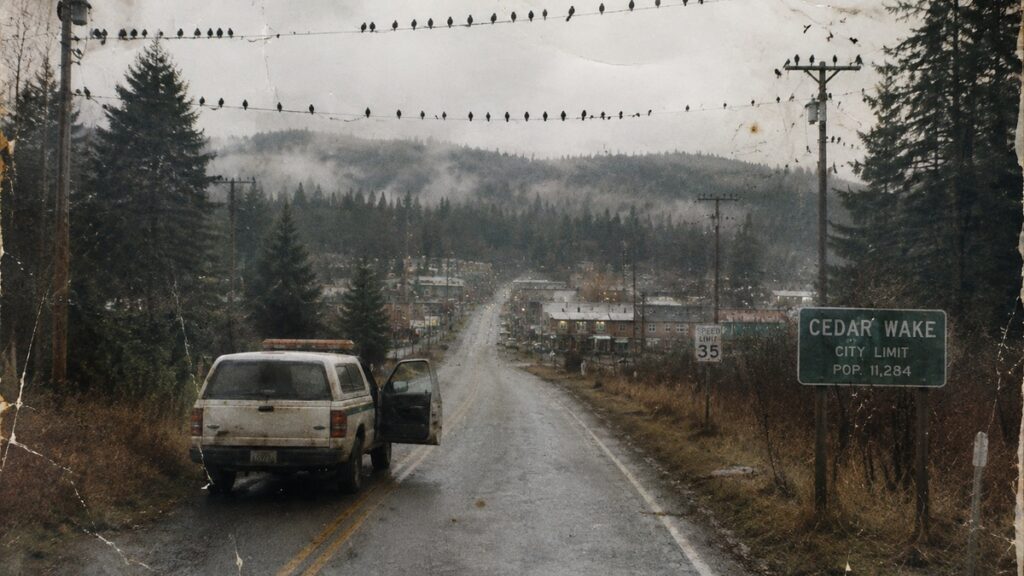
RECONSTRUCTION: Western approach to Cedar Wake, California, November 8, 1994. Edward’s Alder County Wildlife Services vehicle was positioned approximately two miles west of town while thousands of ravens occupied the roadway, utility lines, trees, and surrounding ground. This image is an Archive reconstruction based on Edward’s surviving notes and is not photographic evidence.
CLASSIFICATION: Unexplained Incident / Mass Anomalous Event
STATUS: Active
THREAT LEVEL: Critical
FIRST RECORDED: October 4, 1994
LOCATION: Cedar Wake, Alder County, California
POPULATION AT TIME OF EVENT: 11,284
KNOWN FATALITIES: Unknown
KNOWN SURVIVORS OF FINAL EVENT: 1
PRIMARY WITNESS: Edward
CURRENT LOCATION STATUS: No recognized settlement exists at the recorded coordinates.
CURRENT RECOMMENDATION: Do not enter the former Cedar Wake area following unusual mass raven activity. If ravens establish an apparent stationary perimeter, do not cross it.
CASE SUMMARY
Cedar Wake was a community in Alder County, California.
On November 8, 1994, it ceased to exist.
The disappearance was preceded by approximately five weeks of increasingly unusual raven activity and several apparently unrelated incidents involving spatial distortion, apparent human duplication, and an unidentified biological entity.
Edward experienced part of that escalation firsthand.
At the time, he worked for Alder County Wildlife Services.
The ravens were his responsibility before anything else was.
Residents complained about unusual gatherings.
The sheriff’s department requested his assistance.
Edward counted birds, inspected locations, examined feathers and carcasses, and repeatedly found the same frustrating result.
The ravens appeared normal.
Healthy.
Uninjured.
No disease.
No aggression beyond ordinary defensive behavior.
No identifiable reason for their gatherings.
Then the other incidents began.
Edward was present during the Daniel Mercer incident.
He examined the birds surrounding Michael Dyer’s home hours before a second Michael appeared at the door.
He observed the raven concentration along Mill Creek Road less than an hour before Nathan Cole reported something running beside his vehicle.
He spoke with witnesses.
He spoke with Johnny Hale.
He heard details that never entered ordinary wildlife reports.
By late October, Edward no longer believed the events around Cedar Wake were coincidences.
He also did not believe the available evidence proved the ravens were responsible.
On November 8, thousands of ravens formed an irregular perimeter around the town.
At approximately 5:47 p.m., Cedar Wake lost electrical power.
Emergency calls and sheriff’s radio traffic continued intermittently for another nineteen minutes.
Edward listened from his truck outside the western boundary.
Residents reported strangers standing in their yards.
Roads leading somewhere else.
Deceased relatives returning home.
People disappearing in darkness.
Something moving behind downtown buildings.
Something knocking beneath the town.
At 6:05 p.m., Deputy Johnny Hale told Edward not to return.
At 6:06 p.m., Cedar Wake disappeared.
There was no explosion.
No flash.
No sound.
Where the town had been, Edward saw mature forest.
No official investigation followed.
Edward did not report that a town had vanished.
Within days, he began discovering that such a report would have been almost impossible to make.
Cedar Wake was disappearing from records.
Then from photographs.
Then from memory.
Edward had already begun writing everything down.
At first, because he was afraid he would forget.
Later, because everyone else was beginning to.
THE FIRST GATHERING
DATE: October 4, 1994
PRIMARY PHENOMENON: Abnormal Raven Congregation
OUTCOME: No immediate incident
At approximately 5:30 p.m., residents along Old Quarry Road reported an unusual number of ravens occupying telephone poles, fence posts, rooftops, and nearby trees.
Edward responded.
He counted eighty-three birds.
They appeared healthy.
No unusual aggression was observed.
No obvious food source was located.
There was no nearby carcass.
No recently harvested field.
No exposed refuse.
The gathering itself was unusual but not impossible.
The silence was harder to explain.
Edward remained on site for approximately forty minutes.
During that period, he heard very few vocalizations.
The birds moved normally when approached.
They did not appear lethargic.
They were simply quiet.
Edward also noted that most of the ravens appeared oriented in the same direction.
Southeast.
Toward Cedar Wake.
His field report concluded:
“Unusual communal roosting behavior. No intervention recommended.”
There was nothing unreasonable about the assessment.
Ravens gather.
That would become important later.
At the time, it meant very little.
Three days later, Daniel Mercer was found on Old Quarry Road.
INCIDENT 01 — DANIEL MERCER
DATE: October 7, 1994
PRIMARY PHENOMENON: Perceptual / Spatial Distortion
OUTCOME: Survivor
Daniel Mercer was discovered sitting inside his pickup truck in an unused turnout approximately nine miles outside Cedar Wake.
The engine was running.
Both hands were on the steering wheel.
Deputy Johnny Hale approached the driver’s side.
Daniel lowered the window.
He appeared annoyed.
He asked why Johnny had stopped him.
Johnny explained that he hadn’t.
Daniel replied:
“Then why are you standing in the road?”
There was no road in front of Daniel’s truck beyond the turnout.
There were trees.
Daniel insisted he was stopped at the intersection of Main and Hollis in downtown Cedar Wake.
Johnny asked him to look through the windshield.
Daniel did.
He described traffic.
Storefronts.
Pedestrians.
A pharmacy on the corner.
Johnny was looking at pine trees.
Johnny radioed Edward after noticing ravens gathering in the trees surrounding the turnout.
Edward arrived twelve minutes later.
He counted twenty-six.
Again, the birds were unusually quiet.
Daniel remained inside the vehicle.
Edward approached the passenger side.
Daniel turned toward him normally.
Edward asked whether Daniel knew where he was.
Daniel looked confused by the question.
“Main and Hollis.”
Edward asked whether Daniel could see him.
Daniel replied:
“You’re standing in the crosswalk.”
Edward looked down.
His boots were standing on gravel and pine needles.
He asked Daniel to describe what was behind him.
Daniel correctly identified a grocery store.
A hardware shop.
Then:
Weller Pharmacy.
Weller Pharmacy had closed seven years earlier.
Edward knew the building.
Everyone in Cedar Wake did.
It had been vacant since 1987.
Edward asked Daniel to turn off the engine.
Daniel refused.
“The light’s going to change.”
There was no traffic light.
Johnny eventually opened the driver’s door and physically removed Daniel.
The moment Daniel’s feet touched the ground, he stopped resisting.
He looked through the windshield.
Then around the turnout.
Then began screaming.
Later, Daniel provided an accurate description of downtown Cedar Wake as it had appeared approximately seven years earlier.
Edward was present for part of the interview.
One detail remained unexplained.
Daniel repeatedly stated that a man had been standing inside Weller Pharmacy.
Very tall.
Dark clothing.
Facing the window.
Daniel said the man never moved.
Johnny searched the abandoned pharmacy later that evening.
Nobody was inside.
He did find forty-one black feathers scattered across the floor.
Edward examined several himself.
Raven feathers.
Ordinary raven feathers.
Nothing chemically or physically unusual was identified.
This was the first incident that caused Edward to seriously consider a relationship between the birds and what residents were experiencing.
It would not be the last.
INCIDENT 02 — MICHAEL DYER
DATE: October 15, 1994
PRIMARY PHENOMENON: Apparent Human Duplication
OUTCOME: Survivor
On October 14, seventy-six ravens gathered around the home of Michael Dyer.
Michael called the sheriff’s department.
The sheriff’s department called Edward.
By then, this had become routine.
Edward arrived shortly before sunset.
The birds occupied the roof, telephone line, several nearby trees, and portions of the front lawn.
He examined the gathering for almost an hour.
Again:
Healthy.
Normal plumage.
Normal eyes.
Normal movement.
No signs of poisoning.
No visible disease.
No reason for seventy-six ravens to spend an afternoon surrounding one house.
Edward left at approximately 7:20 p.m.
Johnny remained.
At 3:12 the following morning, Michael’s telephone rang.
He answered.
For several seconds, nobody spoke.
Then Michael heard his own voice.
It said:
“Don’t let me upstairs.”
The call disconnected.
Thirty-one seconds later, someone knocked on the front door.
Johnny Hale was inside the residence with Michael.
Two additional deputies were outside.
Johnny approached the door.
A man was standing on the porch.
Michael Dyer.
Same height.
Same hair.
Same clothing.
Same scar above the left eyebrow.
The actual Michael was standing approximately fifteen feet behind Johnny.
The man outside knocked again.
Michael shouted:
“Who are you?”
The man answered:
“Michael.”
Same voice.
Johnny asked what he wanted.
The second Michael looked past him.
Toward the staircase.
Then said:
“I need to get upstairs.”
Nobody opened the door.
Sensible.
The second Michael remained on the porch for almost three hours.
He occasionally knocked.
He did not threaten anyone.
He never attempted forced entry.
At sunrise, he stepped away from the house and walked down the road.
A patrol vehicle followed.
The deputy maintained visual contact until the man walked behind a parked utility truck.
He did not emerge from the other side.
The deputy stopped immediately.
Nobody was behind the truck.
Johnny called Edward shortly after 7:00 a.m.
Edward initially thought he was joking.
Johnny did not appreciate this.
Edward arrived twenty-three minutes later.
Most of the ravens were gone.
Eleven remained on the roof.
Michael refused to go upstairs while Edward was present.
Before leaving Cedar Wake two weeks later, Michael removed the upstairs bedroom door entirely.
Edward asked him why.
Michael said:
“I don’t know what would’ve happened if he got up there.”
Neither do we.
Michael left Cedar Wake before November 8.
His current whereabouts are unknown.
INCIDENT 03 — MILL CREEK ROAD
DATE: October 23, 1994
PRIMARY PHENOMENON: Unidentified Biological Entity
OUTCOME: Survivor
More than two hundred ravens gathered along Mill Creek Road on the morning of October 23.
This time Edward witnessed the concentration before anything else occurred.
He arrived at 9:32 a.m.
The birds occupied both sides of the road for nearly half a mile.
Trees.
Fence posts.
Telephone lines.
Drainage ditches.
Several stood directly on the pavement.
Edward stopped his truck approximately one hundred yards away.
He took photographs.
He attempted a count.
The number became unreliable after two hundred.
At 10:14 a.m., every raven left.
Not gradually.
Not in groups.
All at once.
The sound of wings was loud enough that Edward stepped back toward his truck.
Within seconds, the road was empty.
Edward wrote the time down.
Forty-eight minutes later, Nathan Cole called emergency services while driving toward Cedar Wake on the same road.
The surviving account begins with Nathan breathing heavily.
The dispatcher asks what is wrong.
Nathan answers:
“Something’s running beside me.”
The dispatcher asks whether he means an animal.
Nathan does not answer.
She asks his speed.
“Fifty-five.”
The dispatcher tells him not to accelerate.
Nathan says:
“It’s not even trying.”
Something strikes the passenger side of the vehicle.
The dispatcher asks Nathan to describe it.
There is a pause.
Then:
“It doesn’t have a front.”
Nathan’s vehicle left the roadway less than one minute later and struck a tree.
He survived.
Edward was contacted because of the raven gathering he had documented earlier that morning.
He saw the vehicle before it was removed.
Five elongated scratches crossed the passenger-side panels.
They were deep enough to expose bare metal.
Nathan described the animal as approximately the size of a horse.
Four limbs.
Pale skin.
No visible fur.
No identifiable head.
The body narrowed where a neck should have begun.
Nathan repeatedly insisted the animal had been running backward while keeping pace with the vehicle.
Investigators initially attributed portions of the description to concussion.
Then biological material was recovered from one of the scratches.
Testing identified skin cells.
No species was identified.
The sample disappeared during transfer to a state laboratory.
Nathan was shown photographs of mountain lions, bears, deer, malformed livestock, and several other animals.
He rejected all of them.
Edward spoke with Nathan once before he was discharged.
He asked whether the animal had been chasing him.
Nathan said no.
Edward asked what it had been doing.
Nathan answered:
“Looking through the window.”
Edward stopped treating the raven gatherings as an ordinary wildlife problem after that.
THE WRONG CONCLUSION
Three significant incidents.
Three different phenomena.
One visible common element.
Ravens.
By late October, Cedar Wake residents had become frightened of them.
Calls increased.
Businesses installed bird deterrents.
Residents chased flocks from their properties.
Several ravens were found shot.
The local newspaper began referring to the incidents as the Cedar Wake Raven Scare.
Johnny increasingly suspected the birds were responsible.
Edward was less certain.
His October 26 field report contains the following:
“We have established that ravens are present at several incident locations. We have not established that the ravens are responsible for those incidents.”
This distinction was not particularly popular.
People wanted something they could identify.
The birds were visible.
The other things weren’t.
Edward understood the impulse.
He had stood beside Daniel’s truck while Daniel saw a town that was not there.
He had listened to Johnny describe a second Michael Dyer.
He had examined the damage to Nathan Cole’s vehicle.
He knew something was happening.
He simply could not prove that the ravens were causing it.
Then the pattern changed.
The ravens stopped gathering around individual incidents.
They began gathering around Cedar Wake itself.
NOVEMBER 8
DATE: November 8, 1994
PRIMARY PHENOMENON: Mass Raven Perimeter Formation
OUTCOME: Cedar Wake lost
The first report came at 3:41 p.m.
Hundreds of ravens had gathered west of Cedar Wake.
Edward responded.
Before he arrived, another report came in.
More birds north of town.
Then south.
Then east.
By 4:30 p.m., thousands of ravens had gathered around Cedar Wake.
They were not inside the town.
They were surrounding it.
Edward drove as much of the perimeter as road access allowed.
The pattern remained consistent.
Trees.
Utility poles.
Rooftops near the outer roads.
Fencing.
Open ground.
Nearly every bird faced inward.
Toward Cedar Wake.
Edward stopped several times.
The ravens allowed him to approach.
They showed no aggression.
They showed little interest in food placed nearby.
At 4:52 p.m., Edward crossed the western concentration and entered Cedar Wake.
The birds reacted when his truck passed.
Several took flight.
Most remained.
Edward drove to the sheriff’s substation.
Johnny was there.
By then, both men knew the gathering was different.
Johnny asked whether Edward had ever seen ravens surround anything this way.
Edward said no.
Johnny asked whether they should start moving people out.
Edward hesitated.
Evacuating more than eleven thousand people because birds were behaving strangely was not a recommendation he could justify.
Not yet.
He told Johnny he needed to see the rest of the perimeter.
That answer bothered him later.
At the time, it was reasonable.
At 5:16 p.m., Edward left Cedar Wake again.
He crossed through the western flock.
He was now outside town.
More ravens continued arriving behind him.
THE BOUNDARY
DATE: November 8, 1994 — 5:30 p.m.
PRIMARY PHENOMENON: Apparent Boundary Recognition
OUTCOME: Edward prevented from returning to Cedar Wake
At approximately 5:30 p.m., Edward noticed that the western concentration had changed.
There were fewer gaps.
More birds had descended from the trees.
Some were standing directly on the roadway.
Edward parked and attempted to approach Cedar Wake on foot.
The birds became agitated.
He stopped.
They settled.
He approached again.
The nearest birds took flight and landed several yards farther ahead.
They did not attack him.
They repositioned.
Edward interpreted the behavior as territorial.
He returned to his vehicle.
At 5:34 p.m., he radioed Johnny.
Johnny asked whether anything had changed.
Edward replied:
“They’re on the road now.”
Johnny asked whether Edward could get through.
Edward looked ahead.
“Probably.”
He was wrong.
At 5:39 p.m., Edward began driving toward Cedar Wake.
Dozens of ravens descended onto the highway.
Edward stopped.
He sounded the horn.
The birds remained.
He exited the truck.
They scattered.
He returned to the driver’s seat.
They landed again.
Edward repeated this twice.
On the third attempt, several hundred birds descended.
Road.
Trees.
Telephone lines.
Fence posts.
The hood of the truck.
Edward became angry.
He threw a flashlight.
It accomplished nothing.
There were other options.
He eventually reversed approximately half a mile.
He would never cross the western boundary again.
5:47 P.M.
At 5:47 p.m., Cedar Wake lost electrical power.
The failure appeared nearly simultaneous across town.
Edward could see portions of Cedar Wake from the western road.
Streetlights went dark.
Windows disappeared.
The sheriff’s radio frequency became crowded almost immediately.
Edward kept a portable cassette recorder in his Wildlife Services truck for field observations.
At approximately 5:49 p.m., once the radio traffic became difficult to follow, he placed the recorder beside the speaker and pressed record.
That cassette became the primary surviving record of Cedar Wake’s final seventeen minutes.
At first, the calls concerned the outage.
Then they changed.
Edward listened.
He did not yet understand that he was hearing the town disappear.
THE FINAL NINETEEN MINUTES
5:51 P.M.
A resident on Weller Street reported several people standing in neighboring backyards.
The figures were motionless.
None were recognized.
One had reportedly been standing behind the same house for more than five minutes without moving.
5:53 P.M.
Two motorists reported that Hollis Street no longer connected to Main Street.
Both claimed the road continued east into an unfamiliar residential district.
No such district existed.
One motorist attempted to turn around.
He reported seeing his own vehicle traveling toward him.
Contact was lost shortly afterward.
5:55 P.M.
A caller downtown reported something moving behind the buildings.
The dispatcher asked for a description.
The caller said he could not see all of it at once.
Then:
“I can only see pieces of it.”
Edward heard the transmission from his truck.
He wrote the sentence in the margin of his Wildlife Services notebook.
5:57 P.M.
Multiple callers reported deceased relatives standing outside their homes.
One caller spoke to his mother through a closed window.
She had died in 1989.
The woman outside knew his name.
She knew the names of his children.
She repeatedly asked him to open the door.
He refused.
This was correct.
6:01 P.M.
Officer Richard Bell reported that people were disappearing after entering unlit areas.
His transmission:
“Keep everybody under the streetlights. I don’t care how stupid that sounds.”
It did not sound stupid for long.
6:03 P.M.
The first underground noises were reported.
Knocking.
Not beneath one building.
Throughout town.
Different locations.
Same rhythm.
Three knocks.
Pause.
Three knocks.
Pause.
Edward could hear part of it through an officer’s open transmission.
At first, he thought it was radio interference.
Then another officer reported hearing it beneath the pavement.
6:04 P.M.
Dogs can be heard barking across several open transmissions.
The barking becomes frantic.
Then stops.
Almost simultaneously.
Edward later estimated that the silence arrived within approximately five seconds across multiple locations.
6:05 P.M.
Johnny Hale contacted Edward directly.
Johnny was breathing heavily.
There were people shouting behind him.
Edward asked what was happening.
Johnny said:
“Do not come back.”
Edward tried to answer.
Johnny interrupted.
“Edward. Listen to me. Whatever the birds are doing—”
Static obscures approximately three seconds.
Then Johnny says:
“Stay behind them.”
Edward called his name.
No response.
He tried again.
Nothing.
The cassette continued recording.
6:06 P.M.
DATE: November 8, 1994 — 6:06 p.m.
PRIMARY PHENOMENON: Mass Spatial Disappearance
OUTCOME: Cedar Wake and its population removed from observable location
Edward was standing beside his truck approximately two miles west of Cedar Wake.
The ravens remained between him and the town.
Thousands of them.
He could still see portions of Cedar Wake beyond the road.
The final visible lights had gone dark.
Edward looked toward the radio.
When he looked back, Cedar Wake was gone.
There was no explosion.
No flash.
No visible distortion.
No sound.
The highway continued for a short distance.
Then stopped.
Beyond it:
Trees.
Mature trees.
Evergreens.
Underbrush.
Forest.
Not damaged.
Not newly exposed.
Not growing through ruins.
Forest.
Edward remained where he was, outside the completed boundary, still wearing his Alder County Wildlife Services uniform.
Everyone else associated with Cedar Wake remained on the other side when the town disappeared.
For several minutes, nothing moved.
No radio traffic came from town.
Edward continued calling Johnny.
No response.
At approximately 6:10 p.m., one raven flew into the forest.
Another followed.
Then another.
The flock began dispersing.
By 6:24 p.m., most were gone.
Edward drove forward.
The pavement ended in soil.
He stopped.
He got out.
There should have been homes.
A gas station.
Utility poles.
Main Street.
The diner.
The sheriff’s substation.
Johnny.
There should have been 11,284 people.
There were trees.
Nothing else remained.
No structures.
No signs.
No lights.
No debris.
No part of Cedar Wake was left behind.
Edward later identified this as the moment he panicked.
Not during the radio calls.
Not when the birds blocked the road.
Not when Johnny stopped answering.
Here.
Because there was nothing left to help.
THE FIRST RECORD
DATE: November 8, 1994 — approximately 6:31 p.m.
PRIMARY PHENOMENON: Post-event documentation
OUTCOME: Earliest surviving Ravenwood record created
Edward returned to his truck.
His first attempt to write was largely illegible.
He turned to a clean page.
The first surviving post-event entry reads:
6:06 — CEDAR WAKE GONE.
JOHNNY LAST CONTACT 6:05.
RAVENS WOULD NOT LET ME CROSS.
ROAD ENDS IN WOODS.
11,284 PEOPLE.
Then Edward began writing names.
Johnny Hale.
Daniel Mercer.
Michael Dyer.
Nathan Cole.
Richard Bell.
Then streets.
Main.
Hollis.
Weller.
Old Quarry.
Mill Creek.
Then details.
Weller Pharmacy closed in 1987.
Michael heard his own voice on the telephone.
Nathan said the thing had no front.
Three knocks.
Pause.
Three knocks.
Edward did not yet intend to create an archive.
He did not believe he was conducting an investigation.
He was afraid.
More specifically, he was afraid he would wake the following morning and discover that some detail had already become uncertain.
So he wrote.
Every time he remembered something from the previous five weeks, he added it.
Things he had personally witnessed.
Things Johnny had told him.
Things residents had said.
The numbers of ravens.
Their locations.
The times.
The calls he had just heard over the radio.
He filled twenty-seven pages before sunrise.
This was not Ravenwood.
Not yet.
It was panic with a pen.
NO ONE CAME
Edward did not call state authorities.
He did not request a search team.
He did not report that Cedar Wake had disappeared.
He considered it.
His radio still worked.
Ordinary county traffic gradually resumed.
A vehicle collision.
Livestock on a roadway.
A deputy requesting a registration check.
Normal problems.
Normal places.
Edward picked up the handset several times.
He never transmitted.
He had spent years writing reports for county government.
He understood what would happen.
Someone would ask for the location of the emergency.
He would provide it.
They would arrive.
They would find forest.
No smoke.
No wreckage.
No collapsed buildings.
No injured residents.
No bodies.
No town.
Then Edward would have to explain that eleven thousand people had occupied the forest less than an hour earlier.
He remained silent.
For years, he questioned that decision.
Later developments suggested it would not have mattered.
THE MORNING AFTER
DATE: November 9, 1994
PRIMARY PHENOMENON: Physical Replacement / Historical Inconsistency
OUTCOME: No physical evidence of Cedar Wake located
Edward entered the forest shortly after sunrise.
Alone.
He was still wearing the same Alder County Wildlife Services uniform he had worn the previous evening.
He carried his county map, camera, field notebook, compass, and the cassette from the truck.
According to the map, he crossed the western edge of Cedar Wake.
The forest did not agree.
He walked east.
No pavement appeared.
No foundations.
No utility poles.
No sewer covers.
No drainage systems.
No broken glass.
No nails.
No discarded metal.
No buried concrete.
Nothing.
At the approximate location of Cedar Wake’s municipal building stood a mature cedar.
Its trunk measured more than three feet across.
Edward photographed it.
He continued.
According to his map, he crossed Main Street.
Then the diner.
Then residential blocks.
Then the sheriff’s substation.
Forest.
The land did not look as though nature had reclaimed Cedar Wake.
It looked as though Cedar Wake had never interrupted the forest in the first place.
By late morning, Edward stopped searching for the town.
He began searching for proof that he had not imagined it.
That distinction would occupy the rest of his life.
THE ERASURE
DATE: Beginning November 9, 1994
PRIMARY PHENOMENON: Documentary and Mnemonic Degradation
OUTCOME: Cedar Wake progressively removed from conventional records and memory
The first inconsistency appeared that afternoon.
Edward unfolded a state road map from his truck.
Cedar Wake was not printed on it.
He assumed he had taken the wrong map.
He checked another at home.
Nothing.
The following day, Edward visited an Alder County records office.
He did not tell the clerk a town had vanished.
He asked for a road map covering Cedar Wake.
She gave him one.
The same forest appeared where Cedar Wake should have been.
Edward asked where Cedar Wake was.
The clerk asked him to repeat the name.
He did.
She told him there was no incorporated or unincorporated community by that name in Alder County.
Edward left.
He began contacting people quietly.
A delivery driver who had made regular runs into Cedar Wake remembered driving north.
He remembered unloading groceries.
He remembered a loading dock.
He could not remember the town.
A contractor who had resurfaced Main Street in 1992 remembered laying asphalt.
He remembered working somewhere in Alder County.
He could not remember where.
A state inspector who had visited the municipal building six months earlier remembered conducting an inspection.
He could not remember the building.
Edward contacted a man whose sister had lived in Cedar Wake.
The man remembered having a sister.
He could not remember her name.
Two days later, when Edward called again, the man insisted he had never had a sister.
Edward stopped calling people.
Cedar Wake had not only disappeared from the land.
It was disappearing from everything connected to it.
THE RECORDS
Photographs changed next.
An image showing the Cedar Wake sheriff’s substation gradually lost the building.
For several weeks, Johnny Hale remained visible in the photograph.
He was standing beside an empty rural road.
Then Johnny disappeared too.
Newspaper archives became inconsistent.
Some retained references to Cedar Wake.
Others did not.
Headlines survived while locations vanished.
Names disappeared from captions.
Dates changed.
Entire articles became unrelated advertisements or blank space.
Edward began making copies.
Then copies of copies.
He stored them in different places.
Different buildings.
Different containers.
Different formats.
Photographs.
Cassette tapes.
Typed transcripts.
Handwritten transcripts.
Maps.
Names.
Addresses.
Descriptions.
Some changed.
Some disappeared.
Some survived.
Handwritten material appeared more resistant than official records.
Not immune.
Resistant.
Edward learned that distinction early.
So he wrote down details no conventional investigator would have considered useful.
The diner served coffee in brown ceramic mugs.
The municipal building clock ran approximately four minutes fast.
There was a loose floorboard near the sheriff’s substation entrance.
Johnny hated olives.
Edward once knew the name of the waitress who worked mornings at the diner.
He wrote it down.
Years later, the name disappeared from the page.
The rest of the sentence remained.
That was when Edward stopped trusting any single copy of anything.
WHY EDWARD REMEMBERED
No explanation has been established for Edward’s comparatively persistent memory of Cedar Wake.
He was not immune.
His memory deteriorated.
It simply deteriorated more slowly.
The clearest distinction between Edward and the residents who disappeared was his location when the final event occurred.
Edward crossed the developing raven concentration at 4:52 p.m.
He entered Cedar Wake.
At 5:16 p.m., he crossed outward.
When the apparent perimeter completed at approximately 5:39 p.m., Edward was outside.
He attempted to return.
The ravens prevented it.
Everyone known to have remained inside the completed perimeter disappeared with Cedar Wake.
Whether Edward’s position outside the boundary preserved his memory is unknown.
Whether repeatedly writing, reading, and reconstructing those memories helped preserve them is also unknown.
Both explanations remain plausible.
There is another possibility.
Edward’s memory may not have been preserved at all.
It may simply have been erased more slowly.
This remains a concern.
THE SURVIVING FOOTAGE
In 2021, during digitization of Ravenwood’s earliest materials, an analog traffic-monitoring cassette was examined in detail.
Edward had removed it from a county roadside unit on November 9, 1994.
The unit had been positioned west of Cedar Wake.
Edward remembered passing it regularly during his Wildlife Services work.
Within several weeks of the disappearance, county equipment inventories no longer acknowledged that the monitoring unit had ever existed at that location.
Edward kept the cassette anyway.
The footage was badly degraded.
Enough survived.
At 4:52 p.m., Edward’s truck can be seen crossing the developing raven concentration toward Cedar Wake.
At 5:16 p.m., it crosses outward.
The flock is dense but incomplete.
Over the next twenty-three minutes, more ravens arrive.
Visible gaps close.
At approximately 5:39 p.m., the birds form an uninterrupted perimeter across the western approach.
Edward’s truck returns.
Ravens descend onto the road.
He stops.
He tries again.
They close the gap again.
This confirmed something Edward had misunderstood for years.
The ravens did not simply happen to prevent him from returning.
Their behavior changed when the perimeter completed.
The significance is not that Edward was selected.
There is no evidence of that.
Edward crossed before the boundary closed.
Then he crossed out.
When he attempted to enter after closure, the birds stopped him.
For years, Edward said the ravens saved his life.
He no longer uses that wording.
It assumes intent.
We have evidence of behavior.
Nothing more.
THE PERIMETER
Mapping Edward’s notes against the surviving traffic footage produced an irregular ring around Cedar Wake.
It did not precisely follow municipal boundaries.
In several areas, the birds gathered hundreds of yards beyond developed property.
In others, the perimeter passed unusually close to homes.
Every major anomalous event reported during Cedar Wake’s final minutes occurred inside the ring.
No confirmed anomaly occurred outside it.
There is another observation.
Before approximately 5:30 p.m., animals crossed the developing perimeter normally.
Deer.
Dogs.
Livestock.
After 5:39 p.m., surviving footage shows no animal crossing in either direction.
Not one.
At 5:44 p.m., a deer approaches the western boundary.
It stops approximately twenty feet from the nearest ravens.
The animal remains there for almost a minute.
Then turns around.
This has led to a working theory.
The ravens may not have created the boundary.
They may simply have been able to perceive it.
That could explain why they gathered along its edge.
It could explain why they repeatedly prevented Edward from crossing.
It does not explain what the boundary was.
Or what it was for.
There are two obvious possibilities.
It was intended to keep something outside.
Or it was intended to keep something inside.
Cedar Wake disappeared seventeen minutes after the perimeter closed.
We do not currently know which possibility is worse.
THE BEGINNING OF THE ARCHIVE
Edward did not decide to create an archive on November 8.
He decided to write down what happened.
There is an important difference.
His first concern was Cedar Wake.
Johnny.
The people whose names he still remembered.
The previous five weeks.
The things he had seen.
The things he had heard.
He reconstructed events from whatever remained available to him.
His ordinary Wildlife Services reports.
His own notes.
The November 8 cassette.
Photographs he had taken.
Details Johnny had told him.
Witness conversations.
Times and locations he personally remembered.
When records changed, Edward rewrote them.
When photographs deteriorated, he copied what they had shown before the change.
When he became uncertain whether a memory was his own or something another witness had told him, he marked the distinction.
This was not sophistication.
It was necessity.
Over time, Edward developed rules.
Record what was observed.
Separate observation from interpretation.
Keep mundane explanations when they remain plausible.
Do not improve a witness statement because the improved version sounds better.
Record uncertainty.
Make copies.
Assume evidence can disappear.
Those principles eventually became the foundation of Ravenwood.
The reason for them was simpler.
Edward had watched a town disappear.
Then he watched the evidence that it had ever existed begin disappearing too.
Someone had to keep the record.
At first, he believed that someone only needed to document Cedar Wake.
He was wrong about that too.
THE OTHER FILES
For several years, Edward documented almost nothing beyond Cedar Wake.
Then other accounts began finding him.
Not because anyone knew what had happened to Cedar Wake.
Most did not.
Edward had simply become someone who listened carefully when people described something they could not explain.
A structure beside a highway that had not been there the day before.
A missing person returning without having aged.
An animal that matched no known species.
A room appearing inside a house overnight.
A road repeatedly returning drivers to the same location.
Edward did not believe every story.
Many were mistakes.
Some had ordinary explanations.
Some witnesses lied.
Those files were closed.
Others remained.
Edward documented them using the methods Cedar Wake had forced him to learn.
A folder became a drawer.
A drawer became a cabinet.
One cabinet became several.
The collection was no longer only about Cedar Wake.
But Cedar Wake remained the reason it existed.
THE NAME
The collection did not initially have a formal name.
Edward called them the files.
For a time, he considered using Cedar Wake.
He decided against it.
The name belonged to 11,284 people.
It was their town.
Their disappearance.
Edward did not want every unexplained incident that came afterward placed beneath it.
There was another reason.
The words Cedar Wake were themselves becoming unreliable.
Edward wanted a name he had created.
Something that did not depend on a map.
An official record.
A sign.
Or anyone else remembering what it meant.
He eventually returned to the first notebook he had written in after the disappearance.
One line stood out.
RAVENS WOULD NOT LET ME CROSS.
Another followed.
ROAD ENDS IN WOODS.
Edward remembered the view without needing the notebook.
Ravens behind him.
Woods ahead.
Everything that should have existed between them was gone.
Those were the two things the event had left him with.
Raven.
Wood.
RAVENWOOD.
There was no hidden meaning.
No forgotten settlement.
No message.
No artifact bearing the name.
Edward created it.
The collection became:
THE RAVENWOOD ARCHIVE.
The Cedar Wake disappearance was reorganized as its first formal case.
CASE FILE #001 — THE RAVENWOOD EVENT.
Not because the event had called itself Ravenwood.
Because Ravenwood existed as a result of what happened there.
ARCHIVIST’S NOTES
There is something I have deliberately omitted from the account above.
Edward is me.
I have written the preceding sections in the third person because distance is useful.
Particularly when documenting people you knew.
I was there before Cedar Wake disappeared.
Not for everything.
That distinction matters.
I counted eighty-three ravens on Old Quarry Road.
I stood beside Daniel’s truck while he looked through a windshield and saw Main and Hollis where I saw trees.
I examined the birds outside Michael Dyer’s house.
I was not there when the other Michael knocked.
Johnny was.
He called me afterward.
I saw Nathan Cole’s truck.
I saw the scratches.
I spoke with Nathan.
I listened while he told me that whatever had been beside his vehicle was not chasing him.
It was looking through the window.
By November 8, I knew something was happening around Cedar Wake.
I did not know what.
I certainly did not know what was coming.
Johnny was my friend.
He was not “the final confirmed radio transmission.”
He was Johnny.
I knew where he lived.
I knew what he ordered at the diner.
I knew he hated olives.
I remember his voice at 6:05 p.m.
I remember trying to answer him after the radio went quiet.
I remember trying to drive back into Cedar Wake.
The ravens stopped me.
For years, I thought they saved my life.
I do not say that anymore.
It assumes too much.
The footage made that clear.
I entered before the perimeter closed.
I left before the perimeter closed.
When I tried to return, it had closed behind me.
That may be the entire reason I am alive.
Wrong place.
Right side.
When Cedar Wake disappeared, I was still standing beside that road in my Wildlife Services uniform.
Everyone I knew inside the town was gone.
The town was gone.
The streets were gone.
The buildings were gone.
Eventually the ravens left too.
Then there was just me.
And the forest.
I have wondered whether I should have called for help afterward.
I did not.
That decision bothered me for years.
It still does occasionally.
But I remember sitting in the truck with the radio handset in my hand.
I remember looking down the road.
What was I supposed to say?
Send everyone?
To where?
There was no Cedar Wake.
There was forest.
No smoke.
No wreckage.
No injured people in the road.
Nothing that supported what I had just witnessed.
Only me.
If someone had arrived, they would have found a frightened wildlife officer claiming that eleven thousand people had disappeared from a town that was not there.
Maybe I should have made the call anyway.
I did not.
Instead, I started writing.
That was not inspiration.
Not initially.
There was no Archive in my head.
No mission.
No philosophy.
I was frightened I would forget the time Johnny called.
So I wrote it down.
Then I was frightened I would forget exactly what Daniel had said.
I wrote that down.
Michael.
Nathan.
The birds.
The knocking.
The number of people.
Eleven thousand, two hundred eighty-four.
Once I started, I kept remembering things.
So I kept writing them.
The following day, the maps changed.
Then people changed.
Then photographs.
That was when the notebook became something else.
It was no longer only a record of what I remembered.
It was becoming evidence against what the rest of the world was beginning to forget.
That is where Ravenwood actually started.
Not with the name.
The name came years later.
It started with the realization that a thing can happen and still lose the argument that it ever happened at all.
That concerned me more than I can adequately explain.
We spent most of October blaming the ravens.
Daniel’s truck.
Michael’s visitor.
Nathan’s encounter.
The birds appeared.
Something impossible followed.
Cause and effect seemed obvious.
It wasn’t.
I do not believe the ravens brought those things.
I think they noticed them.
There is a difference.
Animals notice things we do not.
Weather.
Predators.
Pressure.
Movement.
Things approaching before we hear them.
Perhaps the ravens could perceive whatever was happening around Cedar Wake before we could.
Perhaps they saw the boundary.
Perhaps they were afraid of it.
Perhaps none of those explanations are correct.
Belief is not evidence.
Make that distinction.
People occasionally ask where the name Ravenwood came from.
There is not much mystery to it.
When Cedar Wake disappeared, there were ravens behind me.
There were woods ahead of me.
Everything between them was gone.
Years later, the collection needed a name.
Those were still the two things I could see most clearly when I closed my eyes.
Raven.
Wood.
Ravenwood.
I do not know why Cedar Wake disappeared.
I do not know what the knocking beneath the town was.
I do not know where Hollis Street went.
I do not know what Nathan saw through his passenger window.
I do not know what would have happened if Michael had opened the door.
And I do not know whether the people inside Cedar Wake died.
I hope they did.
That sentence has bothered me every time I have written it.
But death is an explanation I understand.
Whatever happened to Cedar Wake is not.
The records continue to deteriorate.
So does memory.
I no longer remember the name of the diner.
I know I once did.
An earlier copy of this file says I did.
The name is missing from that copy now.
I remember the brown coffee mugs.
I remember Johnny complaining that the coffee tasted burnt.
I remember a waitress whose face I can no longer picture.
There were 11,284 people in Cedar Wake.
I write that number often.
Eleven thousand, two hundred eighty-four.
They existed.
Cedar Wake existed.
If there comes a time when I no longer remember that, this file will have to remember for me.
That is why Ravenwood exists.
Not to prove every strange story is true.
Most aren’t.
Not to make monsters out of things we do not understand.
And certainly not to make the unexplained more dramatic than it already is.
Ravenwood exists because records disappear.
Witnesses die.
Memories change.
And occasionally, apparently, entire towns go with them.
Someone should keep the record.
So I did.
CURRENT RECOMMENDATION
The former Cedar Wake coordinates should not be entered following unusual raven activity.
Ordinary raven gatherings are not considered anomalous.
Do not harass, capture, or kill ravens solely because they congregate in large numbers.
Ravenwood recommends immediate withdrawal if a large flock demonstrates several of the following behaviors:
- Rapid congregation without an identifiable food source.
- Unusual silence.
- Consistent orientation toward a single location.
- Coordinated relocation.
- Repeated obstruction of a road or path.
- Formation of an apparent perimeter around a populated area.
If a perimeter appears incomplete:
Move away from the enclosed area before it closes.
If the perimeter has already closed:
Do not cross it.
Do not assume the ravens created it.
Do not assume they can protect you from whatever did.
CASE STATUS
ACTIVE — UNRESOLVED
Cedar Wake, California remains absent.
The 11,284 residents present on November 8, 1994 remain unaccounted for.
No confirmed communication has been received from inside the former perimeter since Johnny Hale’s transmission at 6:05 p.m.
The former location of Cedar Wake remains forest.
No structures have reappeared.
No roads have reappeared.
No signs, utilities, foundations, debris, or other physical remains of the town have been recovered.
Edward, who was outside the completed raven boundary at the time of the disappearance, remains the only known survivor of the final event.
Ravenwood continues to monitor the area.
RAVENWOOD ORIGINAL
This case is a work of fiction created for Ravenwood Archive. Names, characters, locations, events, and accompanying evidence are fictional or presented as part of the story.
FILE REMAINS OPEN