
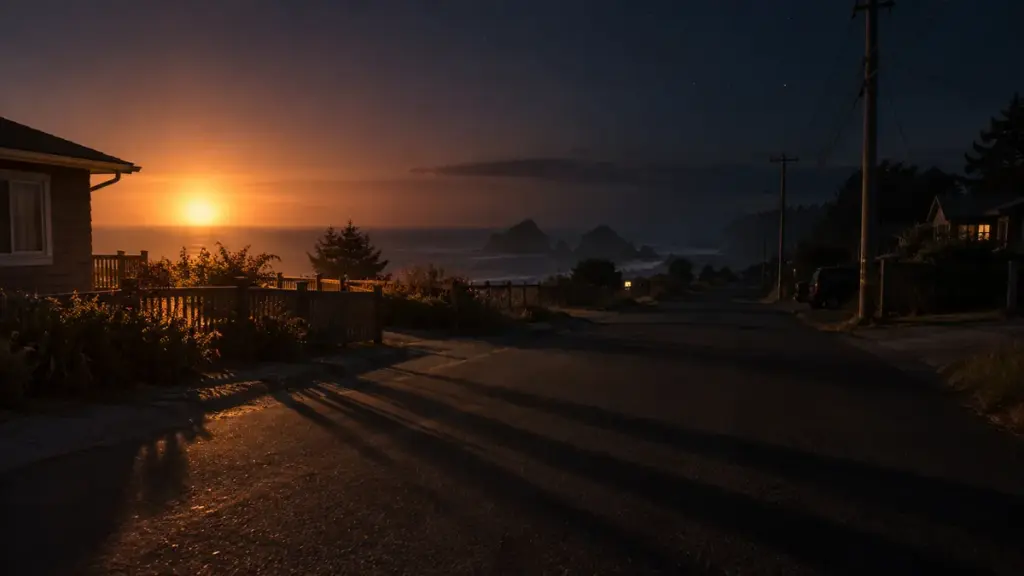
RECONSTRUCTION: Ravenwood reconstruction of the August 14, 2026 Dunmere event based on witness statements and surviving video. The western light appeared as a pale orange sunrise low over the Pacific, producing a second set of eastward shadows while the eastern horizon remained dark. This image is an Archive reconstruction and is not photographic evidence.
CLASSIFICATION: Temporal Anomaly / Photonic Event / Shadow Displacement
STATUS: Active — Unresolved
THREAT LEVEL: IV
FIRST RECORDED: August 14, 2026
PRIMARY LOCATION: Dunmere, Oregon
EVENT DURATION: 11 minutes
INITIAL APPEARANCE: 4:51 a.m.
TERMINATION: 5:02 a.m.
EXPECTED SUNRISE: Approximately 56 minutes later
CONFIRMED WITNESSES: 46
CONFIRMED MISSING: 3
KNOWN FATALITIES: 0
SECONDARY PHENOMENON: Abnormal and independently moving shadows
TEMPORAL DISCREPANCY: 11 minutes
KNOWN RECURRENCE: September 2, 2026 — 11 seconds
CURRENT RECOMMENDATION: Do not enter, touch, or deliberately cross any shadow produced by an unidentified light source.
DOCUMENTATION NOTE
There are several ways to describe what happened in Dunmere.
The sun rose in the wrong direction.
Time stopped for eleven minutes.
Shadows moved without their owners.
Three people disappeared.
All four statements are supported by at least one witness.
None adequately describes the event.
At 4:51 a.m. on August 14, 2026, residents along the western edge of Dunmere reported an orange light appearing over the Pacific Ocean.
Not in the sky above them.
On the horizon.
Where sunrise does not occur in Oregon.
The light brightened.
Shadows formed.
Then some of them moved.
Ravenwood considers the distinction important.
CASE SUMMARY
Dunmere is a small coastal community approximately twelve miles north of the nearest major highway junction.
At 4:51 a.m., before astronomical conditions permitted normal sunrise, multiple residents observed a pale orange light appearing over the western ocean.
The eastern horizon remained dark.
Stars were reportedly still visible.
Within approximately ninety seconds, the western light became bright enough to illuminate buildings, vehicles, utility poles, and people standing outside.
Objects began producing shadows toward the east.
This would have been unusual enough.
Several residents then realized they were also producing weaker shadows toward the west.
Two light sources.
Two sets of shadows.
Except only one visible source existed.
At approximately 4:57 a.m., witnesses began reporting that some of the eastward shadows were no longer matching the movements of the objects or people creating them.
At 5:00 a.m., three residents disappeared.
At 5:02 a.m., the western light extinguished.
Not faded.
Extinguished.
The town returned to darkness.
The three residents did not.
4:51 A.M.
The earliest confirmed report came from Thomas Harris, who was awake preparing equipment for an early fishing trip.
Harris initially believed a vessel was burning offshore.
He stepped outside.
There was no smoke.
No visible ship.
No column of flame.
Only a wide orange glow sitting along the western horizon.
Harris retrieved his phone.
His first surviving video begins at 4:52 a.m.
The footage lasts six minutes and fourteen seconds.
It is the most significant surviving record of the event.
The video shows Harris’s driveway, neighboring houses, a section of road, and the glow beyond the western tree line.
Exposure varies.
The phenomenon does not.
The light is clearly coming from the west.
Harris can be heard saying:
“That’s not right.”
It remains one of the more useful statements in the file.
THE WESTERN HORIZON
Witnesses consistently compared the light to sunrise.
Not a spotlight.
Not fire.
Not lightning.
Sunrise.
The color was described as pale orange, amber, yellow-white, or occasionally pink near the upper edge.
Several witnesses reported what appeared to be the upper arc of a solar disk.
Others saw only brightness.
No reliable photograph clearly resolves a circular object.
The apparent source remained close to the ocean horizon throughout the event.
It did not visibly rise.
That matters.
A normal sunrise changes position.
The Dunmere light brightened.
It did not climb.
For eleven minutes, dawn remained fixed.
THE EAST
While residents watched the western horizon, several witnesses photographed the opposite direction.
The eastern sky remained dark.
Stars were visible in at least two photographs timestamped during the event.
There was no corresponding eastern dawn.
No unusual cloud cover appears to have divided the sky.
No weather system explains the contrast.
Dunmere had morning on one side of town.
Night on the other.
There were other problems.
THE FIRST SHADOWS
The first shadows were expected.
If a bright source sits low in the west, objects should cast long shadows toward the east.
They did.
Utility poles.
Parked cars.
Mailboxes.
Trees.
People.
All produced extremely long eastward shadows.
Several residents noticed something else.
Faint shadows also extended west.
Initially these were attributed to porch lights, streetlights, vehicle headlights, or reflected illumination.
This was reasonable.
Ravenwood investigators later recreated the available light sources at several documented positions.
The secondary shadows could not be reproduced consistently.
More importantly:
Those shadows began moving.
DOUBLE SHADOWS
Witness Laura Menendez reported standing outside her home with her husband when she noticed two shadows extending from him.
One pointed east.
The other west.
When her husband raised his right arm, both shadows initially copied him.
Approximately thirty seconds later, the western shadow lowered its arm first.
Her husband had not moved.
She called his attention to it.
He raised both arms.
The eastern shadow followed.
The western shadow did not.
It remained still.
Menendez and her husband went inside.
Sensible.
Other witnesses remained outside.
There were other options.
THE HARRIS RECORDING
Thomas Harris’s recording provides the clearest visual evidence of abnormal shadow behavior.
At approximately four minutes into the footage, Harris turns the camera toward his garage.
His shadow is visible stretching across the driveway.
He moves the phone.
The shadow moves.
Nothing unusual.
Then Harris steps backward.
His body moves immediately.
The shadow appears to remain stationary for approximately half a second before following.
The discrepancy is brief enough to dismiss as compression, frame loss, rolling shutter distortion, or stabilization artifacts.
Approximately forty seconds later, it happens again.
Longer.
Harris raises his left arm.
The shadow does not.
Harris lowers it.
The shadow raises its arm.
There is no commentary.
Harris apparently does not notice.
Ravenwood has reviewed the original file rather than social media copies or recompressed versions.
The delay is present in the source recording.
At 4:58:17 a.m., Harris walks out of frame.
His shadow remains visible for another eleven frames.
Then it follows.
THEY WERE NOT ALL DELAYED
Delay is an inadequate description.
Some shadows lagged behind movement.
Some failed to move.
At least four witnesses described shadows performing movements their owners had not yet made.
One reported watching her shadow turn sideways before she did.
She then felt what she described as a sudden compulsion to turn.
She did.
Another witness refused to imitate the position of his shadow.
According to his statement, it remained that way for nearly a minute.
Then it changed again.
He went indoors shortly afterward.
Ravenwood has no evidence that these reports were coordinated before interviews.
We also have no way to objectively confirm most of them.
The Harris recording is the exception.
Something on that driveway was not synchronized.
THE LAST TWO MINUTES
The event changed at approximately 5:00 a.m.
The western light intensified.
Multiple witnesses described the increase as painful to look at, although surviving recordings do not show a corresponding dramatic increase in camera exposure.
This may indicate a limitation of the recordings.
It may also indicate that witnesses were perceiving something the cameras were not.
At this point, shadows throughout the western portion of town reportedly lengthened.
Not gradually.
They extended.
Several crossed roads.
One climbed the exterior wall of a residence despite the object producing it remaining at ground level.
The three disappearances occurred within the next two minutes.
THE FIRST DISAPPEARANCE
Daniel Mercer, age thirty-eight, was standing near the entrance of Dunmere Harbor when he disappeared.
Two witnesses were present.
Neither described Mercer fading.
Neither described a flash.
They described his shadow becoming unusually dark.
Mercer noticed.
He stepped backward.
The shadow extended toward him instead of away.
One witness said it looked like “a hole opening flat on the ground.”
Mercer moved behind a parked truck.
For approximately one second, witnesses lost direct sight of him.
He did not emerge from the other side.
The truck remained.
Mercer did not.
No sound was reported.
No clothing.
No blood.
No physical disturbance.
His phone was later found on the pavement.
Its clock displayed 4:49 a.m.
Network time at recovery was 5:11 a.m.
THE SECOND AND THIRD DISAPPEARANCES
The second disappearance occurred less than a minute later.
Rebecca Sloan, twenty-six, was visible to three witnesses outside an apartment complex on Alder Street.
A long shadow from a utility pole crossed between Sloan and the witnesses.
As the shadow passed over her position, Sloan became difficult to see.
One witness described the effect as though she had been standing “behind smoked glass.”
The pole did not move.
The shadow did.
When it passed, Sloan was gone.
The third missing person, Eli Warren, sixty-one, disappeared near the northern beach access.
There were no direct witnesses to the exact moment.
His dog returned home alone at 5:19 a.m.
Warren’s footprints were later documented in damp sand.
They continued toward the shoreline.
Then stopped.
There were no return prints.
There was no corresponding disturbance in the water.
His shadow appears in the background of one surviving photograph.
Warren does not.
THE WORD “OPENING”
Investigators did not introduce the term.
Witnesses did.
Five separate statements described the shadows as resembling openings.
Two used the word door.
One used hole.
One used depth.
Laura Menendez said:
“It looked like the ground had stopped being ground.”
Photographs do not show this.
They show dark shapes.
Flat ones.
The apparent depth exists only in witness testimony.
This is important because people are notoriously poor at describing unfamiliar visual phenomena.
It is also important because three people are missing.
5:02 A.M.
At precisely 5:02 a.m., according to the majority of synchronized digital devices recovered afterward, the western light vanished.
Witnesses compared it to a switch being turned off.
There was no sunset.
No dimming.
No movement below the horizon.
Orange light.
Then darkness.
The abnormal shadows disappeared with it.
Most of them.
Thomas Harris’s recording continues for fourteen seconds after the light vanishes.
The driveway is nearly black.
At the far edge of the frame, a narrow shadow remains.
There is no identifiable object producing it.
The recording ends when Harris turns toward his house.
He survived the event.
He has declined further interviews.
Ravenwood considers that reasonable.
THE ELEVEN MINUTES
At first the duration appeared coincidental.
4:51.
5:02.
Eleven minutes.
Then residents began comparing clocks.
Mechanical clocks appeared unaffected.
Many network-connected devices corrected automatically once service stabilized.
Several battery-powered digital clocks displayed times exactly eleven minutes behind expected local time.
Vehicle clocks were inconsistent.
Three security systems contain missing footage between 4:51 and 5:02.
Not black footage.
Not corrupted footage.
The timestamps move directly from 4:50:59 to 5:02:00.
No file occupies the interval.
Yet witnesses experienced it.
Harris recorded part of it.
The missing eleven minutes both happened and, on several systems, did not exist.
Ravenwood has not found a useful way to phrase that more comfortably.
NORMAL SUNRISE
The actual sun rose normally that morning.
Approximately fifty-six minutes after the western event began.
It appeared in the east.
It behaved as expected.
Several residents refused to go outside.
No abnormal shadows were reported.
Nothing unusual appeared on the western horizon.
There is no evidence the real sun was affected.
This distinction produced the name used internally for the incident:
The Second Sunrise.
Technically it occurred first.
We are keeping the name.
WEATHER
Conditions that morning were calm.
No severe electrical storm was present.
No recorded atmospheric event explains the illumination.
No wildfire of sufficient magnitude existed offshore.
No rocket launch trajectory available to Ravenwood matches the observation.
No military flare event has been confirmed.
No astronomical body capable of producing the reported effect was present.
A highly unusual atmospheric refraction event could potentially distort a distant light source.
It would not explain the shadows.
That sentence will recur.
THE SHADOW PROBLEM
Light creates shadows by being blocked.
This is not usually controversial.
If a shadow changes independently, one of three things must ordinarily be happening.
The object moved.
The light moved.
Another object or light source changed the projected shape.
During the Harris recording, none of those explanations accounts for all observed motion.
If the recording is authentic—and current analysis suggests it is—then the shadow was not behaving solely as a passive absence of light.
Ravenwood therefore treats the shadows as the primary anomaly.
Not the sunrise.
The sunrise may have been the mechanism.
The shadows were the effect.
Possibly the dangerous one.
SEPTEMBER 2
At 3:17 a.m. on September 2, 2026, a Dunmere patrol officer reported abnormal shadows along Breakwater Road.
There was no western light.
No second sunrise.
No unusual weather.
Streetlamps were functioning normally.
For approximately eleven seconds, shadows from three utility poles extended eastward simultaneously.
This direction did not match any active light source.
The shadows lengthened across the road.
Stopped.
Then withdrew.
The event was captured by a dashboard camera.
Frame analysis confirms the movement.
No disappearances occurred.
No residents in the immediate area reported symptoms.
The duration was eleven seconds.
The number is being recorded.
We are not assigning meaning to it yet.
ELEVEN
The original event lasted eleven minutes.
The Harris recording shows his shadow remaining after him for eleven frames.
The September recurrence lasted eleven seconds.
Three digital systems missing the event transition directly across an eleven-minute gap.
This may be coincidence.
Patterns become attractive quickly in unresolved cases.
Investigators can do considerable damage once they begin finding the number they expect to find.
Ravenwood therefore does not consider eleven a confirmed property of the phenomenon.
We do, however, continue writing it down.
That is how patterns become evidence.
Or stop being patterns.
WHAT HAPPENED TO THE MISSING
There is no confirmed answer.
No bodies have been recovered.
No financial activity has been identified.
No verified communication has been received.
No sightings have been confirmed.
Searches of the coastline, surrounding forest, harbor infrastructure, drainage systems, and nearby roads found no useful trace.
The three disappearances occurred in separate locations.
The common factor is the event.
More specifically:
Each disappearance is associated with obscuration by an anomalous shadow.
That correlation is currently strong enough to influence safety protocol.
It is not strong enough to explain destination.
Ravenwood does not know whether the missing are dead.
We do not know whether they were physically transported.
We do not know whether “where” remains a meaningful question.
TEMPORAL DISPLACEMENT
The clock anomalies suggest a temporal component.
This does not mean time stopped.
Witnesses moved normally.
Recordings functioned.
People spoke.
Vehicles traveled.
Physical processes continued.
If time had literally stopped for eleven minutes, no one inside the event should have experienced those minutes.
A better working description is temporal isolation.
For eleven minutes, some systems inside Dunmere appear to have experienced an interval not correctly reconciled with time outside it.
This would explain the missing timestamps.
It would not explain the western sun.
Or the shadows.
There it is again.
THE LIGHT MAY NOT HAVE BEEN LIGHT
This possibility is currently considered seriously.
Witnesses perceived illumination.
Cameras recorded increased brightness.
Objects produced shadows.
By every practical standard, the phenomenon behaved like light.
Except when it did not.
Some cameras recorded less brightness than witnesses described.
Shadows moved independently.
Objects occasionally cast shadows inconsistent with the apparent source.
The phenomenon may therefore have produced a visual and physical effect similar to illumination without behaving according to ordinary optics.
Calling it a sunrise may be equivalent to calling a screen a window because both show you outside.
Appearance is not mechanism.
THE SHADOWS MAY NOT HAVE BEEN SHADOWS
This is worse.
If the dark forms were simply failures of illumination, they should have remained geometrically dependent on the objects blocking the light.
Some did.
Some apparently did not.
The working model therefore distinguishes between:
Ordinary shadows produced during the event.
And:
Anomalous dark forms occupying the same visual category.
The second group may have used existing shadows as boundaries.
Or entry points.
Or camouflage.
Those terms are speculative.
The disappearances are not.
THE MOST LIKELY WORKING MODEL
Ravenwood’s present reconstruction is as follows.
At 4:51 a.m., an unidentified phenomenon manifested over or beyond the western horizon near Dunmere.
The event produced illumination closely resembling sunrise.
The phenomenon altered local shadow behavior and may have created dark spatial or temporal discontinuities aligned with existing shadows.
During the final two minutes, the instability increased.
Three individuals intersected or were obscured by these discontinuities.
They disappeared.
At 5:02 a.m., the primary phenomenon terminated.
Some electronic systems failed to retain the eleven-minute interval correctly.
Eighteen days later, a localized shadow event occurred without the accompanying light.
This suggests either residual activity or that the western illumination was never necessary for the shadow phenomenon to occur.
The second possibility is the one Ravenwood currently finds more concerning.
WHAT WE DO NOT KNOW
We do not know what produced the western light.
We do not know why it resembled sunrise.
We do not know why the event lasted eleven minutes.
We do not know why some clocks lost the interval.
We do not know whether all abnormal shadows were manifestations of the same phenomenon.
We do not know where the missing people went.
We do not know whether they are alive.
We do not know why the September recurrence occurred without visible illumination.
We do not know whether the event is finished.
That last question remains open.
WHAT WE KNOW
Forty-six witnesses observed abnormal western illumination.
Multiple independent recordings confirm a major light source where no sunrise should have been possible.
Normal sunrise occurred later from the east.
Unusual shadow behavior was reported independently by multiple witnesses.
Thomas Harris’s original recording contains measurable movement inconsistent with his own movement.
Three people disappeared during the event.
No conventional disappearance mechanism has been established.
Several devices failed to record the same eleven-minute interval witnesses experienced.
A smaller shadow event occurred on September 2.
Something happened in Dunmere.
Whatever produced the sunrise may not have been the part taking people.
ARCHIVIST’S NOTES
The first thing everyone asks is whether the sun actually rose in the west.
No.
Probably not.
I find that answer less reassuring than they expect.
The sun is ninety-three million miles away.
I understand the sun.
I understand where it is supposed to be.
Something pretending to be the sun from the wrong side of the horizon is a different problem.
The shadows bother me more.
A light in the sky can be distant.
A shadow is beside you.
We have watched the Harris recording enough times to stop arguing about the arm.
His arm comes down.
The shadow’s goes up.
We checked frames.
We checked compression.
We checked stabilization.
We checked whether another person could have crossed behind him.
Then we checked again because none of us particularly liked the first answer.
The footage remains the footage.
The disappearances are worse.
Mercer’s phone was still there.
Sloan’s shoes were not.
Warren’s footprints simply end.
There is no dramatic final mark in the sand.
No struggle.
No indication that something dragged him away.
He was walking.
Then the record of where he was walking stops.
I keep thinking about Laura Menendez.
Her husband noticed his shadow was wrong.
They went inside.
That may be the entire survival procedure.
See something impossible.
Do not investigate it.
Close the door.
A surprisingly large portion of this Archive could have been shorter if people followed that policy.
The September event removed one comfort.
Until then, we could pretend the false sunrise caused everything.
Now we have shadows without sunrise.
Eleven seconds.
No missing people.
No injuries.
Just three dark lines reaching across an empty road when nothing told them to.
That footage ends normally.
The road remains empty.
I prefer it that way.
CURRENT RECOMMENDATION
Dunmere remains under passive Ravenwood observation.
Any recurrence of unexplained illumination or shadow displacement should be treated as an immediate hazard.
If abnormal shadow behavior is observed:
Do not approach it.
Do not step across it.
Do not test whether it reacts to movement.
Do not stand between it and the object apparently producing it.
Do not assume entering a building provides protection unless all anomalous shadows remain outside.
Move away from the affected area while maintaining visual awareness of the ground.
Use multiple independent timekeeping devices.
Record both the apparent light source and the shadows simultaneously whenever this can be done without approaching the phenomenon.
If your shadow moves before you do:
Leave.
Do not wait to see what it wants.
CASE STATUS
ACTIVE — UNRESOLVED
The Dunmere Second Sunrise remains an active temporal and shadow anomaly originating with the August 14, 2026 event.
For eleven minutes, an unidentified western light illuminated portions of the town nearly one hour before normal sunrise.
The event produced duplicate and abnormal shadows, several of which appeared capable of moving independently from the people or objects associated with them.
Three individuals disappeared during the final two minutes of the event.
They remain missing.
Multiple electronic systems recorded an eleven-minute temporal discrepancy.
A secondary event on September 2 demonstrated that abnormal shadow movement can occur without the western illumination.
No conventional explanation accounts for the complete incident.
No method of recovering the missing has been identified.
No evidence establishes that the phenomenon has ended.
The sun has not risen in the west again.
The shadows have.
RAVENWOOD ORIGINAL
This case is a work of fiction created for Ravenwood Archive. Names, characters, locations, events, and accompanying evidence are fictional or presented as part of the story.
FILE REMAINS OPEN