
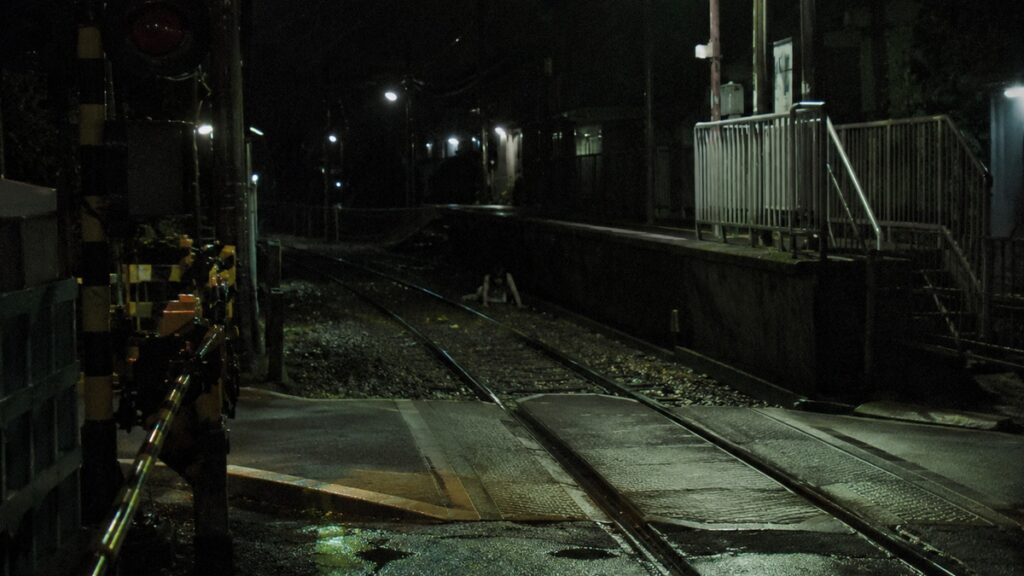
RECONSTRUCTION: Ravenwood reconstruction of Teke Teke near an unidentified Japanese railway crossing. The figure is intentionally obscured due to variations in the legend and the absence of verified photographic evidence. This image is an Archive reconstruction and is not presented as evidence of an actual encounter.
CLASSIFICATION: Urban Legend / Apparitional Figure
STATUS: Folkloric — Unverified
PRIMARY REGION: Japan
ASSOCIATED LOCATIONS: Railway lines, train stations, urban streets
COMMON FORM: Female apparition missing the lower half of the body
VERIFIED FIRST REPORT: None established
VERIFIED HISTORICAL VICTIM: None established
PHYSICAL EVIDENCE: None verified
CONFIRMED FATALITIES ATTRIBUTABLE TO PHENOMENON: None verified
CURRENT ACTIVITY: Unconfirmed
CURRENT RECOMMENDATION: Treat reported encounters as folklore unless independently documented. Do not enter railway property while attempting to investigate the legend.
DOCUMENTATION NOTE
Teke Teke presents an unusual problem for an archive.
There is no single documented encounter around which the case can be built.
No known first witness.
No preserved object.
No verified photograph.
No identified body.
Even the event commonly presented as the beginning of the legend cannot presently be tied to one confirmed victim within the sources used for this file.
What survives is the story.
And the sound.
Teke. Teke.
CASE SUMMARY
Teke Teke is a Japanese urban legend concerning the apparition of a young woman or schoolgirl whose body ends at approximately the waist.
She is commonly described as moving on her hands or elbows, dragging the remaining half of her body across the ground.
The resulting scraping or striking noise is said to resemble:
teke teke
The sound gives the apparition its name. [1]
Many versions place encounters near railway stations, tracks, crossings, or other urban areas after dark.
The figure initially appears incapable of meaningful pursuit.
That impression does not last.
According to the legend, Teke Teke can move at extraordinary speed and will chase anyone who encounters her.
Those she catches are sometimes said to be cut in half, leaving them in the same condition as the apparition. [1]
There is no verified evidence that any such attack has occurred.
That has done little to slow the story down.
THE NAME
The name is unusually important.
Teke Teke is not generally presented as the woman’s birth name.
It is a sound.
The repeated noise allegedly produced while the apparition moves became the means by which the apparition itself is identified. [1]
Different versions attribute the noise to different movements.
Hands against pavement.
Elbows striking concrete.
The lower torso scraping against the ground.
The exact mechanism changes.
The rhythm does not.
Teke.
Teke.
Teke.
That makes the legend effective without requiring the apparition to be visible.
A figure can be misidentified.
A sound around a corner requires considerably more imagination.
The witness supplies that part themselves.
THE RAILWAY STORY
The best-known origin describes a young woman or schoolgirl being struck by a train.
Her body is severed at the waist.
She dies as a result.
She later returns without her lower half. [1]
From there, the details become less cooperative.
Some versions say she fell onto the tracks.
Others add circumstances surrounding the accident.
Some describe negligence after the collision.
Others provide little explanation beyond the death itself.
Northern Japan is sometimes attached to the story.
A specific victim is not.
Ravenwood has therefore classified this account as:
LEGENDARY ORIGIN — UNVERIFIED
This is an important distinction.
A railway death is part of the Teke Teke story.
That does not automatically make it a documented historical event.
Within the copyright-safe sources used for this file, no specific woman, date, train, station, or police record has been established as the definitive origin of the legend.
The story gives us a victim.
History has not yet identified her.
THE BODY
Most versions agree on the feature that makes Teke Teke immediately recognizable.
Half of the body is missing.
That feature also creates the central contradiction of the legend.
A person without legs should be easier to escape from.
Teke Teke is said to be exceptionally fast. [1]
The story gives the witness approximately enough time to understand why this is a problem.
Then the pursuit begins.
Some versions describe the apparition moving on her hands.
Others emphasize the elbows.
The image varies considerably between retellings, and modern illustrations have further standardized details that cannot be treated as historical evidence.
For this reason, Ravenwood does not maintain an official anatomical reconstruction beyond the following:
Female appearance.
Human upper torso.
Lower body absent.
Rapid movement.
Everything beyond that should be treated cautiously.
The monster has become more visually precise than the evidence supporting it.
This happens frequently.
THE CHASE
Teke Teke is unusual among ghost stories because the encounter is rarely passive.
She does not simply appear.
She pursues.
The victim notices the figure or hears the approaching sound.
The figure advances.
The victim attempts to flee.
The apparition follows.
Quickly.
In many versions, escape is impossible once the pursuit has properly begun. [1]
This may explain part of the legend’s longevity.
The premise is understood immediately.
There are no elaborate rituals required.
No haunted building that needs to be entered.
No object that needs to be touched.
You are walking.
You hear something.
You look.
Now it is coming toward you.
There were other options.
The story chose this one.
THE CUTTING
Many versions of the legend end with the victim being severed at the waist.
Some versions introduce a scythe or another bladed weapon to accomplish this. [1]
The weapon is not consistent enough for Ravenwood to treat it as a defining characteristic.
The outcome is more stable than the method.
The victim is made to resemble the apparition.
That structure is common in folklore.
The dead repeat what happened to them.
The punished become the next example.
The creature reproduces its own condition.
Whether Teke Teke was always told this way is considerably harder to establish.
Modern legends change while they circulate.
Details that make the story easier to remember tend to survive.
Being cut in half by the thing that was cut in half is difficult to forget.
KASHIMA REIKO
Teke Teke is sometimes connected to another Japanese urban legend commonly known as Kashima Reiko.
The two should not automatically be treated as the same apparition.
Kashima Reiko traditions also involve a woman who has lost her lower body or legs, but versions of that legend frequently involve different locations, questions, rules, and methods of survival.
Modern retellings have blended elements of the two traditions. [1]
That creates an archival problem.
Once two legends begin exchanging details, later versions can make the relationship appear much older and cleaner than it actually is.
A detail found in a modern Teke Teke story may once have belonged primarily to Kashima Reiko.
Or the reverse.
Ravenwood therefore records the relationship as:
RELATED FOLKLORE — POSSIBLE CROSS-CONTAMINATION
Not:
SAME ENTITY
The Archive has insufficient evidence to make that distinction disappear simply because later storytellers did.
A MODERN LEGEND
Teke Teke belongs to Japan’s modern urban-legend tradition rather than being securely documented as an ancient supernatural figure.
By 2003, Japanese publishing records cataloged Teke Teke among collections explicitly devoted to contemporary urban legends. [2]
That does not tell us exactly when the story began.
It does establish that the legend was circulating widely enough to be collected and published by the early twenty-first century.
This distinction matters.
Ancient folklore often grows around isolated landscapes.
Mountains.
Forests.
Shrines.
Rivers.
Teke Teke belongs comfortably to somewhere more modern.
Concrete.
Streetlights.
Railways.
Platforms.
Pedestrian crossings.
Routes home from school.
The environment changed.
The ghost changed with it.
WHY RAILWAYS?
There is no need to invoke the supernatural to understand why railway infrastructure works so well as a setting.
Railways already contain many of the things the story requires.
Restricted spaces.
Blind corners.
Mechanical sounds.
Flashing lights.
Long empty platforms.
Sudden noise.
Moving machinery.
Distances that are difficult to judge after dark.
And, most importantly, genuine danger.
A story about a person killed and dismembered by a train does not need to convince the listener that the location can kill someone.
The railway has already handled that part.
The legend only adds the possibility that something remained afterward.
THE SOUND PROBLEM
Consider what happens once someone already knows the story.
They walk beside a railway line at night.
Something scrapes behind them.
Metal.
A loose object.
An animal.
A bicycle.
Construction material shifting in the wind.
They hear it again.
Now there is another possibility available.
Teke Teke.
This is one of the central difficulties in investigating folklore-based encounters.
Knowledge changes interpretation.
The witness does not need to be dishonest.
They may accurately report hearing an unfamiliar scraping noise.
The problem begins when observation becomes identification.
“I heard something behind me.”
Useful.
“I heard Teke Teke.”
Much less useful.
The second statement contains information the witness could not actually have heard.
THE ORIGIN PROBLEM
Legends prefer exact beginnings.
Researchers rarely receive them.
The familiar Teke Teke story provides everything necessary for a convincing origin.
A young woman.
Winter.
A railway.
A terrible accident.
A death.
A reason for vengeance.
What it does not reliably provide is documentation.
No definitive originating victim has been established within the sources approved for this file.
No confirmed first teller.
No unquestioned first publication.
No universally accepted location.
That does not mean none of these things ever existed.
It means Ravenwood cannot presently state that they did.
The difference is important.
A detailed story can still be an undocumented story.
Sometimes additional detail makes that easier to forget.
THE PHYSICAL EVIDENCE
There isn’t any.
No verified photograph depicts Teke Teke.
No authenticated video records an encounter.
No biological material has been recovered.
No weapon has been associated with an alleged attack.
No physical trace has been established as belonging to an unknown human-like apparition.
No documented series of unexplained bisection deaths has been shown to correspond to the legend.
No surviving historical evidence establishes a supernatural cause.
This file therefore does not classify Teke Teke as a confirmed entity.
The subject being documented is the legend.
That legend is real.
Its subject remains another matter.
WHAT WE DO NOT KNOW
We do not know the identity of an original victim.
We do not know whether there was one.
We do not know the location of the first version.
We do not know when the name Teke Teke was first attached to the apparition.
We do not know which characteristics belonged to the earliest form of the story.
We do not know when details from Teke Teke and Kashima Reiko began overlapping.
We do not know whether any alleged encounter began with a person genuinely seeing something they could not identify.
And we do not know whether the famous railway death preserves a distorted memory of a real incident or exists entirely because it makes the ghost easier to explain.
Those uncertainties should remain visible.
WHAT WE DO KNOW
Teke Teke is a recognized Japanese urban legend. [1]
The familiar apparition is female and lacks the lower half of her body. [1]
She is commonly associated with railway and urban environments. [1]
Her name is connected to the repeated sound attributed to her movement. [1]
The legend commonly includes rapid pursuit and the threat of the victim being cut in half. [1]
Teke Teke has been included in Japanese publications cataloged specifically as collections of modern urban legends. [2]
Everything beyond those basic points becomes increasingly dependent on which version is being told.
There is no single canonical witness statement.
There is no canonical police report.
There is only a story that became recognizable enough for strangers to know what the sound means.
ARCHIVIST’S NOTES
There is something unusually effective about giving a monster a sound instead of a name.
Names require introductions.
A sound does not.
Someone tells you what teke teke means once.
Years later, you are walking home.
Something scrapes twice behind you.
The story has done the rest of the work already.
I find the alleged speed particularly unfair.
The woman has no legs.
This appears, initially, to be useful information.
It is not.
More important is the question I kept returning to while assembling this file.
Who was she?
The answer should be simple.
The legend describes a death specific enough that there ought to be a person attached to it.
Instead there is a gap.
A woman died.
Where?
The tracks.
Which tracks?
Somewhere in Japan.
When?
That depends on who is telling you.
Her name?
Usually absent.
This is where the case becomes more interesting to me.
Not more supernatural.
Less certain.
A real accident may sit somewhere beneath the story.
It would not be surprising.
Railway fatalities happen.
A particularly disturbing one could easily be remembered, changed, repeated, and eventually detached from the person who actually died.
That is possible.
It is not established.
The other possibility is simpler.
There was never one woman.
The story required someone to have been cut in half.
So eventually someone was.
Then someone gave her anger.
Then speed.
Then a weapon.
Then rules.
Another legend contributed details.
Children repeated them.
Books recorded versions after the story was already moving.
Eventually the woman became much easier to describe than to locate historically.
That is usually a warning sign.
The clearest thing in this file is not the apparition.
It is the transmission.
Someone heard the story.
Then someone else did.
Then someone else.
Now you have.
That does not make the curse real.
But it does explain why Teke Teke has never needed legs to travel.
CURRENT RECOMMENDATION
Teke Teke should presently be treated as a modern folklore phenomenon rather than a verified supernatural entity.
Any claimed encounter should be documented independently before comparison with established versions of the legend.
Record:
Exact location.
Date and time.
Lighting conditions.
Distance from the reported figure.
Duration of observation.
Description of movement.
Description of any sound before visual contact.
Nearby railway activity.
Nearby pedestrians or wildlife.
Original photographs or video.
And whether the witness knew the Teke Teke story beforehand.
Do not trespass on railway tracks, tunnels, restricted platforms, maintenance areas, or crossings in an attempt to recreate the legend.
A real train remains considerably better documented than Teke Teke.
Treat it accordingly.
CASE STATUS
ARCHIVED — INSUFFICIENT EVIDENCE
Teke Teke remains a documented Japanese urban legend whose supernatural component has not been verified.
The commonly repeated railway-death origin cannot presently be tied to a definitive historical victim within Ravenwood’s approved research record.
No authenticated physical, photographic, biological, or forensic evidence establishes the existence of the apparition described in the legend.
Variations between accounts and overlap with related folklore make reconstruction of the earliest version uncertain.
The apparition remains unverified.
The legend does not.
FILE REMAINS OPEN
RESEARCH SOURCES
[1] Wikipedia — “Teke Teke”
Used for the widely circulated characteristics of the legend, including the half-bodied female apparition, the origin of the name, railway association, pursuit narrative, and overlap with Kashima Reiko traditions.
Source Type: Freely licensed third-party reference material — Creative Commons Attribution-ShareAlike. (Wikipedia)
[2] National Diet Library Search — Japanese catalog records documenting Teke Teke in published urban-legend collections
Used only to establish that Teke Teke appears in Japan’s modern published urban-legend record, including a 2003 collection whose catalog metadata lists Teke Teke among its contents. National Diet Library Catalog metadata is provided under CC BY reuse terms. (国立国会図書館サーチ(NDLサーチ))