
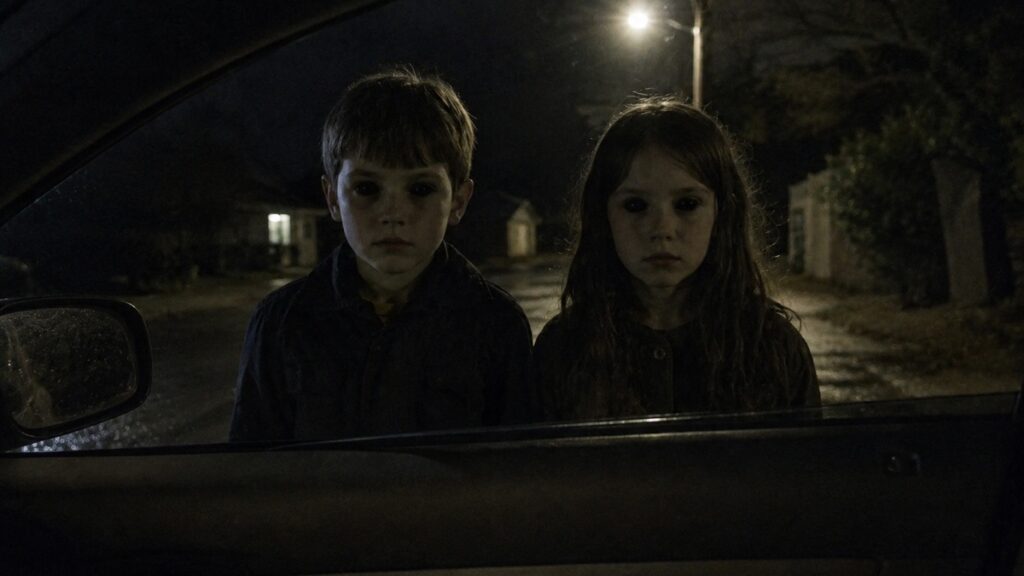
RECONSTRUCTION: Ravenwood reconstruction of a reported Black-Eyed Children encounter near a parked vehicle and residential threshold. The figures should remain partly obscured, with emphasis placed on posture, stillness, and the impression of wrongness rather than a full clear portrait. This image is an Archive reconstruction and is not photographic evidence.
CLASSIFICATION: Urban Legend / Threshold Encounter / Visitor Phenomenon
STATUS: Folkloric — Unverified
FIRST POPULAR CIRCULATION: 1996
PRIMARY REGION: United States
ASSOCIATED LOCATIONS: Parked vehicles, front porches, doorways, suburban roads, shopping-center lots
COMMON DESCRIPTION: Child or young teenager with pale skin and completely black eyes
REPORTED BEHAVIOR: Requests entry into a home or vehicle; calm but insistent speech
VERIFIED FIRST WITNESS: None independently confirmed beyond the originating personal account
PHYSICAL EVIDENCE: None verified
CONFIRMED FATALITIES ATTRIBUTABLE TO PHENOMENON: None verified
CURRENT ACTIVITY: Unconfirmed
CURRENT RECOMMENDATION: Treat all reports as folklore accounts unless independently documented. Do not confuse a compelling anecdote with verified evidence.
DOCUMENTATION NOTE
The Black-Eyed Children present a very modern archival problem.
The legend is widely known.
The evidence is not.
Unlike older folklore built from decades of local tradition, the Black-Eyed Children story appears to have spread primarily through late-twentieth-century and early internet retelling. The best-known origin is a 1996 account by Texas reporter Brian Bethel, whose reported encounter in Abilene became the pattern from which later stories largely developed. [1]
That distinction matters.
There is a difference between a legend with a known point of popular circulation and a phenomenon supported by a reliable body of evidence.
The Black-Eyed Children clearly satisfy the first condition.
They have never convincingly satisfied the second.
CASE SUMMARY
Black-Eyed Children—sometimes shortened to BEKs—are described as children or young teenagers who appear outwardly human except for one impossible feature:
Their eyes are entirely black.
No visible iris.
No visible sclera.
No ordinary human expression available to soften the effect.
According to the familiar legend, they approach an adult who is alone or relatively isolated, often in a parked car, near a home, or at a doorway. They speak calmly. They ask to be let inside a vehicle or residence, or to be driven somewhere. They are not always overtly threatening. In many accounts, they are polite. The fear arrives anyway. [1]
That fear is one of the most consistent parts of the story.
Witnesses usually describe an immediate and disproportionate sense of dread before clearly understanding why.
Only afterward do they notice the eyes.
Or, in some tellings, the eyes are not immediately visible at all.
The children keep them lowered.
Then look up.
That is good storytelling.
It is not, by itself, good evidence.
THE ABILENE ACCOUNT
The case begins, in practical terms, with the account that made it famous.
Most modern summaries trace the legend’s popular emergence to a 1996 report by Texas journalist Brian Bethel, who described being approached in his car at night by two boys asking for a ride. The location is usually given as Abilene, Texas. Bethel’s account circulated online and became the foundation upon which later Black-Eyed Children stories were built. [1]
Ravenwood’s concern here is not whether Bethel lied.
That cannot be demonstrated from the approved source record.
The more useful point is this:
One first-person account became a template.
After that, later reports no longer had to invent themselves from nothing.
They could borrow structure.
Two children.
Night.
Wrongness.
Request for entry.
Escalating insistence.
Eyes revealed last.
This does not make every later report fictional.
It does make every later report harder to evaluate independently.
A witness who already knows the script can experience fear through that script.
That is how legends become efficient.
THE THRESHOLD RULE
Perhaps the most interesting recurring feature is the apparent need for permission.
Black-Eyed Children typically do not force entry.
They ask.
To come inside the house.
To enter the car.
To be taken somewhere.
To use the phone.
To wait until their parents arrive.
The exact request varies. The structure remains recognizable. [1]
This has caused obvious comparison with older folklore motifs involving thresholds and invitation.
Ravenwood notes the resemblance.
Ravenwood does not treat it as proof.
There is no verified historical chain linking the Black-Eyed Children directly to older vampire traditions, fairy-lure narratives, or other invitation-bound entities.
Still, the similarity is useful.
A story becomes more unsettling when the witness is not attacked immediately.
They are asked to cooperate.
The danger becomes partly moral.
Open the door or don’t.
Help the children or don’t.
It is a more interesting trap than simple pursuit.
It also places the witness in a position likely to generate guilt afterward, whether the encounter was paranormal, mistaken, or invented.
THE APPEARANCE
Descriptions are consistent in the broadest possible way.
The figures are young.
Usually between late childhood and the early teens.
Their skin is often described as pale.
Their clothing is often slightly off, plain, outdated, or difficult to remember clearly.
Their speech is controlled.
Flat.
Sometimes formal.
What witnesses tend to remember best are the eyes. [1]
This should not be surprising.
Once a story stabilizes around one shocking visual trait, that trait becomes the part later witnesses are most likely to report.
It becomes the legend’s passport.
A child asking for help is only a child asking for help.
A child asking for help with entirely black eyes is now part of a known category.
From that point forward, the category begins shaping the account.
This is one reason Ravenwood remains cautious.
The more a legend teaches people what they are supposed to notice, the more likely later reports are to arrive already organized.
THE WRONGNESS
Most folklore creatures need a defining ability.
The Black-Eyed Children do not appear to have a stable one.
They are not consistently described as vanishing, flying, shape-shifting, or physically attacking witnesses.
What they possess instead is atmosphere.
Witnesses describe them as deeply wrong before they can explain why.
Fear comes first.
Interpretation follows. [1]
That feature may explain the legend’s staying power.
A witness does not need to provide evidence of what the children are.
They only need to describe how strongly they felt that something was wrong.
As testimony, that is weak.
As horror, it is excellent.
A child outside a window should not be terrifying.
A child who seems to understand this and continue anyway is considerably more effective.
THE INTERNET SPREAD
The Black-Eyed Children belong to a category of legend that is difficult to separate from the medium that carried it.
According to the approved source record, the story spread online after Bethel’s account circulated and later became associated with internet horror and creepypasta culture. [1]
This matters more than it may seem.
Older legends often spread through families, regions, schools, workplaces, churches, and newspapers.
The Black-Eyed Children spread through message boards, websites, repostings, paranormal television, and retellings designed to be shared quickly.
That affects the evidence.
Internet-distributed legends can become geographically widespread before they acquire any meaningful local variation.
Everyone knows the same version.
Or thinks they do.
That creates a strange kind of consistency.
Not the consistency of independent witnesses seeing the same thing.
The consistency of many people repeating the same well-formed story.
The Archive does not dismiss that outright.
It does, however, classify it differently.
WHAT THE CHILDREN WANT
This is where the case becomes noticeably less stable.
Some versions imply the children want entry in order to do harm.
Others suggest abduction, possession, feeding, surveillance, or something less clearly defined.
Paranormal interpreters have variously described them as ghosts, aliens, demons, vampires, or otherwise inhuman beings imitating children. [1]
Ravenwood does not adopt any of those labels.
They are explanations attached after the fact.
The evidence does not choose among them because the evidence does not meaningfully support any of them.
The children want entry.
That is the one reliable point.
What happens if they receive it is largely a product of the story’s later embellishment.
In some tellings, severe consequences are implied.
In others, the story ends before anything can be verified.
This is not unusual.
A legend often becomes most durable at the moment before proof would have to arrive.
THE EVIDENCE PROBLEM
The modern world should be unkind to the Black-Eyed Children.
Doorbell cameras.
Dashboard cameras.
Security systems.
Street surveillance.
Phone cameras carried by nearly everyone.
And yet Ravenwood’s approved research record contains no authenticated photograph, no verified video, no police file sufficient to establish a nonordinary event, and no physical evidence connecting the stories to a real recurring phenomenon.
This does not prove the legend false.
It does change the burden.
A creature said to appear at porches and cars in the modern era ought to leave better evidence than a seventeenth-century bog spirit.
The Black-Eyed Children have not done so.
The stories remain anecdotal.
Atmospheric.
Memorable.
Difficult to verify.
Extremely easy to repeat.
WHAT WE DO NOT HAVE
We do not have a verified specimen.
We do not have an authenticated image.
We do not have a medically documented case of fully black eyes connected to a Black-Eyed Children report.
We do not have independently confirmed evidence that the original Abilene encounter involved anything paranormal.
We do not have a reliable body of witness reports gathered under consistent investigative conditions.
We do not have clear proof that the reports represent one phenomenon rather than a mixture of storytelling, embellishment, misremembered encounters, and invented testimony.
Most importantly:
We do not have evidence proportional to the confidence with which the legend is usually retold.
WHAT WE DO HAVE
We have a recognizable modern urban legend.
We have a reported 1996 encounter that appears to have served as the story’s popular point of emergence. [1]
We have a stable encounter pattern:
An isolated adult.
A request.
A threshold.
A child who appears human but wrong.
A reveal involving black eyes.
And a refusal, usually just in time.
That is enough to sustain a legend very effectively.
It is not enough to establish a species, an entity class, or a confirmed paranormal threat.
WHY THE STORY WORKS
The Black-Eyed Children are built from a useful contradiction.
Children are supposed to be vulnerable.
They are supposed to need help.
They are supposed to make adults feel responsible.
The legend turns each of those assumptions against the witness.
If you refuse them, you feel cruel.
If you help them, you may be in danger.
If you hesitate, you are already involved.
The black eyes merely finish the transaction.
By the time they appear, the witness has already crossed the interesting part of the story:
They have been asked to choose.
That is why the legend has lasted.
Not because the children are visually elaborate.
They aren’t.
Not because the evidence is overwhelming.
It isn’t.
The story lasts because it understands that politeness can be more frightening than open aggression.
ARCHIVIST’S NOTES
There are creatures in folklore that improve when described in detail.
The Black-Eyed Children are not among them.
The longer someone explains what they are, the less convincing the case usually becomes.
Ghosts, demons, aliens, hybrids, vampires, interdimensional scouts. None of these labels arrive with evidence attached. They arrive because the witness—or the listener—dislikes leaving the file empty.
I understand the impulse.
I am not rewarding it.
What interests me most is the threshold.
Not the eyes.
Not even the children.
The threshold.
A person is alone in a place that should be ordinary. A request is made. The request is not unreasonable. Then some buried instinct objects before the mind can explain why.
That sequence is older than the internet, even if the Black-Eyed Children are not.
Every culture keeps stories about the moment hospitality becomes dangerous.
Open the gate.
Invite the traveler in.
Help the lost stranger.
Take the child into the car because it is raining and you are not a monster.
Then discover that prudence and compassion were pointed in opposite directions.
That is a very old fear.
The Black-Eyed Children are a modern container for it.
I suspect that is why the legend spread so quickly once it found the right shape. The eyes are theatrical. The request is the machinery.
And then there is the obvious problem.
If these children appeared as often as internet folklore occasionally claims, someone should have caught them clearly by now.
Not a story.
Not a retelling.
Not a friend of a cousin of a coworker.
A recording.
A porch camera.
A police body cam.
Something better than atmosphere.
We do not have it.
The lack does not close the case as fiction. Legends do not require closure.
It does keep the file where it belongs.
Not under evidence.
Under warning.
That is where many effective stories prefer to live.
CURRENT RECOMMENDATION
No active paranormal threat associated with the Black-Eyed Children has been verified.
Reported encounters should be documented as contemporary folklore claims unless independent corroboration exists.
If a witness reports an incident, record:
Exact location.
Date and time.
Lighting conditions.
Number of individuals present.
Distance from the figures.
Exact words spoken, if remembered.
Whether entry into a home or vehicle was requested.
Whether the witness noticed the eyes immediately or only later.
Any available video, security footage, or vehicle camera footage.
And whether the witness already knew the legend before the encounter.
That final point is especially important.
Prior knowledge may not disprove the experience.
It does affect how the experience should be interpreted.
Do not harass actual children in public because a story on the internet taught you pattern recognition badly.
That recommendation may seem unnecessary.
Experience continues to argue otherwise.
CASE STATUS
ARCHIVED — INSUFFICIENT EVIDENCE
The Black-Eyed Children remain a documented modern urban legend with a clear and influential pattern of retelling.
The legend’s popular emergence is generally traced to a 1996 reported encounter in Abilene, Texas, but no independently verified body of evidence establishes that the phenomenon exists as an objective paranormal reality.
No authenticated photographic, forensic, or physical evidence currently supports the existence of the entities described in the legend.
The story persists.
The proof does not.
FILE REMAINS OPEN
RESEARCH SOURCES
[1] Wikipedia — “Black-eyed children”
Used for the broad outline of the legend, the reported 1996 Brian Bethel origin account, the common encounter pattern, the spread of the story through modern internet folklore, and the range of later paranormal interpretations.
Source Type: Freely licensed reference source — Creative Commons Attribution-ShareAlike.
No wording from the source has been reproduced. Factual elements were independently paraphrased into Ravenwood Archive prose.