
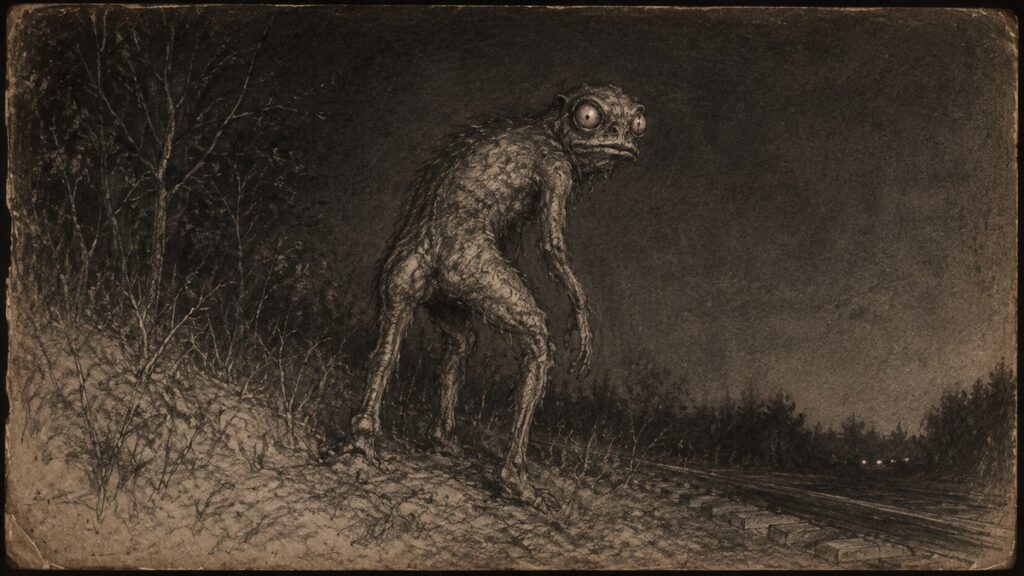
RECONSTRUCTION: Ravenwood reconstruction based on the broad characteristics reported during the 1973 Enfield incidents: short humanoid body, unusual limb arrangement, large reflective eyes, and powerful jumping movement. Accounts conflict, and no verified photograph establishes the creature’s appearance. This image is an Archive reconstruction and is not photographic evidence.
CLASSIFICATION: Cryptid / Unidentified Animal / Regional Incident
STATUS: Historical — Unresolved
PRIMARY ACTIVITY PERIOD: April–May 1973
PRIMARY LOCATION: Enfield, Illinois
PRIMARY WITNESS: Henry McDaniel
REPORTED HEIGHT: Approximately 4½ feet
REPORTED LIMBS: Three legs / two short arms
REPORTED EYES: Large / pink or reflective
ASSOCIATED LOCATION: Railroad embankment and tracks near the witness residence
PHYSICAL EVIDENCE: Unverified footprints
CONFIRMED FATALITIES ATTRIBUTABLE TO PHENOMENON: 0
CURRENT ACTIVITY: Unconfirmed
CURRENT RECOMMENDATION: Treat the Enfield reports as a small number of unusual eyewitness claims later amplified by publicity. Known-animal explanations remain plausible.
DOCUMENTATION NOTE
The Enfield Horror is a good example of what happens when a strange encounter and a growing story begin moving at different speeds.
The original event was small.
One man.
One house.
One animal—or something resembling one.
Then came reporters.
Another claimed witness.
Radio coverage.
Search parties.
Armed visitors.
More stories.
By the time researchers examined the episode several years later, they concluded that only a very small number of firsthand reports existed beneath what had become a much larger local phenomenon. [1]
That does not mean nothing happened.
It means the size of the legend should not be mistaken for the size of the evidence.
CASE SUMMARY
On the night of April 25, 1973, Enfield resident Henry McDaniel heard scratching at the front door of his home.
It was approximately 10:00 p.m.
McDaniel initially suspected an ordinary animal.
He took a firearm and flashlight outside.
Between two rosebushes near the house, he said he encountered something he could not identify. [1]
His description was unusual enough to become the defining image of the case.
Approximately four and a half feet tall.
Grayish in color.
Short body.
Two small arms.
Large pink-looking eyes.
And three legs.
Not three apparent limbs glimpsed in brush.
Three legs.
McDaniel also described the body as roughly humanoid.
Then he shot at it.
THE THREE LEGS
This is the detail that keeps the case alive.
Most unidentified-animal reports eventually settle into something recognizable.
Bear.
Dog.
Deer.
Large cat.
Escaped exotic pet.
The Enfield creature did not cooperate.
McDaniel described three legs supporting a short body. [1]
That arrangement is difficult to reconcile with any large terrestrial animal ordinarily found in southern Illinois.
Later explanations attempted to solve the problem by suggesting a kangaroo.
From certain angles, a kangaroo’s large tail may appear to function as a third supporting limb.
That is biologically convenient.
Unfortunately, McDaniel rejected the explanation.
He reportedly had firsthand familiarity with kangaroos from his time in Australia and believed the animal he saw was built differently. [1]
That does not make his interpretation correct.
It does make simple unfamiliarity with a kangaroo less satisfying as an explanation.
THE EYES
The eyes were described as exceptionally large.
Pink.
Bright enough in the flashlight beam to become one of the most repeated features of the story. [1]
There is nothing supernatural about reflective eyes.
Many animals possess a tapetum lucidum, a reflective structure that improves night vision and causes eyeshine when illuminated.
Depending on angle, light source, and species, eyes may appear white, green, yellow, orange, or red.
Pink-looking eyes therefore do not require an unknown animal.
Their apparent size is another matter.
A startled witness estimating the size of brightly reflecting eyes at night is not performing an anatomical measurement.
The eyes may have been unusually large.
Or they may simply have been the easiest feature to see.
Darkness is generous with proportions.
THE SHOTS
McDaniel fired four times.
He believed one round struck the creature. [1]
The animal reacted with a loud hissing or wildcat-like noise and fled.
What happened next became another defining feature.
It jumped.
According to the report, the creature traveled roughly fifty feet in only three bounds while moving toward a nearby railroad embankment. [1]
That implies extraordinary jumping ability if the distance estimate is accurate.
It also strengthens the kangaroo hypothesis.
Unfortunately, witness estimates made during a nighttime encounter involving gunfire are not ideal measurement tools.
No blood sample was recovered.
No body was found.
No bullet was recovered from an animal.
No biological evidence confirmed that McDaniel actually struck it.
Whatever left the yard left the case with it.
THE TRACKS
Local authorities responded afterward.
Footprints were reportedly found in soft ground near the residence.
McDaniel described them as somewhat dog-like, but with approximately six toe pads. [1]
No preserved cast has become reliable physical evidence in the modern case record.
No measurement series exists sufficient for comparison with known species.
No genetic material was collected.
No authenticated photograph allows independent analysis.
That leaves the tracks in an awkward category.
Reported.
Potentially interesting.
Practically useless.
A six-toed print sounds remarkable until the original impression cannot be examined.
Mud has been responsible for several cryptids.
It remains unrepentant.
THE FIRST PROBLEM
McDaniel was not initially presented as the only witness.
Investigators were told that a ten-year-old neighbor had encountered the creature shortly before McDaniel’s sighting.
The story was dramatic.
The creature supposedly approached the boy and damaged his shoes.
That would have provided something extremely valuable.
A second witness.
A separate encounter.
Physical interaction.
Except the boy later told researchers that he had invented the story as a prank. [1]
This matters considerably.
It does not invalidate McDaniel’s account.
It demonstrates that false information entered the case almost immediately.
From that moment forward, every additional report requires more caution.
Not less.
THE SECOND MCDANIEL SIGHTING
McDaniel did not consider the April encounter isolated.
On May 6, 1973, he contacted radio station WWKI and reported seeing the creature again during the early morning hours. [1]
This time it was near the railroad tracks.
He described something moving along or negotiating the trestle near his home.
There was no shooting.
No close encounter.
The figure continued down the tracks.
This second report is visually less dramatic.
That may make it more interesting.
McDaniel was now seeing something in precisely the environment into which the first creature had supposedly escaped.
Railroad.
Darkness.
Distance.
An animal moving along elevated structures.
There were still no photographs.
THE RADIO SEARCH
The second report attracted a search party that included personnel from WWKI.
Later that day, members of the group claimed to observe an ape-like figure inside or near an abandoned building in the area. [1]
They reportedly attempted to record unusual cries.
A firearm was discharged.
The figure fled.
Again.
No body.
No specimen.
No usable photograph.
The description also changed.
McDaniel’s three-legged animal had become something ape-like.
That does not necessarily mean two different animals were involved.
It does mean the visual profile was becoming less stable.
Three-legged humanoid.
Ape.
Kangaroo.
Possibly several descriptions attempting to solve the same darkness.
THE RECORDING
A recording of alleged cries associated with the search was reportedly made and later examined by people interested in the case. [1]
It has never provided verified biological evidence for an unknown species.
Sound recordings are difficult evidence even when provenance is excellent.
Animals produce unfamiliar calls.
Distances distort them.
Recording equipment changes tone.
Playback changes it again.
And without a visible source, an unusual noise remains exactly that.
Unusual.
The recording therefore belongs in the historical record.
It does not belong in the specimen cabinet.
THE MONSTER HUNTERS
Publicity created a different problem.
People began coming to Enfield looking for the creature.
Some came armed.
Five men from outside the area were eventually arrested after reports of gunfire brought police attention to their activities. [1]
The incident was widely characterized as monster hunting.
The local sheriff was considerably less impressed.
He reportedly regarded the event primarily as young men drinking, causing trouble, and violating hunting laws rather than conducting a serious expedition. [1]
Sensible.
The residents of Enfield had good reason to be concerned.
Once armed strangers begin searching rural property at night for an unidentified creature, the cryptid stops being the most immediate hazard.
THE KANGAROO THEORY
The kangaroo explanation appeared quickly.
It remains one of the better known-animal candidates.
The logic is straightforward.
Powerful hind legs.
Large jumping distance.
Short front limbs.
A heavy tail that could be mistaken for a third leg.
An escaped exotic animal would also explain why residents failed to recognize it immediately.
There was even a report that an Ohio man believed the creature might have been his missing pet kangaroo, which had disappeared roughly a year earlier. [1]
Interesting.
Not proof.
There is no verified documentation connecting that animal specifically to Enfield.
McDaniel also rejected the kangaroo interpretation.
The theory remains plausible.
It does not become true merely because it fits several features.
THE APE THEORY
Another suggestion involved an escaped or unidentified ape.
That explanation accounts for the later radio-party description better than it accounts for McDaniel’s original animal.
Humanoid body.
Short arms become less useful here.
Three legs become worse.
The jumping ability becomes possible but unusual.
The explanation therefore solves one version of the creature while damaging another.
This is a recurring problem.
Every known animal candidate explains part of the Enfield Horror.
None explains the entire standard description comfortably.
That might mean the creature was extraordinary.
It might also mean the standard description was never one coherent animal to begin with.
THE SOCIAL CONTAGION STUDY
In 1978, researchers associated with Western Illinois University used the Enfield episode as a case study in collective behavior and social contagion. [1]
Their investigation is important because it looked beyond the creature itself.
How many people actually claimed firsthand encounters?
How many stories arrived later?
How did media coverage affect participation?
How did residents respond once the town became associated with a monster?
The researchers concluded that the apparent wave of sightings was considerably larger in public perception than in firsthand evidence.
They identified no more than a few direct reports beneath the expanding story. [1]
This does not prove McDaniel saw nothing.
In fact, the broader analysis allowed the possibility that witnesses encountered ordinary animals.
The important conclusion was different.
A small number of unusual sensory experiences became a much larger community event.
That is not unusual.
The monster did not have to multiply.
The stories did it for him.
THE MEDIA EFFECT
The Enfield Horror spread rapidly through newspapers and radio.
That increased awareness.
It also changed the conditions under which future reports occurred.
Before April 25:
A strange shape beside railroad tracks was a strange shape.
After April 25:
It might be the monster.
This distinction is fundamental.
Once witnesses know what they are supposed to see, later observations cannot be evaluated as though they occurred independently.
A large dog.
A deer standing incorrectly.
An escaped exotic animal.
A shadow.
A prank.
Any of these can enter an established legend much more easily than they can create one.
Enfield acquired a monster.
Then people started looking for it.
Those are not the same event.
WHY ENFIELD WORKED
The creature’s design is almost too strange.
Three legs.
Tiny arms.
Huge pink eyes.
Extraordinary jumps.
Gray body.
Unusual tracks.
Nothing fits cleanly.
That may be precisely why the story survived.
A bear can be dismissed.
A kangaroo can be argued.
An ape can be compared.
The Enfield Horror remains structurally inconvenient.
Each explanation leaves something behind.
If it was a kangaroo, what about the face and tracks?
If it was an ape, what about the three legs and jumping?
If McDaniel misperceived the limbs, how accurate are the remaining details?
If later accounts were influenced by publicity, which features existed before people knew what to look for?
The answer becomes less satisfying the closer one gets.
There may never have been one accurate composite description.
A CREATURE MADE FROM SECONDS
Consider how little time is actually required.
Door scratches.
Flashlight.
Movement between bushes.
Recognition that the animal is unfamiliar.
Gunfire.
Jumping.
Gone.
The modern Enfield Horror has been drawn thousands of times from that.
Front view.
Side view.
Three perfectly arranged legs.
Specific muscle groups.
Claws.
Skin texture.
Head shape.
Sometimes teeth.
Witness testimony did not provide that level of anatomical certainty.
Artists did.
Ravenwood will not confuse the two.
Any reconstruction accompanying this file should look uncertain.
The animal was.
WHAT WE DO NOT HAVE
No body.
No verified tissue.
No blood sample.
No hair conclusively associated with the creature.
No preserved track cast available for modern analysis.
No authenticated photograph.
No film.
No verified anatomical measurement.
No confirmed exotic animal linked specifically to the incident.
No evidence that the creature was extraterrestrial.
No evidence that the creature represented an unknown breeding species.
And no large wave of independent eyewitnesses despite the later reputation of the event.
WHAT WE DO HAVE
A documented 1973 report from Henry McDaniel involving an unidentified animal outside his Enfield home. [1]
A description unusual enough to resist easy classification.
Reported footprints.
A second sighting claimed by the same witness.
A later search party that reported seeing something described differently.
A supporting childhood encounter that was later admitted to be a hoax. [1]
Known-animal hypotheses involving kangaroos, apes, and local wildlife.
And a later sociological examination showing how rapidly a small number of reports became a much larger public event. [1]
That is enough for an Archive file.
It is not enough for a species designation.
ARCHIVIST’S NOTES
Three legs.
I kept coming back to that.
Remove one detail and the case becomes much easier.
Two legs and short arms?
Perhaps an ape.
Large hind legs, short front limbs, powerful jumps?
Kangaroo.
Dog-like tracks?
Dog.
Unfortunately, the witness insisted on three.
This is why eyewitness reports are so frustrating.
The strangest detail may be the most important thing observed.
Or the thing observed least accurately.
We have no way to recover the ten seconds and check.
The admitted hoax bothers me more than the kangaroo.
Not because the boy’s story was particularly convincing.
Because it demonstrates how quickly fiction attached itself to an unresolved event.
Half an hour before the main sighting, apparently.
Efficient.
Then publicity arrives.
Reporters.
Searchers.
People with guns.
Another alleged sighting.
Another gunshot.
Soon the creature has become a public event larger than the evidence supporting it.
This is usually where investigators make one of two mistakes.
Some decide everyone saw the monster.
Others decide nobody saw anything.
Both conclusions are lazy.
McDaniel may have seen an animal.
The radio party may also have seen one.
Neither requires a three-legged unknown species.
Neither requires dishonesty.
Animals are frequently uncooperative about appearing from useful angles.
Night is worse.
Fear does the rest.
Still.
There is a stubborn little problem in the center of the file.
McDaniel did not describe something vague.
He described something bizarre.
Specific.
Three legs.
Two short arms.
Large pink eyes.
Gray body.
Then it crossed fifty feet in three jumps.
Perhaps those details are exactly why the explanation should be ordinary.
A known animal seen badly.
Several details distorted at once.
That happens.
Or perhaps one of those details is accurate.
That is the part worth keeping.
Not all of them.
Just one.
If there really was an animal outside that house whose body plan matched the description even approximately, I would very much like to know where the rest of them went.
So far, they have been more difficult to locate than the reporters.
CURRENT RECOMMENDATION
The Enfield Horror should presently be treated as an unresolved historical animal report surrounded by substantial folklore amplification.
Future claims should be evaluated independently rather than matched automatically to the 1973 description.
Document:
Exact location.
Date and time.
Viewing distance.
Duration.
Lighting.
Number and arrangement of visible limbs.
Presence of a tail.
Method of locomotion.
Estimated jump distance.
Footprints photographed with scale.
Original video or photographs.
Nearby captive or escaped exotic animals.
And whether the witness knew the Enfield story beforehand.
Do not conduct armed nighttime searches on private property.
Do not fire at unidentified animals merely because they look unusual.
If the animal has three legs, photograph it first.
This would substantially improve the file.
CASE STATUS
ARCHIVED — INSUFFICIENT EVIDENCE
The Enfield Horror remains an unresolved Illinois cryptid legend centered primarily on a small number of reported encounters in 1973.
Henry McDaniel’s original report described an unidentified animal with an unusual body plan and extraordinary jumping ability, but no verified biological evidence was recovered.
One supporting encounter was later admitted to be a hoax, while later sightings occurred after significant publicity had already surrounded the case. [1]
Known-animal explanations—including an escaped kangaroo or other misidentified wildlife—remain plausible but unproven.
The evidence does not establish an unknown species.
It does establish that something frightened Henry McDaniel badly enough to shoot at it.
What that something was remains uncertain.
FILE REMAINS OPEN
RESEARCH SOURCES
[1] Wikipedia — “Enfield Monster”
Used for the chronology of the April–May 1973 incidents, Henry McDaniel’s reported encounter, the alleged footprints, the later admission that one supporting story was a hoax, the WWKI search, contemporary known-animal theories, public reaction, and the later Western Illinois University social-contagion study.
Source Type: Freely licensed reference source — Creative Commons Attribution-ShareAlike.
Historical details have been independently summarized into Ravenwood Archive prose. No source quotations or copyrighted newspaper wording have been reproduced.