
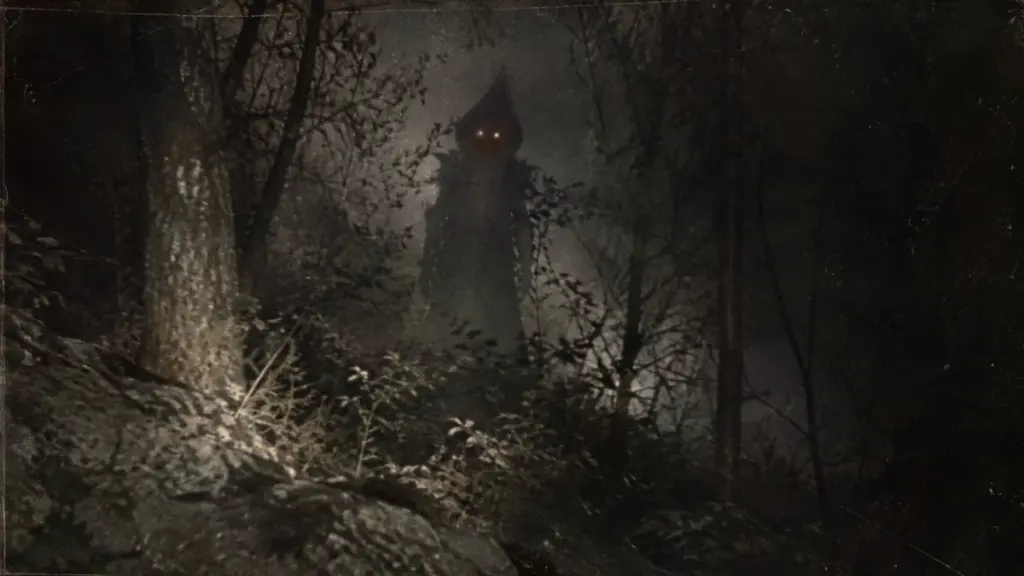
RECONSTRUCTION: Ravenwood reconstruction based on recurring descriptions associated with the 1952 Flatwoods encounter: a towering figure, bright eyes, a round or reddish face within a pointed hood-like silhouette, and a dark draped lower body. Witness descriptions vary considerably, and no verified photograph of the alleged entity exists. This image is an Archive reconstruction and is not photographic evidence.
CLASSIFICATION: UFO-Associated Entity / Regional Folklore / Misidentified Animal Candidate
STATUS: Historical — Unresolved
DATE: September 12, 1952
PRIMARY LOCATION: Flatwoods, Braxton County, West Virginia
ASSOCIATED LOCATION: Hillside near the G. Bailey Fisher farm
PRIMARY WITNESSES: Kathleen May, Eugene Lemon, and several local youths
REPORTED HEIGHT: Approximately 10–12 feet
COMMONLY REPORTED FEATURES: Bright eyes / red or glowing face / pointed hood or spade-shaped outline / dark or green draped lower body
REPORTED MOVEMENT: Gliding or smooth forward motion
ASSOCIATED AERIAL PHENOMENON: Bright fireball crossing the evening sky
PHYSICAL EVIDENCE: None verified
CONFIRMED FATALITIES: 0
KNOWN RECURRENCE: None verified
CURRENT ACTIVITY: Active regional folklore
CURRENT RECOMMENDATION: Evaluate the fireball, hillside light, and reported figure separately rather than assuming all three shared one cause.
DOCUMENTATION NOTE
The Flatwoods Monster has one of the most recognizable silhouettes in American paranormal folklore.
That is unfortunate.
Not because the image is bad.
Because it is much clearer than the encounter ever was.
The famous pointed hood.
The enormous body.
The glowing face.
The long dress-like lower half.
Those features eventually became standardized into a creature almost anyone interested in cryptids can recognize.
The original encounter lasted only moments.
It occurred after dark.
In mist.
At the top of a wooded West Virginia hillside.
Several frightened people were looking at something illuminated by a flashlight.
The monster became precise later.
Ravenwood begins before the drawing.
CASE SUMMARY
Near dusk on September 12, 1952, several young residents of Flatwoods were outside when they observed a bright object moving rapidly across the sky.
From their perspective, it appeared to descend somewhere beyond a nearby hill.
The boys went to tell Kathleen May, mother of two of the witnesses.
May joined them.
So did Eugene Lemon, a seventeen-year-old National Guardsman.
The group headed toward the hillside near the G. Bailey Fisher farm to investigate. [1][2]
They expected to find whatever had crossed the sky.
Instead, they reported finding a red light.
Then eyes.
Then something considerably larger.
THE FIREBALL
The incident begins with the sky.
Witnesses described a bright object moving overhead and apparently descending beyond the surrounding terrain.
From ground level, this can be extremely convincing.
A meteor traveling through the atmosphere does not need to strike nearby ground to appear as though it has fallen behind a hill.
Perspective does the rest.
Later investigator Joe Nickell noted that a bright meteor had been observed across a wide region that evening, including reports from West Virginia and neighboring states. [3]
If those observations describe the same object, the initial “landing” was an illusion.
The light did not descend onto the Fisher property.
It continued far beyond it.
The witnesses could not know that.
So they went looking.
THE WALK UP THE HILL
The group approached the area where they believed the object had come down.
It was nearly dark.
Visibility was limited.
They reportedly observed a pulsating red light farther ahead.
Then Lemon’s attention shifted elsewhere.
Something reflected the flashlight.
Two bright points.
Eyes.
The beam was raised toward them.
What appeared in the light became the Flatwoods Monster.
THE FIGURE
Descriptions vary.
That should be stated before anything else.
Recurring elements include a figure approximately ten feet or more in apparent height, a rounded or reddish face, bright eye-like features, and a large pointed outline surrounding the head.
Kathleen May described folds or draping around the lower portion.
Some accounts characterized the body as dark or nearly colorless.
Others later described it as green.
The outline around the head was compared to a hood.
Then a spade.
Eventually:
The ace of spades.
The figure appeared enormous.
And then it moved.
THE MOVEMENT
Witnesses did not describe ordinary walking.
The figure seemed to move smoothly.
Some accounts characterize the motion as gliding.
The figure came toward the group.
Eugene Lemon screamed.
The flashlight dropped.
The group ran.
The entire close observation appears to have been brief. [1][2]
This matters.
Nearly every detailed modern illustration shows the creature standing still long enough to understand its anatomy.
The witnesses did not have that opportunity.
They saw something.
It moved.
They left.
A reasonable decision.
THE HISSING
The figure was also associated with a hissing or unusual sound.
This became another feature of the monster.
It also matters considerably to one conventional explanation.
Owls hiss.
Particularly when frightened, cornered, or defending territory.
A large nocturnal bird suddenly illuminated at close range may spread itself, vocalize, and leave its perch.
That movement does not look particularly mysterious when expected.
The witnesses were expecting something that had fallen from the sky.
Context does most of its work before the flashlight turns on.
THE MIST
Accounts also describe a pungent mist or unusual odor around the hillside.
Some members of the group reportedly experienced nausea afterward. [1][2]
Later retellings sometimes treat this as evidence of poisonous extraterrestrial gas.
There is no preserved environmental sample.
No chemical analysis.
No documented toxic substance.
Fog, vegetation, stress, physical exertion, and fear provide considerably more ordinary candidates.
The odor is worth recording.
It is not worth identifying.
THE FAMOUS DRAWING
Soon after the encounter, an illustration based on Kathleen May’s description helped give the creature its enduring appearance.
Braxton County’s current historical presentation identifies the image as a drawing commissioned by local newspaper publisher A. Lee Stewart and based on May’s account.
The original artwork, long believed lost, was later rediscovered in Braxton County. [1]
This drawing matters enormously.
Possibly more than the encounter itself.
Once people saw the illustration, they no longer had to imagine the Flatwoods Monster.
The image did it for them.
From then on, later artwork began with a template.
Pointed head.
Circular face.
Tall body.
Pleated lower section.
The witness description became a design.
And the design became the witness description.
THE COLOR PROBLEM
Modern Flatwoods Monsters are usually green.
Very green.
The town itself embraces the Green Monster identity.
But the early descriptions are less stable.
Braxton County’s own historical material notes that the body was described by some accounts as dark or effectively colorless, while green became associated with later versions. [1]
Other historical summaries do describe green clothing or body coloration. [2]
Ravenwood therefore records:
REPORTED COLOR: INCONSISTENT
This is not a trivial detail.
Color is one of the easiest things for later artwork to standardize.
Once the creature becomes green in popular imagery, witnesses from seventy years ago begin remembering green whether the original record did or not.
Illustrations are useful.
They are also invasive.
THE SIZE
Ten feet.
Sometimes twelve.
Occasionally later retellings made it even larger.
There was no physical measurement.
The entity was seen in darkness at uncertain distance with poor visual references.
If the witnesses misjudged how far away the object was, height estimates would change dramatically.
A smaller object positioned higher in a tree can appear enormous when interpreted as something standing on the ground.
That possibility becomes extremely important when considering the owl hypothesis.
The monster may have been ten feet tall.
Or the witnesses may have been looking ten feet up.
Those are different measurements.
THE SEARCH
The group returned frightened.
Other residents went to the hillside.
Law enforcement also examined the general area.
No large creature was recovered.
No spacecraft was found.
No unfamiliar biological material was preserved.
No mechanical debris established a landing.
Some later reports described flattened vegetation, tracks, or a strange residue in the area.
Those traces were never demonstrated to originate from an unknown vehicle or creature. [2][3]
The hillside provided stories.
It did not provide a specimen.
THE THREE-PART PROBLEM
The Flatwoods incident is usually told as one event.
A spacecraft flies overhead.
It lands.
An alien exits.
Witnesses encounter it.
This is neat.
Possibly too neat.
There were actually at least three observations:
The bright object crossing the sky.
The pulsating red light on or beyond the hill.
The figure revealed by the flashlight.
Nothing requires those three things to have been the same phenomenon.
Separating them changes the case completely.
Meteor.
Beacon.
Animal.
Three ordinary things can produce one extraordinary encounter if the witnesses reasonably assume they are connected.
That is the strongest mundane reconstruction.
THE METEOR EXPLANATION
The first part is comparatively straightforward.
Nickell’s investigation identified reports of a bright meteor visible over multiple states at approximately the relevant time. [3]
A meteor seen over a large geographic area cannot also have landed on one nearby West Virginia farm.
The apparent descent behind the hill is a normal perspective effect.
This provides a strong explanation for the aerial object.
It does not explain the creature.
It does something more important.
It removes the need for the creature to have arrived in a spacecraft.
One mystery down.
THE RED LIGHT
Nickell also identified aircraft navigation or obstruction beacons visible from the area.
A distant flashing red beacon viewed through darkness and mist could plausibly produce the pulsating light the group believed was associated with the fallen object. [3]
Again:
Not proven.
But mundane.
If the fireball had already convinced the witnesses something had landed nearby, a blinking red light in the correct direction would become very persuasive.
The landscape now appears to confirm the assumption.
Something came down.
There is its light.
So what is standing beside it?
THE OWL
This is where the case becomes unexpectedly good.
A barn owl has been proposed as the creature.
At first glance, this seems ridiculous.
The monster was reportedly ten feet tall.
Barn owls are not.
Fortunately, the theory does not require one.
It requires witnesses to misjudge the position and outline of an owl perched above the ground.
A barn owl provides several useful features:
Large reflective eyes.
A pale, almost face-like facial disc.
An unusual silhouette when seen directly from the front.
Powerful talons.
Hissing vocalizations.
Silent or smooth flight.
A tendency to perch in trees.
If foliage or branches obscured the body beneath it, the witnesses could have interpreted those shapes as part of a much larger figure. [3]
That sounds suspiciously convenient.
It is.
It is also testable in a way extraterrestrial explanations are not.
THE HOOD
The pointed hood is the most difficult iconic feature.
It is also possibly not anatomical.
A perched owl viewed through branches can produce an outline much larger than the bird itself.
Leaves.
Branches.
Shadow.
Background.
All of these become part of the object when the viewer cannot distinguish boundaries.
The flashlight reveals two eyes.
The mind builds outward.
Face.
Head.
Shoulders.
Body.
Something beneath.
The result does not need to resemble an owl once the interpretation has begun.
It only needs to start with one.
THE CLAWS
Some versions of the witness account include small claw-like hands extending in front of the entity.
This sounds poor for an owl.
Until the perch is considered.
An owl’s talons wrapped around a branch can create exactly the sort of ambiguous shape likely to be interpreted as hands under bad lighting.
Again, Ravenwood does not claim this proves an owl.
We note that the supposed extraterrestrial anatomy aligns remarkably well with parts of a terrestrial bird when the bird is seen from an unhelpful angle.
Night is generous.
THE GLIDE
Then there is the motion.
The entity reportedly glided.
A bird leaving a perch does that rather well.
An owl can launch almost silently.
If witnesses believed the entire large silhouette was one standing creature, the sudden movement of the actual animal could appear as though the figure itself had floated toward them.
That is a powerful explanation.
And an unpleasant experience.
A large owl flying directly out of darkness toward your flashlight will remain memorable even without extraterrestrial assistance.
ONE OWL DOES NOT EXPLAIN EVERYTHING
This needs saying.
The owl hypothesis is strong.
It is not demonstrated.
No owl was captured at the site.
No feather was collected and tied to the encounter.
No photograph exists.
The original scene cannot be reconstructed perfectly.
Witness accounts changed and diverged.
Distances are uncertain.
Exact positions are uncertain.
The vegetation is gone.
The theory works because it explains several reported features with an animal known to exist.
That makes it preferable to an unsupported alien explanation.
It does not transform hypothesis into fact.
Ravenwood does not close files by enthusiasm.
Either kind.
1952
The year matters.
America was in the middle of an extraordinary period of flying-saucer interest.
Project Blue Book had begun operating that year.
UFO stories were appearing nationally.
Cold War anxiety was high.
The Korean War was ongoing.
Atomic weapons had changed how people imagined threats from the sky.
Months before the Flatwoods incident, Life magazine had publicly entertained the possibility that some flying-saucer reports deserved serious attention.
People in September 1952 did not need science-fiction movies decades later to teach them what a mysterious light might mean.
The idea was already available.
Something in the sky no longer had to be merely something in the sky.
It could have occupants.
THE FOLKLORE MACHINE
The Flatwoods Monster did not reappear in any verified continuation of the original event.
The story did.
Newspaper coverage spread rapidly.
UFO writers investigated.
The drawing circulated.
The creature acquired standardized colors and anatomy.
Later books added interpretations.
The town eventually embraced the thing that had terrified several residents.
Today, Braxton County has a Flatwoods Monster Museum, public displays, themed attractions, and events built around the legend. [1]
There is something wonderfully human about this.
Encounter something terrifying.
Wait long enough.
Put it on a lantern.
2026
The legend remains active more than seventy years later.
Braxton County continues to maintain the Flatwoods Monster as part of its regional identity.
On September 12, 2026, seventy-four years to the day after the original encounter, Flatwoods is scheduled to host Monster in the Hills, including a hayride to the privately owned area associated with the sighting. [1]
The creature has not returned.
The audience has.
That tells us nothing about extraterrestrial life.
It tells us quite a lot about folklore.
WHAT WE DO NOT HAVE
No verified photograph of the creature.
No film.
No body.
No tissue.
No hair or feathers conclusively associated with the encounter.
No unknown mechanical debris.
No confirmed spacecraft.
No preserved chemical sample of the reported mist.
No reliable measurement establishing a ten-to-twelve-foot organism.
No evidence demonstrating that the fireball, red light, and figure shared one cause.
No repeat appearance establishing a population or recurring phenomenon.
And no evidence requiring an extraterrestrial explanation.
WHAT WE DO HAVE
A documented group of frightened witnesses in Flatwoods on September 12, 1952. [1][2]
A bright aerial phenomenon.
A nighttime trip toward the apparent landing area.
A reported pulsating red light.
A brief encounter with something described as a large, strangely shaped figure.
A famous reconstruction based on witness testimony.
A regional meteor that plausibly explains the initial aerial event. [3]
A strong conventional hypothesis involving aircraft warning lights and a startled barn owl.
And one of the most enduring pieces of West Virginia folklore.
Something happened on that hillside.
The difficult part is deciding how many things happened.
THE MOST LIKELY RECONSTRUCTION
Ravenwood’s current reconstruction is as follows.
A bright meteor crosses the evening sky.
From Flatwoods, perspective makes it appear to descend behind a nearby hill.
Several boys believe something has landed.
A group goes to investigate.
A distant red obstruction or navigation light appears to confirm that expectation.
In the darkness nearby, their flashlight catches the reflective eyes of a barn owl perched above them.
The bird’s face, branch, foliage, and surrounding shadow merge into one enormous silhouette.
The owl reacts.
It hisses.
It leaves the perch.
The group runs.
Later descriptions, press coverage, illustration, and repetition turn several ambiguous observations into one coherent extraterrestrial encounter.
It fits.
Very well.
It cannot be proven.
That difference is why the file remains here.
ARCHIVIST’S NOTES
This may be my favorite kind of case.
Not because I think they met an alien.
Because I can understand exactly how they might have thought they did.
The meteor matters.
Without it, an owl is an owl.
Perhaps a disturbing owl.
Still an owl.
But first give several children a fireball apparently descending beyond a hill.
Then give them a blinking red light where they expect the wreckage to be.
Then send them into mist after sunset.
Now illuminate two eyes above the ground.
At that point the owl has very little chance of remaining an owl.
The famous drawing did the rest.
It is excellent.
Possibly too excellent.
The creature in the drawing has anatomy.
The witnesses had seconds.
That gap should bother us.
The owl explanation bothers believers because it sounds small.
People prefer explanations roughly the same size as the mystery.
Ten-foot monster.
Ten-foot answer.
Reality does not work that way.
Sometimes the answer weighs a pound.
Still.
I would not call the witnesses foolish.
Quite the opposite.
They went up the hill.
I know several investigators who would have waited until morning and described the decision as methodology.
There remains no way to return to that moment and move the flashlight six inches to the left.
That is all I really want.
One clean look.
Creature.
Owl.
Branch.
Anything.
Instead we inherited the silhouette.
An ace of spades standing in West Virginia.
Good story.
Good mystery.
Probably a terrible night to be an owl.
CURRENT RECOMMENDATION
The Flatwoods Monster should presently be treated as a historical UFO-associated encounter with a strong but unconfirmed conventional reconstruction.
Future discussion should distinguish:
The aerial fireball.
The pulsating red light.
The reported figure.
The famous post-encounter artwork.
Later green-monster imagery.
Do not assume the aerial object landed.
Do not treat the reconstruction drawing as photographic evidence.
Do not assign the figure a precise height without reliable distance measurements.
Known nocturnal wildlife—particularly owls—should remain central to any reconstruction of the encounter.
If investigating a presumed crash site after dark:
Document the sky first.
Document fixed lights in the area.
Establish distances before estimating size.
And identify everything in the trees before declaring it extraterrestrial.
This advice arrived seventy-four years late.
It remains useful.
CASE STATUS
ARCHIVED — INSUFFICIENT EVIDENCE
The Flatwoods Monster remains a historic West Virginia UFO and entity legend originating with a brief nighttime encounter on September 12, 1952.
Witnesses reported a bright aerial object, a pulsating light near a hillside, and a large figure with bright eyes and an unusual pointed silhouette.
No verified physical evidence establishes the presence of an extraterrestrial craft or unknown organism.
A regional meteor provides a strong explanation for the initial aerial sighting.
A distant warning light and misidentified barn owl provide plausible explanations for the later hillside observations.
The combined conventional explanation is coherent.
It remains a reconstruction rather than a demonstrated solution.
The extraterrestrial interpretation remains unsupported.
The creature remains unidentified.
The legend has had considerably better luck.
FILE REMAINS OPEN
RESEARCH SOURCES
[1] Braxton County Convention & Visitors Bureau / Visit Braxton — The Flatwoods Monster
Used for the locally preserved chronology of the September 12, 1952 encounter, Kathleen May and Eugene Lemon’s involvement, the location near the Fisher farm, recurring witness descriptions, the history of the original reconstruction drawing, and the continuing cultural presence of the Flatwoods Monster in Braxton County.
Source Type: Regional tourism and local historical resource.
[2] e-WV: The West Virginia Encyclopedia — “Flatwoods Monster”
Used for the historical summary of the encounter, reported physical appearance, associated odor, later search of the site, and the legend’s development within West Virginia folklore.
Source Type: West Virginia historical and cultural reference resource.
[3] Joe Nickell — “The Flatwoods UFO Monster,” Skeptical Inquirer, November/December 2000
Used for the principal conventional reconstruction of the event: a regional meteor as the aerial object, distant red aircraft-warning lights as the apparent pulsating glow, and a barn owl and surrounding vegetation as a possible explanation for the reported creature.
Source Type: Investigative / skeptical analysis.
Ravenwood treats the meteor-and-owl reconstruction as a strong hypothesis rather than established fact.