
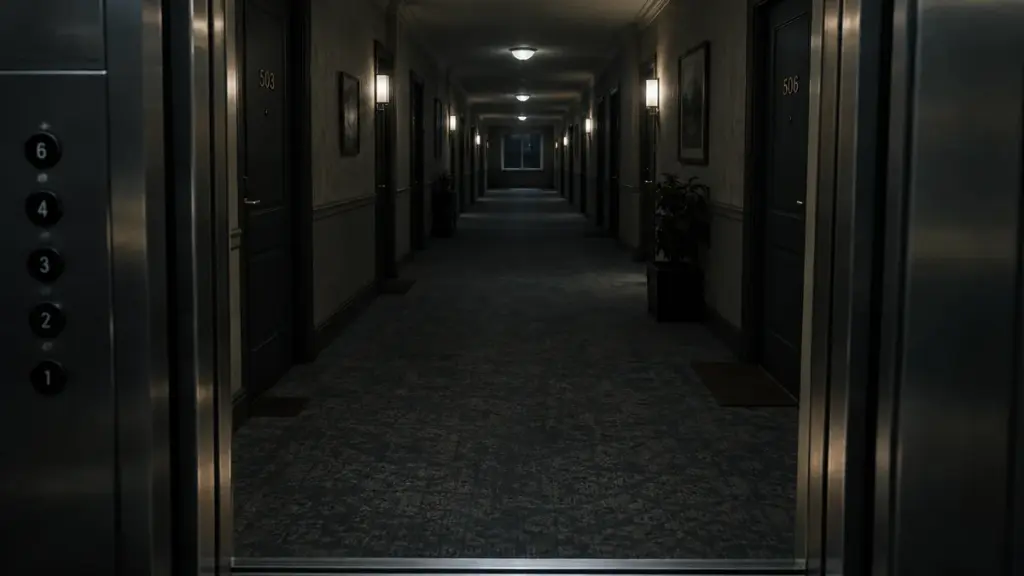
RECONSTRUCTION: Ravenwood reconstruction of the unidentified floor observed inside Wrenford Apartments based on tenant statements, building surveillance, and investigative documentation. The hallway resembles the occupied floors of the building but is completely silent, extends beyond the physical dimensions of the structure, and contains an unidentified elevator bell audible only from within the anomaly. This image is an Archive reconstruction and is not photographic evidence.
CLASSIFICATION: Location Anomaly / Impossible Architecture / Acoustic Suppression
STATUS: Active — Contained
THREAT LEVEL: III
FIRST RECORDED: March 17, 2024
PRIMARY LOCATION: Wrenford Apartments, Tacoma, Washington
STRUCTURE: Six-story residential building
OFFICIAL FLOOR PLAN: Floors 1–4 and 6
ANOMALOUS FLOOR: Unnumbered / physically unaccounted for
KNOWN ACCESS POINT: Main passenger elevator
CONFIRMED ENTRIES: 9
CONFIRMED RETURNS: 8
CONFIRMED MISSING: 1
PRIMARY PHENOMENON: Complete loss of audible sound after leaving the elevator
SECONDARY PHENOMENON: Unidentified elevator chime originating deeper within the floor
PHYSICAL EXTENT: Unknown
CURRENT RECOMMENDATION: Remain inside the elevator if an unmarked floor is reached. Do not attempt to locate the source of the bell.
DOCUMENTATION NOTE
Wrenford Apartments does not have a fifth floor.
This is not superstition.
The building was constructed without one.
The elevator panel reads:
There is no hidden button.
No covered plate.
No unfinished level between four and six.
The architectural plans account for the space.
So do exterior measurements.
The building is six stories tall.
There is simply no floor marked five.
On rare occasions, the elevator stops there anyway.
CASE SUMMARY
The first documented incident occurred on March 17, 2024, when Wrenford resident Maya Chen entered the elevator shortly after midnight and selected the sixth floor.
The elevator passed floor four.
Then stopped.
The floor indicator went blank.
Chen assumed there had been a malfunction.
The doors opened.
Beyond them was a hallway.
Same carpet.
Same wallpaper.
Same ceiling fixtures.
Same apartment doors.
Nothing visibly unusual.
Except Chen could not hear the elevator.
She could not hear the lights.
She could not hear herself breathing.
She stepped into the hallway.
Her shoes made no sound.
She clapped.
Nothing.
She shouted.
Nothing.
Then the elevator doors began closing behind her.
Chen immediately stepped backward into the car.
The doors shut.
The elevator continued to floor six.
Sound returned before the doors reopened.
She reported the malfunction the following morning.
Maintenance found nothing wrong.
The elevator logs showed no stop between floors four and six.
There was, however, a seventy-three-second delay in the trip.
Nobody considered that particularly important.
Yet.
WRENFORD APARTMENTS
Wrenford Apartments was completed in 1987.
The building contains forty-eight residential units distributed across five occupied residential levels.
Floor numbering skips five.
The reason is mundane.
The original developer reportedly believed apartments labeled with the number five rented poorly in the local market at the time.
Ravenwood has been unable to find evidence supporting the belief.
Developers have done stranger things.
What matters is architectural continuity.
Floor four sits directly beneath floor six.
Measurements confirm it.
There is no concealed structural level between them.
No maintenance floor.
No abandoned construction space.
No undocumented mezzanine.
The elevator shaft passes through approximately fourteen feet of vertical space between the two stops.
That is normal.
The hallway Chen entered was not.
THE SECOND INCIDENT
The next documented occurrence came four months later.
Resident Patrick Lowe entered the elevator at 2:08 a.m.
He was returning from work.
His destination was floor three.
The elevator passed floor two.
Stopped.
The indicator went dark.
The doors opened.
Lowe initially believed he had reached floor three.
He stepped out.
The doors remained open behind him.
According to Lowe, the hallway looked almost identical to his own floor.
There were eight apartment doors.
Four on each side.
A window stood at the far end.
The ceiling lights were on.
Lowe noticed the silence immediately.
He later described it as:
“Not quiet. Missing.”
That distinction appears repeatedly in later accounts.
Lowe attempted to speak.
He felt his throat move.
He felt air leave his mouth.
He heard nothing.
He snapped his fingers beside his ear.
Nothing.
Then he noticed the elevator doors beginning to close.
He ran back.
Before the doors met, Lowe heard something.
A single electronic chime.
The same sound Wrenford’s elevator makes when arriving at a floor.
It did not come from the elevator behind him.
It came from farther down the hallway.
The doors closed.
Lowe returned to floor three.
THE BELL
The bell changed the file.
Silence can have mechanical explanations.
Soundproofing.
Pressure differences.
Hearing impairment.
Psychological response.
Recording failure.
The hallway apparently suppressed all sound generated within it.
Except one.
The elevator bell.
Every individual who has spent more than approximately thirty seconds on the floor has reported hearing it.
The sound is remarkably consistent.
One clear electronic tone.
Approximately two seconds long.
Then silence.
The location varies.
Sometimes directly ahead.
Sometimes around a corner.
Sometimes seemingly behind an apartment door.
It always sounds distant.
No witness has identified its source.
One tried.
THE THIRD INCIDENT
On November 2, 2024, resident Aaron Bell entered the anomalous floor.
Bell had heard rumors from other tenants.
He had also consumed enough alcohol to consider those rumors an invitation.
There were alternatives.
Bell exited the elevator carrying his phone.
The elevator’s interior camera recorded him stepping into the hallway.
The doors remained open for sixty-one seconds.
Bell walked approximately twenty feet from the car.
He turned.
He waved toward the elevator camera.
Then pointed down the hall.
No audio exists.
At approximately thirty-eight seconds, Bell reacted sharply.
He turned toward the far end of the corridor.
This is believed to correspond with the chime.
Bell began walking toward it.
The elevator doors started closing.
He noticed.
He ran back.
He reached the doors after they had nearly met and forced them apart with both hands.
The obstruction sensor responded normally.
Bell returned to the car.
He was laughing when sound returned.
Then he began crying.
He later told responding officers that when the bell rang, one of the apartment doors had opened.
Nobody came out.
Bell said he could not see inside.
Only darkness.
When asked why he walked toward it, he gave the same answer three times.
“I thought somebody needed the elevator.”
THE SOUND TEST
Wrenford management eventually contacted Ravenwood after repeated service inspections found no mechanical fault.
Our first controlled entry occurred on January 9, 2025.
Two investigators entered the elevator.
The car was equipped with:
Three digital audio recorders.
Two body cameras.
A sound-pressure meter.
A portable radio.
A mechanical alarm bell.
An air horn.
A battery-powered speaker producing a continuous 1 kHz tone.
The anomalous stop occurred after fourteen controlled rides between floors four and six.
The indicator blanked.
The doors opened.
The speaker was already producing its tone.
Investigator M. Hale carried it into the hallway.
The sound stopped the moment the speaker crossed the elevator threshold.
The speaker remained powered.
Its cone continued moving.
The sound-pressure meter registered no measurable output above ambient baseline.
Hale brought the speaker back into the elevator.
The tone immediately returned.
No gradual transition.
Inside:
Sound.
Outside:
None.
The threshold was approximately two inches beyond the elevator sill.
We repeated the test six times.
Results were identical.
SPEAKING WITHOUT SOUND
Human speech behaved the same way.
Investigators could feel themselves speaking.
Body cameras captured mouth movement.
Audio recorders captured nothing.
Not low volume.
Nothing.
Inside the elevator, recordings remained normal.
Cross the threshold:
Flat silence.
Investigators reported being able to feel internal bodily sounds.
Heartbeat.
Swallowing.
Jaw movement.
One investigator described hearing something resembling pressure inside the skull.
External sound was absent.
This created immediate communication problems.
Hand signals became mandatory.
The floor was thereafter designated an acoustic-isolation environment.
That designation lasted eleven minutes.
Then the bell rang.
THE FIRST RAVENWOOD CHIME
At 1:42 a.m., both investigators heard the arrival tone.
The sound came from beyond the visible end of the corridor.
Both body cameras show the investigators reacting simultaneously.
Neither audio track contains the chime.
This is important.
The investigators heard it.
The recording equipment did not.
The sound was therefore either:
Not acoustic.
Not externally generated.
Or not being perceived through the ears.
Hale later described it as perfectly normal.
That may be the most abnormal detail.
Nothing else could make noise.
The bell sounded exactly as expected.
THE HALLWAY
Initial visual measurements placed the visible corridor at approximately eighty feet.
That should not fit inside Wrenford Apartments.
The building is roughly sixty-three feet wide along that axis.
Investigators marked the elevator threshold and advanced while measuring distance with a laser rangefinder.
At sixty feet:
Hallway.
At seventy:
Hallway.
At eighty:
Hallway.
At ninety:
Hallway.
At 103 feet, the device stopped returning reliable measurements.
The corridor continued.
Exterior geometry does not permit this.
There is no ambiguity.
Whatever occupies the anomalous floor extends beyond the physical boundary of the building.
No corresponding structure is visible outside.
Wrenford’s fifth floor is not hidden.
It is somewhere else.
THE WINDOWS
The first hallway contained one window at its far end.
Investigator Hale eventually reached it during the second controlled entry.
The window was real enough to touch.
The glass was cool.
The frame appeared identical to windows installed elsewhere in Wrenford.
The view outside was not Tacoma.
There were no neighboring buildings.
No city lights.
No road.
No recognizable skyline.
Hale described seeing a dark exterior courtyard enclosed by additional wings of the apartment building.
Wrenford has no courtyard.
The structure appeared to continue in every direction.
Rows of windows extended into darkness.
Some were illuminated.
No movement was observed.
Hale photographed the view.
Every image captured through the window was completely black.
THE APARTMENTS
The corridor contains numbered doors.
The numbering does not correspond with Wrenford’s official units.
Observed examples include:
The sequence changes between entries.
Investigators initially placed removable markers near several doors.
None were present during subsequent access.
No apartment door has been opened under Ravenwood authorization.
Not initially.
Again:
Authorization and behavior are different things.
UNIT 511
On March 22, 2025, Investigator Lucas Reed attempted to open Unit 511 without authorization.
Reed later stated that he believed he had seen the door move.
His body camera confirms slight inward motion.
He approached.
The handle turned freely.
Reed opened the door approximately six inches.
The interior was dark.
His flashlight illuminated what appeared to be an apartment entryway.
There was carpet.
A coat rack.
A small table.
A framed photograph.
Reed closed the door.
He did not enter.
This was the correct decision.
The photograph was visible for fourteen frames.
Enhancement revealed four people standing together.
Three remain unidentified.
The fourth appears to be Lucas Reed.
The photograph predates his entry.
There is no rational basis for that statement.
It remains accurate.
Reed has not returned to the floor.
We have been quite clear about unauthorized doors since.
THE ELEVATOR TIMER
After repeated entries, Ravenwood identified a consistent behavior.
Once someone exits the elevator, the doors remain open for approximately sixty seconds.
Normal hold functions do not prevent closure.
Blocking the sensor sometimes works.
Sometimes does not.
After sixty seconds, the doors attempt to close.
If all personnel have returned, the elevator departs normally.
If someone remains outside, the elevator still departs.
There is no call button in the hallway.
No visible elevator controls.
No emergency panel.
No stairwell has been located.
Anyone left behind must find another means of return.
That fact became relevant on May 6.
INVESTIGATOR OWENS
Investigator Sarah Owens entered the floor during Ravenwood’s fifth controlled access.
Her assignment was limited.
Remain within twenty feet of the elevator.
Photograph the corridor.
Return at thirty seconds.
The bell rang at twenty-four.
Owens turned toward it.
The body camera shows nothing unusual.
Then a second bell rang.
Closer.
Owens began moving down the hall.
Her partner signaled for her to return.
Owens continued.
At forty-nine seconds, she disappeared around a corner.
Her partner followed approximately ten feet before retreating.
The elevator doors began closing.
Owens did not return.
Her partner attempted to hold the doors.
The doors closed.
The car returned to floor four.
Ravenwood immediately initiated repeated elevator cycling.
The anomalous floor did not reappear.
Not that night.
Not the next.
It returned eleven days later.
Owens was not there.
THE SECOND ELEVATOR
During the first access after Owens disappeared, Ravenwood investigators discovered something new.
Approximately 146 feet down the corridor was another elevator.
It appeared identical to Wrenford’s passenger elevator.
Same brushed metal doors.
Same frame.
Same call button.
The button illuminated when pressed.
No sound occurred.
Thirty-two seconds later:
The bell rang.
The doors opened.
Nobody entered.
Nobody exited.
The elevator car was empty.
Its interior panel contained only one button.
No number.
Just a blank circular plate.
The team did not enter.
That decision remains one of the more successful decisions associated with this file.
OWENS’S CAMERA
Twenty-nine days after Owens disappeared, a Wrenford resident found a body camera inside the normal elevator.
It was Sarah Owens’s.
Nobody had placed it there.
Security footage shows the elevator arriving empty.
The camera is visible on the floor when the doors open.
Its battery was dead.
The final recording lasts two hours and seventeen minutes.
Most of it shows Owens walking.
The hallway continues.
Corners lead to additional corridors.
Additional corridors lead to additional elevator banks.
Apartment numbering becomes less consistent.
Numbers containing six digits.
One door has no number at all.
Owens repeatedly attempts to speak.
No sound is recorded.
At 1:36:41, she begins running.
There is nothing visible behind her.
At 1:37:03, the camera falls.
Owens apparently picks it up.
She continues walking.
Then:
At 2:11:08, the recording contains audio.
One sound.
An elevator bell.
This is the only confirmed recording on which the bell is audible.
Owens stops.
The camera turns.
At the far end of the corridor, an elevator door is open.
Someone is standing inside.
The image is too distant for identification.
Owens walks toward it.
The recording ends six seconds before she reaches the doors.
The camera returned.
Owens did not.
WHY THE FLOOR IS QUIET
Ravenwood has no confirmed explanation.
The environment does not appear merely soundproof.
Sound does not propagate normally within it.
Mechanical vibration continues.
Objects impact surfaces.
Air moves.
Human vocal cords function.
The expected pressure waves simply fail to produce audible sound.
Or they are prevented from reaching observers.
The elevator chime operates outside this rule.
That suggests the chime is not truly sound.
It may instead be a perceptual event.
A signal.
A location marker.
Possibly an instruction.
Owens followed it.
So did Bell.
The urge to approach should therefore be considered part of the phenomenon.
IT SOUNDS LIKE ARRIVAL
The chime used by Wrenford’s actual elevator is designed for one purpose.
To tell waiting passengers that transportation has arrived.
Inside the Quiet Floor, the same signal repeatedly draws people deeper into the structure.
This may be coincidence.
Ravenwood does not presently believe it is.
The floor removes every other sound.
Then provides one.
The one sound most likely to make a lost person think:
There is the way out.
That is efficient.
THE APARTMENT DOORS
Since Owens’s disappearance, investigators have documented thirty-seven distinct apartment numbers.
No door has remained in the same relative position across every entry.
Some repeat.
Some disappear.
Some appear much farther down the corridor than before.
Three doors have displayed names instead of numbers.
One belonged to Sarah Owens.
One belonged to Investigator Hale.
The third belonged to a Wrenford tenant who had died six years before the first recorded incident.
None have been opened.
Current protocol prohibits approaching named doors.
The protocol exists for good reasons.
We would prefer not to acquire additional ones.
THE OTHER TENANTS
No living occupants have been confirmed inside the anomalous structure.
Movement has been seen.
A silhouette crossed an intersecting hallway during Entry Seven.
A person-shaped figure appeared behind frosted glass in Unit 518.
A body camera captured what appears to be a woman standing approximately sixty feet behind the investigation team.
When investigators turned around, nobody was present.
No sound accompanied any sighting.
No figure has directly approached Ravenwood personnel.
That does not make the floor unoccupied.
It means its occupants are quiet.
An admittedly low bar in this location.
THE ELEVATOR CAMERA
Wrenford’s normal elevator contains one security camera.
The footage has produced another inconsistency.
People who step onto the anomalous floor are visible until the elevator doors close.
Afterward, archived footage occasionally contains additional frames.
In seven instances, the elevator doors reopen onto the Quiet Floor without the elevator having returned there.
The interval lasts less than one second.
The hallway is visible.
Nobody is present.
Except once.
On August 18, 2025, a single frame showed a woman standing directly outside the elevator.
Analysis strongly suggests Sarah Owens.
Her head is turned away.
The following frame shows floor six.
Owens remains missing.
CONTAINMENT
Wrenford’s elevator cannot simply be removed.
Ravenwood considered it.
The anomalous stop has occurred despite replacement of:
The control board.
Floor-position sensors.
Door hardware.
Elevator software.
Emergency systems.
Primary motor components.
The entire interior control panel.
During a three-week period in which the original elevator was taken offline, the service elevator stopped on the Quiet Floor instead.
This ended the mechanical hypothesis.
The phenomenon is not attached to an elevator.
The elevators are simply how it opens.
WHAT WE DO NOT KNOW
We do not know where the Quiet Floor physically exists.
We do not know how large it is.
We do not know why it resembles Wrenford Apartments.
We do not know why sound is suppressed.
We do not know how the elevator bell remains perceptible.
We do not know whether the bell is generated by an actual elevator.
We do not know whether the secondary elevators return to Wrenford.
We do not know who occupies the apartments.
We do not know why some doors carry the names of investigators.
We do not know whether Sarah Owens remains alive.
We do not know who returned her camera.
We do not know whether she was the person standing inside the distant elevator.
And we do not know why the floor occasionally opens when nobody inside the elevator has selected a destination.
WHAT WE KNOW
The floor exists.
Multiple people have entered it.
Its geometry exceeds the dimensions of Wrenford Apartments.
External sound generation fails beyond the elevator threshold.
The elevator bell remains perceptible.
The bell consistently encourages investigation.
Apartment layouts and numbering change.
Multiple elevators exist deeper within the structure.
Sarah Owens disappeared after following the bell.
Her body camera returned without her.
The floor continues to appear.
And the elevator still opens its doors.
THE MOST LIKELY WORKING MODEL
Ravenwood currently classifies the Quiet Floor as a location-based spatial anomaly using elevator transit as an access mechanism.
The environment imitates Wrenford’s architecture but is not physically contained within the building.
Acoustic suppression appears intentional or intrinsic to the space.
The recurring elevator bell may function as a navigational signal.
Whether it guides visitors toward exits, deeper access points, or something else remains unknown.
The floor does not presently demonstrate overt aggression.
It does not need to.
It opens a door.
It removes communication.
It gives you one recognizable sound.
Then it waits for you to follow it.
ARCHIVIST’S NOTES
I dislike silent places.
People call silence peaceful because they usually mean somewhere with birds.
Wind.
A refrigerator humming.
A car three streets away.
Actual silence is different.
Actual silence feels like something has been removed.
Hale described the floor correctly.
It is not quiet.
It is missing.
We’ve recreated the threshold test enough times.
Speaker playing.
Move it forward.
Gone.
Bring it back.
There it is.
Simple.
Clean.
Repeatable.
I would have preferred complicated.
The bell is the part I cannot leave alone.
Everything on that floor has been stripped of sound.
Shoes.
Doors.
Voices.
Equipment.
Then an elevator arrives somewhere a hundred feet away and somehow you hear it perfectly.
That is not an exception.
Exceptions are accidents.
That sounds designed.
Owens knew the rules.
She helped write some of them.
Then the bell rang twice and she followed it anyway.
I have watched that footage more times than I should.
There is no visible reason for her to go.
She simply turns.
Listens.
And walks.
The camera we got back bothers everyone else because of the figure in the elevator.
That is not the part that bothers me.
The camera came back to Wrenford.
Meaning at least one of the elevators down there knows the way home.
Something put the camera inside.
Or someone did.
Either possibility is useful.
Neither is comforting.
For now, the best rule remains the first one Chen discovered accidentally.
When the doors open somewhere they should not:
Stay in the elevator.
You do not need to know what’s at the end of every hallway.
A surprisingly useful principle.
CURRENT RECOMMENDATION
Wrenford Apartments remains occupied under restricted monitoring.
Residents have been instructed that any elevator stop accompanied by a blank floor indicator should be treated as a mechanical emergency.
The actual instructions are simpler:
Remain inside the elevator.
Do not cross the threshold.
Do not attempt to test the silence.
Do not approach apartment doors.
Do not follow visible persons into the hallway.
Do not attempt to locate another elevator.
Most importantly:
If you hear the bell, do not move toward it.
Press any normal floor button.
Remain inside the car.
Allow the doors to close.
If they do not close, activate the emergency stop and wait.
Do not investigate.
The Quiet Floor has demonstrated no difficulty getting people to enter voluntarily.
We see no reason to assist it.
CASE STATUS
ACTIVE — CONTAINED
The Quiet Floor remains an active location anomaly associated with Wrenford Apartments in Tacoma, Washington.
The anomalous floor cannot be reconciled with the building’s physical dimensions and is not represented on architectural plans.
Individuals crossing the elevator threshold experience complete external acoustic suppression.
Despite this, an elevator arrival chime remains consistently perceptible from deeper within the anomaly.
The source of the chime has not been established.
Additional elevators exist inside the location.
Their destinations are unknown.
One Ravenwood investigator, Sarah Owens, remains missing after following the chime beyond the primary corridor.
Her body camera was subsequently returned through unexplained means.
The anomaly continues to manifest intermittently.
Current containment relies on preventing occupants and investigators from leaving the elevator when access occurs.
No further exploratory entry is authorized.
The hallway does not appear to pursue anyone.
It has never needed to.
RAVENWOOD ORIGINAL
This case is a work of fiction created for Ravenwood Archive. Names, characters, locations, events, and accompanying evidence are fictional or presented as part of the story.
FILE REMAINS OPEN