
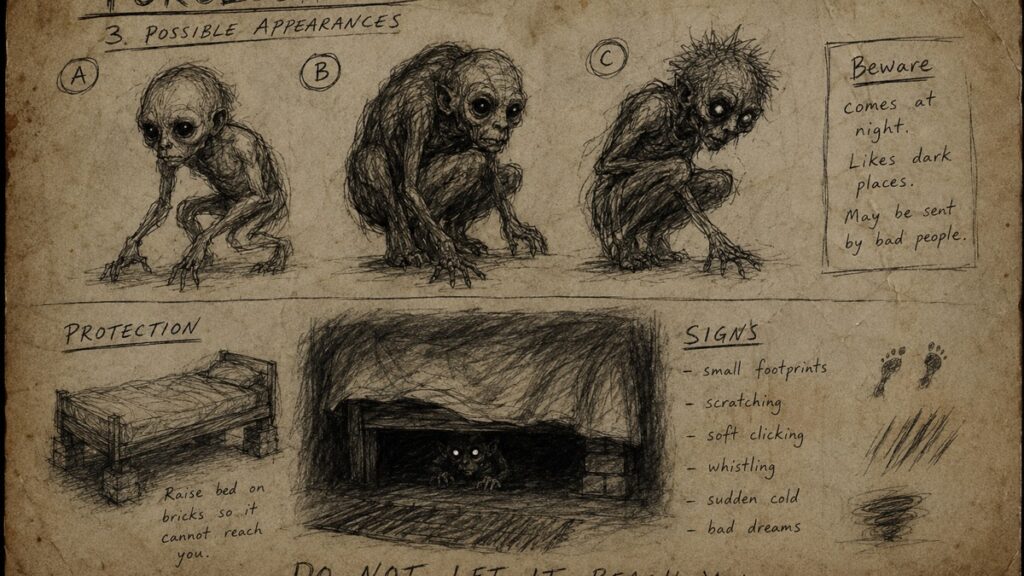
RECONSTRUCTION: Ravenwood reconstruction of a reported Tokoloshe-associated nighttime disturbance. Any accompanying image should emphasize the domestic setting, the intrusion, and the impression of a small threatening presence rather than a clear monster portrait. This image is an Archive reconstruction and is not photographic evidence.
CLASSIFICATION: Folklore / Nocturnal Household Entity
STATUS: Folkloric — Unverified
PRIMARY REGION: Southern Africa
ASSOCIATED TRADITIONS: Zulu / Xhosa / broader southern African witchcraft belief contexts
ASSOCIATED LOCATIONS: Homes, sleeping areas, rural settlements, townships, nighttime domestic spaces
COMMON DESCRIPTION: Small humanoid or goblin-like being associated with mischief, fear, illness, and witchcraft
COMMON PROTECTIVE MEASURE: Raising beds on bricks or blocks
VERIFIED FIRST REPORT: None established
PHYSICAL EVIDENCE: None verified
CONFIRMED FATALITIES ATTRIBUTABLE TO PHENOMENON: None verified
CURRENT ACTIVITY: Ongoing as belief and folklore
CURRENT RECOMMENDATION: Treat reported encounters as culturally significant folklore claims unless independently documented. Do not dismiss witnesses, and do not mistake belief for proof.
DOCUMENTATION NOTE
The Tokoloshe is not best approached as a single “monster sighting” case.
It is better understood as a long-lived southern African folklore figure tied to household fear, witchcraft belief, and explanations for nocturnal misfortune.
That creates an unusual Archive problem.
The Tokoloshe is well known.
The evidence is not.
Descriptions vary.
Motives vary.
Even the creature’s exact appearance varies.
What remains stable is the role it plays.
It enters the home.
It acts at night.
It is feared.
And it is often linked to harm believed to have been sent by another person through witchcraft or spiritual malice. [1][2]
That is enough to make the Tokoloshe culturally real.
It is not enough, by itself, to establish the existence of a literal entity.
CASE SUMMARY
The Tokoloshe, also rendered as Tikoloshe and by several other variant spellings, is a feared supernatural being in southern African folklore.
Modern summaries commonly describe it as small, humanoid, nocturnal, and potentially dangerous. It is frequently associated with mischief at its mildest and illness, terror, or death at its most serious. [1][2]
The creature is not consistently treated as an independent wild thing.
In many accounts, it is connected to witchcraft.
It may be sent.
Summoned.
Directed.
Or otherwise brought against a target by a hostile human agent. [1][2]
This feature matters.
The Tokoloshe is not only a bogeyman.
It is also part of a broader framework of belief about misfortune, jealousy, illness, and spiritual attack.
That means the creature is not simply “seen.”
It is also blamed.
When something happens in the night and no explanation satisfies, the Tokoloshe is already waiting.
THE HOUSEHOLD INTRUSION
The Tokoloshe belongs indoors.
That is one reason the folklore is so effective.
Many legendary beings remain in distant forests, caves, mountains, or rivers.
The Tokoloshe enters the room.
It is associated with sleeping spaces, nighttime disturbances, and the vulnerability of the home after dark. [1][2]
That domestic setting does most of the work.
The victim is not exploring a ruin.
They are in bed.
Or trying to be.
In many tellings, the threat is strongest when the witness is asleep, half-awake, or newly awakened.
That makes the experience difficult to verify and nearly impossible to separate cleanly from dream, fear, or suggestion.
It also makes the story much harder to forget.
THE BEDS ON BRICKS
One of the most widely repeated Tokoloshe details is also one of the most memorable.
Beds are raised.
Usually on bricks.
Sometimes on blocks.
The purpose is simple.
To keep the Tokoloshe from reaching the sleeper. [1][2]
This is one of the rare folkloric details that extends beyond the creature itself and into daily behavior.
It is not merely a story about danger.
It is a story that produces a response.
That response matters to Ravenwood because it shows how belief moves from narration into practice.
A creature people only tell stories about is one kind of folklore.
A creature that alters how people sleep is another.
This does not prove the Tokoloshe exists as a literal being.
It does prove that fear of it has been materially real.
That distinction will remain important throughout this file.
DESCRIPTION PROBLEMS
Anyone hoping for a single reliable anatomical profile will be disappointed.
Some descriptions present the Tokoloshe as dwarf-like.
Others as goblin-like.
Some emphasize a large head or unusual eyes.
Others focus more on behavior than form.
Several accounts suggest invisibility or partial concealment under certain conditions. [1]
This instability is not unusual in folklore.
The clearer a modern illustration becomes, the less likely it is to reflect older oral tradition accurately.
Tokoloshe imagery has been sharpened by retelling.
The underlying tradition has not always been equally specific.
Ravenwood therefore does not maintain a definitive visual reconstruction beyond the broadest shared features:
Small stature.
Humanlike form.
Nocturnal presence.
Association with household intrusion and fear.
Everything more exact should be treated cautiously.
The creature has become easier to draw than to document.
THE WITCHCRAFT CONNECTION
The Tokoloshe is strongly tied to beliefs about witchcraft and bewitchment.
In modern South African discussion of witchcraft-related fear, the Tokoloshe is specifically cited as a being believed to be created or sent by witches and capable of causing illness or death. [2]
That link changes the meaning of the encounter.
A Tokoloshe is not only a creature.
It may also be read as evidence that another person wishes you harm.
That makes every alleged sighting socially heavier than it first appears.
A strange sound in the night is one thing.
A Tokoloshe is an accusation waiting to happen.
Belief systems built around hidden malice tend to produce fear quickly and certainty even faster.
That certainty can have real consequences for the living whether or not any supernatural being was ever present.
CHILDREN, FEAR, AND WARNING
The Tokoloshe occupies an uncomfortable space between cautionary tale and hostile entity.
Some summaries present it as a figure used to frighten or discipline children.
Others emphasize that it is more dangerous to adults or to those specifically targeted through witchcraft. [1]
These functions are not mutually exclusive.
Folklore often survives precisely because it does more than one job.
It can warn children not to wander.
Explain sounds in the night.
Externalize jealousy and conflict.
Provide language for fear.
And offer a ready-made answer when no ordinary cause is visible.
The Tokoloshe endures because it is useful.
That usefulness may tell us more about the story than any alleged footprint ever could.
A NIGHT CREATURE
Night belongs to the Tokoloshe in a way that daylight does not.
This is not a trivial detail.
Darkness reduces certainty.
Sleep weakens observation.
Rooms distort shape and sound.
Half-seen movement becomes more persuasive than it ought to be.
The folklore uses all of that.
The Tokoloshe is rarely framed as a daylight encounter in a public square.
It comes when witnesses are isolated, vulnerable, and uncertain.
That environment is ideal for belief and poor for evidence.
These two conditions frequently coexist.
The weaker the evidence, the stronger the conviction can become.
Especially when the witness already lives within a cultural framework where the Tokoloshe is an available explanation.
THE EVIDENCE PROBLEM
Ravenwood has located no verified specimen, no authenticated photograph, no confirmed biological trace, and no police or medical record demonstrating that an unknown small humanoid being entered homes at night and attacked occupants.
That does not make the folklore trivial.
It does keep the case where it belongs.
Under documented belief.
Not established entity.
This distinction matters because the Tokoloshe is sometimes discussed as though frequency of belief alone settles the matter.
It does not.
Many people can fear the same thing.
Many people can tell the same story.
Many people can alter their behavior because of that story.
None of this automatically produces proof that a literal creature is responsible.
The danger, in archival terms, is confusing cultural persistence with empirical verification.
WHAT THE TOKOLOSHE MAY EXPLAIN
The Tokoloshe functions, in part, as an explanation system.
Why did someone wake in terror?
Why did illness arrive suddenly?
Why was a child troubled by nightmares?
Why was there misfortune in the home?
Why did someone feel a presence at the bedside?
In a culture where spiritual attack is taken seriously, the Tokoloshe offers an answer before an investigation begins.
That does not mean the answer is false.
It means it arrives preassembled.
From an investigative standpoint, this matters enormously.
A witness who says “something frightened me in the night” leaves many possibilities open.
A witness who says “the Tokoloshe came” has already interpreted the event through an existing framework.
The interpretation may be sincere.
It may also prevent further clarity.
Folklore is often most powerful at exactly that point.
REGIONAL AND CULTURAL RANGE
The Tokoloshe is most strongly associated in modern summaries with Zulu and Xhosa traditions, but it is also discussed more broadly within southern African cultural and religious contexts. [1][2]
Ravenwood does not treat the figure as belonging to only one clean, isolated story tradition.
That would be misleading.
The creature appears in different settings, with different emphases, and sometimes with different levels of seriousness.
In one telling, it is an intrusive nuisance.
In another, it is a deadly agent.
In another, it is part of a larger pattern of witchcraft fear.
This flexibility helps explain its survival.
The Tokoloshe is not trapped in a single plot.
It adjusts to the needs of the teller.
That is how folklore remains alive.
It is also why folklore is so difficult to pin down as evidence.
WHAT WE DO NOT KNOW
We do not know when the earliest Tokoloshe tradition first took recognizable shape.
We do not know whether the oldest version described the being in the same way later retellings do.
We do not know whether all Tokoloshe traditions point to one underlying figure or several related traditions that have been compressed together.
We do not know how many reported encounters began as dreams, sleep disturbances, illness experiences, interpersonal suspicion, or deliberate deceit.
We do not know whether any alleged Tokoloshe case involved an objective unknown entity.
Those gaps are substantial.
They should remain visible.
WHAT WE DO KNOW
The Tokoloshe is a widely recognized figure in southern African folklore. [1][2]
It is commonly associated with nocturnal household intrusion, fear, misfortune, and witchcraft. [1][2]
A well-known protective custom involves raising beds on bricks or blocks. [1][2]
Descriptions of the being vary considerably, suggesting a fluid folklore tradition rather than a single stable eyewitness profile. [1]
Belief in the Tokoloshe has social consequences beyond storytelling, especially where witchcraft accusations and spiritual explanations for harm remain influential. [2]
That is enough to establish the Tokoloshe as an important cultural subject.
It is not enough to classify it as verified supernatural fauna.
ARCHIVIST’S NOTES
Some legends live in the wilderness.
The Tokoloshe lives beside the bed.
That is a more intimate kind of problem.
There is something especially efficient about a creature that does not require a journey, a ritual, or a storm. It only requires darkness and a room with a sleeping person in it.
I suspect that is one reason the story survives.
Another is that the Tokoloshe is rarely only a creature.
It is also a suspicion.
If the thing was sent, then someone sent it.
If someone sent it, then the danger did not begin in the dark.
It began with another person.
That makes the folklore more socially dangerous than many imported “monster” stories that modern readers may be tempted to compare it to.
This is not just about being frightened.
It is also about blame.
That deserves caution.
The custom of raising beds is especially revealing.
People do not usually rearrange furniture because of stories they regard as decorative.
They do so because, on some level, they are hedging against the possibility that the story might be true.
Or true enough.
I am not convinced a Tokoloshe has ever crossed a floor in the literal sense described by the legend.
I am convinced the fear has.
That may sound smaller.
It isn’t.
A fear that changes behavior has already entered the house.
Whether anything followed it remains the open part of the file.
CURRENT RECOMMENDATION
The Tokoloshe should presently be treated as a culturally significant folklore tradition rather than a verified supernatural entity.
Any claimed encounter should be documented as a witness report, not accepted automatically as proof of an objective creature.
If investigating a report, record:
Exact location.
Date and time.
Sleeping or waking state of the witness.
Number of witnesses.
Description of the alleged figure.
Sounds heard before visual contact.
Any signs of forced entry or ordinary household disturbance.
Prior knowledge or belief regarding the Tokoloshe.
And whether the witness associates the event with suspected witchcraft or interpersonal conflict.
That final point may be socially sensitive.
Treat it accordingly.
Do not mock witnesses.
Do not encourage accusations against neighbors, relatives, or healers without evidence.
And do not confuse the absence of proof with the absence of impact.
Folklore can still do damage long before a monster is ever found.
CASE STATUS
ARCHIVED — INSUFFICIENT EVIDENCE
The Tokoloshe remains a documented and culturally significant southern African folklore figure associated with nighttime household intrusion, fear, and witchcraft belief.
No authenticated physical, photographic, biological, or forensic evidence currently establishes the existence of the being as an objective supernatural entity.
Descriptions vary across accounts, and the creature’s significance appears closely tied to broader patterns of belief, explanation, and social tension.
The folklore is real.
The entity remains unverified.
FILE REMAINS OPEN
RESEARCH SOURCES
[1] Wikipedia — “Tokoloshe”
Used for the broad outline of the legend, variant spellings, common descriptions, invisibility motif, household intrusion theme, and the widely reported custom of raising beds to avoid the creature.
Source Type: Freely licensed reference source — Creative Commons Attribution-ShareAlike.
No wording from the source has been reproduced. Factual elements were independently paraphrased into Ravenwood Archive prose.
[2] Yaseen Ally, “Burn the witch: The impact of the fear of witchcraft on social cohesion in South Africa” (2015), Psychology in Society / SciELO South Africa
Used for cultural context regarding continuing witchcraft belief in South Africa and for the Tokoloshe’s place within beliefs about harmful witchcraft, illness, and social tension.
Source Type: Open-access academic source.
No wording from the article has been reproduced. It was used only for factual grounding and contextual understanding.