
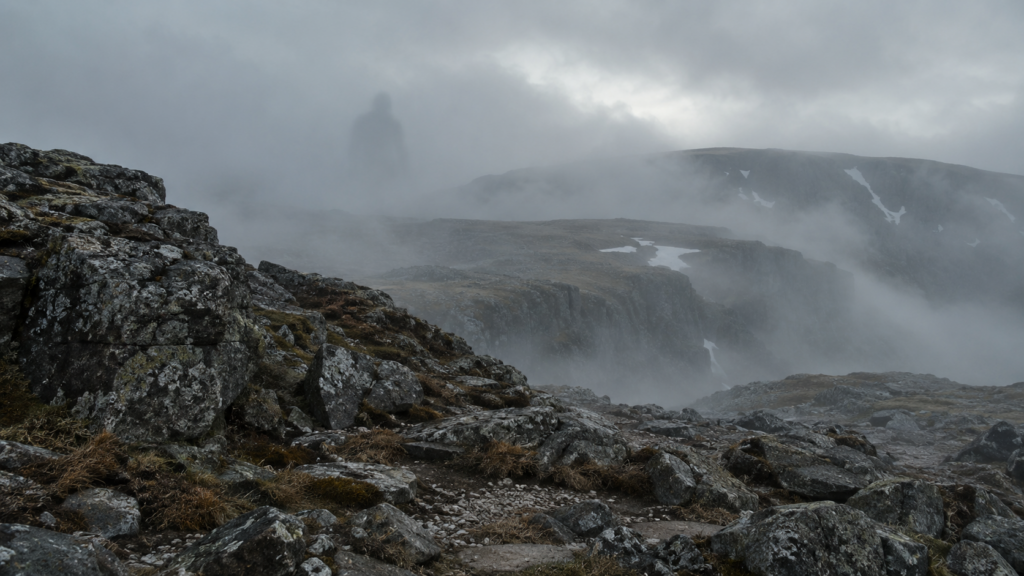
LOCATION RECORD: Ben Macdui, Scotland. Original photograph by Graham Ellis via Geograph/Wikimedia Commons, licensed under CC BY-SA 2.0. Edited by Ravenwood Archive with subject/object removal, added fog, and tonal darkening. Adapted version licensed under CC BY-SA 2.0.
CLASSIFICATION: Mountain Folklore / Apparitional Presence
STATUS: Folkloric — Unverified
ALTERNATE NAME: Am Fear Liath Mòr / The Big Grey Man
PRIMARY LOCATION: Ben Macdui, Cairngorms, Scotland
ELEVATION: Approximately 1,309 metres
EARLIEST FAMOUS ACCOUNT: Experience reportedly occurred in 1891; publicly related in 1925
COMMON PHENOMENA: Unseen footsteps, immense apparent presence, abnormal dread, occasional reports of a large figure in mist
PHYSICAL EVIDENCE: None verified
CONFIRMED FATALITIES ATTRIBUTABLE TO PHENOMENON: None
CURRENT ACTIVITY: Unconfirmed
CURRENT RECOMMENDATION: Treat alleged encounters as folklore reports while accounting for poor visibility, isolation, mountain weather, acoustic effects, fatigue, and atmospheric optical phenomena.
DOCUMENTATION NOTE
The Grey Man presents a useful problem.
Most monsters are remembered for being seen.
This one often isn’t.
The figure known as Am Fear Liath Mòr, commonly translated as the Big Grey Man, is associated with Ben Macdui in Scotland’s Cairngorm Mountains.
The mountain itself is real enough.
At roughly 1,309 metres, Ben Macdui is the second-highest mountain in Britain. [1]
The Grey Man is less cooperative.
Reports generally emphasize an unexplained presence rather than a clear anatomical sighting.
Footsteps.
Movement in mist.
The impression of something following.
And, repeatedly, fear.
Not ordinary caution.
Not discomfort.
Fear severe enough that experienced mountaineers have reportedly abandoned the summit and descended rapidly.
There is no verified specimen.
There is no reliable photograph of a creature.
There is not even one consistent description.
There is mostly a mountain.
Fog.
And the feeling that someone else is walking in it.
CASE SUMMARY
The Grey Man of Ben Macdui is a figure from Scottish mountain folklore associated with the summit plateau and surrounding high ground of Ben Macdui.
Modern descriptions occasionally give it an enormous humanoid form—thin, long-limbed, and far taller than an ordinary person.
Those descriptions should be approached cautiously.
Many of the best-known reports do not involve seeing such a figure at all. [1]
Instead, witnesses describe hearing footsteps apparently following them through mist.
The rhythm is wrong.
A climber takes several steps.
Something behind them appears to take one.
The sound repeats.
The witness stops.
The sound stops.
Walking resumes.
So does the follower.
Nothing appears through the fog.
Then the fear begins.
That pattern forms the center of the Grey Man legend.
Not a face.
Not claws.
Not an attack.
Something keeping pace where nothing should be.
BEN MACDUI
Ben Macdui rises in the Cairngorms of Scotland.
Its summit reaches approximately 1,309 metres, making it the second-highest mountain in Britain after Ben Nevis. [1]
Elevation alone does not explain the reputation.
The summit environment matters.
Ben Macdui belongs to a broad, exposed mountain plateau where weather can dramatically reduce visibility.
Fog and cloud can erase distant landmarks.
Rocky terrain makes footing uncertain.
Wind alters sound.
Distances become difficult to judge.
A person who knows exactly where they are in clear conditions may experience the same landscape very differently when visibility collapses.
This makes the mountain excellent territory for a legend.
It also makes it terrible territory for eyewitness certainty.
Both things can be true.
THE COLLIE ACCOUNT
The most influential Grey Man story is associated with Professor J. Norman Collie, a respected scientist and mountaineer.
Collie reportedly experienced something unusual while descending from the summit of Ben Macdui in 1891.
He did not publicly relate the story until 1925. [1]
Ravenwood will not reproduce Collie’s published wording.
The important details are straightforward.
Collie said he was walking through mist when he became aware of crunching sounds beyond those made by his own feet.
The sounds appeared to follow him.
More disturbing was the spacing.
According to his later account, the apparent follower seemed to cover considerably more ground with each step than Collie did.
He could see nobody.
The sounds continued.
Collie eventually became frightened enough to run from the mountain.
No creature was recovered.
No second witness was present.
No recording exists.
What remains is the recollection of an experienced mountaineer describing an event that disturbed him enough to remember it decades later.
That makes the account interesting.
It does not make the cause supernatural.
THE FOOTSTEPS
The footsteps deserve more attention than the figure.
They are the feature most capable of surviving without one.
Mountain terrain can create complicated echoes.
Footsteps striking loose stone can return from slopes or rock formations at unfamiliar intervals.
Wind can alter direction and apparent distance.
A person’s own movement can produce secondary sounds from clothing, equipment, displaced stone, or echoes.
Under poor visibility, the mind has very little visual information available to correct those interpretations.
One sound becomes two.
Then the second begins to feel separate.
Then intentional.
Then close.
Once the witness believes something is following them, every new sound arrives with an explanation already attached.
That does not mean Collie imagined the noise.
He may have heard exactly what he described.
The unanswered question is what produced it.
THE STRIDE
There is one detail that makes the story unusually effective.
The footsteps are not merely behind you.
They are farther apart than yours.
That implies size.
No figure needs to appear.
The witness calculates the creature for themselves.
One step for every three or four.
Longer stride.
Longer legs.
Larger body.
Something enormous.
This is more effective than seeing a ten-foot figure.
A visible figure can be measured badly.
An unseen follower has no upper limit.
The fog supplies whatever height is required.
THE GREY MAN
Later descriptions often provide a more definite creature.
Extremely tall.
Thin.
Grey or dark.
Long arms.
Broad shoulders.
Sometimes covered in hair.
Sometimes little more than a silhouette. [1]
Ravenwood does not consider this a stable anatomical description.
The earliest famous account does not require it.
That matters.
Once the idea of an enormous humanoid follower becomes established, later ambiguous shapes in fog have a ready identity.
A dark rock becomes a shoulder.
A moving cloud becomes a body.
A human shadow becomes something much larger.
By the time the witness looks again, the figure may already be gone.
This is precisely the sort of environment where reconstruction becomes dangerous.
So Ravenwood will not draw a definitive Grey Man.
There isn’t one.
THE BROCKEN SPECTRE
There is a documented atmospheric phenomenon capable of producing something remarkably close to a giant human figure on a mountain.
It is called a Brocken spectre.
When the Sun is behind an observer and mist or cloud lies ahead, the observer’s shadow can be projected onto the suspended water droplets.
The result can appear to be an enormous human figure standing at a considerable distance. [2]
The Met Office describes the effect as a giant shadow cast onto mist or cloud, with perspective making the figure appear distant and unusually large. [2]
The shadow may also appear to change as the cloud moves.
That is important.
A climber turns.
Something enormous turns.
The climber moves.
The figure moves.
It seems to follow because it does.
It is the observer.
This provides an excellent explanation for at least some alleged giant figures seen in mountainous fog.
It does not explain footsteps.
It does not explain every report.
It is still considerably better documented than the Grey Man.
THE FEAR
The most difficult part of this case to quantify is also one of its most persistent themes.
Dread.
Witnesses do not merely report curiosity.
They describe feeling watched.
Followed.
Driven away.
In some retellings, the fear appears before anything unusual is heard or seen.
This has encouraged more supernatural interpretations.
A psychic presence.
A territorial entity.
Something capable of producing fear directly.
There is no evidence establishing such an ability.
There are less exotic possibilities.
Isolation.
Rapidly deteriorating weather.
Loss of visual reference.
Fatigue.
Cold.
Wind.
Reduced visibility.
Awareness that a navigation error in the mountains can become serious very quickly.
The human nervous system does not require a monster before deciding that conditions are unsafe.
Sometimes it makes that decision before the conscious mind catches up.
On a mountain, this is useful.
It has kept people alive.
WHEN THE MOUNTAIN DISAPPEARS
Fog does something unpleasant to scale.
Near objects remain visible.
Everything else stops existing.
The landscape shrinks to a small moving circle around the walker.
There may be a cliff thirty metres away.
Or open ground.
Or another person.
The witness cannot know from sight alone.
The Met Office defines fog as suspended water droplets capable of reducing surface visibility significantly, and dense fog can reduce it to under one hundred metres. [2]
On a mountain plateau, that removes much of the information humans normally use to orient themselves.
There is no horizon.
Little depth.
No reliable sense of distance.
Then something moves.
Possibly.
This is not evidence against the Grey Man.
It is evidence that the location itself is capable of making observation unreliable.
An investigation should begin there.
THE PRESENCE WITHOUT THE MAN
There may be a mistake hidden in the name.
Grey Man.
It encourages us to look for a man.
Some reports do not require one.
Suppose the alleged phenomenon consists only of:
Footsteps.
A sensation of pursuit.
Sudden dread.
Perhaps an occasional ambiguous shadow.
In that case, the giant figure may be an interpretation added later to make separate experiences resemble one another.
The Grey Man becomes a container.
Hear footsteps?
Grey Man.
See a huge shadow?
Grey Man.
Experience unexplained panic?
Grey Man.
Now three possibly unrelated events appear to describe one entity.
That is how folklore becomes anatomically confident.
The evidence underneath it may remain much less organized.
THE ISOLATION FACTOR
There is another reason mountain legends differ from household hauntings.
Help is farther away.
A strange noise in a bedroom can be investigated the following morning.
A strange noise on an exposed plateau in poor visibility comes with immediate consequences.
Do you continue?
Turn around?
Wait?
Run?
Every option interacts with weather, daylight, temperature, navigation, and terrain.
Fear is therefore not merely emotional.
It changes physical risk.
A witness fleeing an unseen follower across broken mountain ground may be in greater danger from the ground than from whatever they believe is behind them.
This is why Ravenwood’s recommendation is deliberately boring.
Do not chase the Grey Man.
Do not flee blindly from the Grey Man.
Remain aware of the actual mountain.
It has killed more people than the legend has ever been proven to.
AN ENTITY THAT DOES NOT ATTACK
One unusual aspect of the Grey Man is the absence of a stable attack narrative.
The figure follows.
Watches.
Approaches.
Induces fear.
But the folklore does not require a confirmed physical assault.
That makes it more ambiguous.
If the purpose were predation, the record is remarkably poor.
If the purpose were territorial intimidation, one might argue that frightening people away accomplishes it.
There is no evidence for that either.
The simplest interpretation remains:
People experienced something unusual in difficult mountain conditions.
Some of those experiences became attached to a known legend.
Whether anything independent was responsible remains unresolved.
WHAT WE DO NOT HAVE
No verified body.
No biological sample.
No authenticated hair.
No confirmed track belonging to an unknown humanoid.
No clear photograph demonstrating a giant creature.
No consistent anatomical description.
No documented attack.
No confirmed fatality caused by the phenomenon.
No evidence that the footsteps, shadows, and fear reports all share one cause.
And no reason to classify an atmospheric shadow as an unknown species when atmospheric optics already provide a mechanism capable of creating giant humanlike forms in fog. [2]
WHAT WE DO HAVE
A real mountain.
A difficult environment.
A famous account from an accomplished mountaineer describing unexplained footsteps and severe fear. [1]
A long-lived folklore tradition associated with Ben Macdui. [1]
Later reports involving feelings of presence and occasional large shapes in poor visibility. [1]
And a verified optical phenomenon capable of creating enormous human-shaped shadows in mountain mist. [2]
Those facts leave considerably less room for a monster than popular versions suggest.
They do not eliminate every unanswered question.
The footsteps remain particularly irritating.
ARCHIVIST’S NOTES
I expected the Grey Man to be larger.
The story certainly is.
Ten feet.
Maybe more.
Long arms.
Huge stride.
Mountain giant.
Then I went backward through the account.
The man disappeared.
What remained were footsteps.
That interested me considerably more.
A creature you see can be wrong.
Distance.
Fog.
Light.
Expectation.
We’ve covered this.
But footsteps following you in a place where you believe you are alone are harder to dismiss emotionally, even when there are several ordinary ways they might occur.
Collie’s mistake—if it was a mistake—was probably not hearing the sound.
I believe he heard something.
His problem was assigning legs to it.
Long legs, apparently.
Three or four of his steps for every one of theirs.
Sensible inference.
Terrible thing to calculate while alone in fog.
Then there is the Brocken spectre.
I like explanations that are almost as unsettling as the legend.
Stand above cloud.
Put the Sun behind you.
Your own shadow appears enormous in the mist.
Move.
It moves.
Turn.
It turns.
For several seconds you may be looking at something human-shaped, impossibly large, and apparently standing where no person could reasonably stand.
Then the cloud shifts.
Gone.
No monster required.
I would still like an explanation for why the footsteps have persisted as the most memorable part of the reports.
Echo seems reasonable.
Loose stone seems reasonable.
Expectation seems reasonable.
A combination is even better.
But “reasonable” and “demonstrated” are different words.
Belief is not evidence.
Neither is disbelief.
The file stays open because there is something unusually honest about the Grey Man.
It does not give us much.
No face.
No body.
No claws.
No corpse.
Just enough for someone alone on a mountain to decide they are no longer alone.
Sometimes that is plenty.
CURRENT RECOMMENDATION
The Grey Man of Ben Macdui should presently be treated as a mountain folklore phenomenon rather than a verified biological or supernatural entity.
Anyone reporting an encounter should record:
Exact location.
Time.
Visibility.
Cloud and fog conditions.
Sun position.
Wind direction.
Any accompanying witnesses.
Direction and rhythm of reported footsteps.
Whether the sounds stopped when the witness stopped.
Whether an apparent figure remained aligned with the observer’s movement.
Photographs of the surrounding terrain.
And whether the witness knew the Grey Man story before the event.
Do not leave established navigation procedures to investigate an alleged figure in fog.
Do not pursue unexplained footsteps.
Do not run blindly across broken terrain.
If something enormous appears in the mist with the Sun behind you:
Move one arm.
If it does the same thing, congratulations.
You have probably found the Grey Man.
Unfortunately, it is you.
CASE STATUS
ARCHIVED — INSUFFICIENT EVIDENCE
The Grey Man of Ben Macdui remains a documented Scottish mountain legend associated with unexplained footsteps, feelings of pursuit, extreme fear, and occasional reports of a large humanlike figure in mist.
No verified physical evidence establishes the existence of an unknown humanoid entity on Ben Macdui.
Mountain acoustics, impaired visibility, psychological responses to isolation, and documented atmospheric effects such as the Brocken spectre offer plausible explanations for significant portions of the tradition.
They do not conclusively reconstruct every reported experience.
The mountain is documented.
The footsteps were reported.
The man remains unverified.
FILE REMAINS OPEN
RESEARCH SOURCES
[1] Wikipedia — “Am Fear Liath Mòr” / “Ben Macdui”
Used for the broad history of the Grey Man legend, Norman Collie’s reported 1891 experience and 1925 public account, common forms of later reports, the location of the legend, and basic information concerning Ben Macdui.
Source Type: Freely licensed reference source — Creative Commons Attribution-ShareAlike.
No source wording or witness quotations have been reproduced. Historical information has been independently summarized in Ravenwood prose.
[2] UK Met Office — “Optical Effects: Nature’s Light Show” / Fog information
Used for the scientific explanation of the Brocken spectre, including the projection of an observer’s shadow onto mountain mist or cloud and the resulting illusion of an enormous distant figure, as well as general information concerning fog and reduced visibility.
Source Type: Official UK meteorological information.
No source wording has been reproduced.